Understanding ‘Inclusive Development’ in New States – Jharkhand and Chhattisgarh

In June 2014, we embarked upon a research project in the twin states of Jharkhand and Chhattisgarh in India. While we were cognizant of the depths that the study would take us to, I believe having worked on it for more than two years now, it can safely be said that there is a plethora of information and a whole lot of knowledge that we have attained.

To give a background, Chhattisgarh and Jharkhand are two mineral rich states in India which were carved out of Madhya Pradesh and Bihar, respectively. Over the years, there has been a deep interest in the creation of smaller states to alleviate the problem of spatial inequalities of the older, larger states by improving governance and administration, thereby, boosting developmental outcomes. These two states, created in November 2000, started out with broad similarities such as their significant Adivasi populations, presence of large tracts of forest land and their mineral wealth. However, over time, it was realised that the two states have actually embarked upon very distinctive trajectories relating to growth, poverty reduction and outcomes for social welfare programmes. In these respects, Chhattisgarh seems to have done better than Jharkhand on almost all accounts which seek to quantify ‘development’.

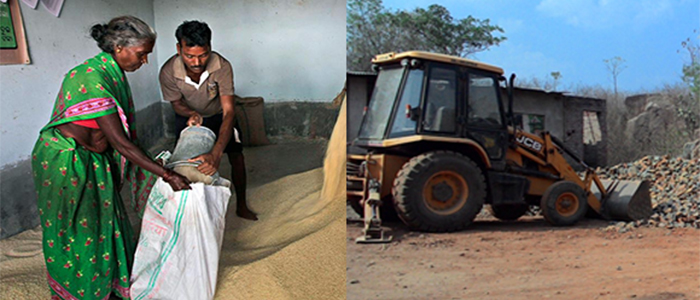
To understand and study the two states, we chose to work on two themes: the extractive regime or mining and the Public Distribution System (PDS). We found that Chhattisgarh has aggressively pursued the reforms process for the PDS, making it a force to reckon with and providing us an interesting contrast to Jharkhand’s PDS or more broadly its social welfare programmatic outcomes story.

While Chhattisgarh has improved the delivery of subsidized food grains under the PDS tremendously after the implementation of reforms, cutting leakages by 82% between 2004-05 and 2011-12, Jharkhand’s cut down leakages from the PDS by 48% during the same period.

Speaking of mining, both the states have actively pursued their interest in mining with an emphasis on modernisation based on mega industries and development. However, even though mining raises revenue and is important for economic growth, it raises significant and often disconcerting questions of dispossession, environmental transformations and acts of resistance, known as the social costs of mining. How the two states deal with these social costs of mining, either through direct investments from mining royalties or through the implementation of their own set of welfare agendas is something which we have aimed to understand through this research.

Going beyond conventional approaches, this research uses a political settlements approach characterising the political arrangements between various social groups in a society – between political and business elites and between elites and other socio-economic groups. These need to be stable at a certain point in time and influence the distribution of benefits from the institutional arrangements. A settlement in that sense, can be said to be successful when it is able to provide an atmosphere where there might not be an absence of conflict, rather there is a resolution or management of distributive conflicts.

image 2.jpg

This research indicates that the differences in outcome in development between the two states, Jharkhand and Chhattisgarh, depend on their respective political settlements. While Chhattisgarh’s political settlement is marked by relatively higher levels of elite cohesion in political competition, higher bureaucratic autonomy and a higher state capacity in terms of responsiveness to the needs of the industry along-with a more centralised system of rent-seeking in place in the state; Jharkhand by contrast suffers from a lower level of elite cohesion in political competition with a multitude of regional parties, low bureaucratic autonomy and state capacity with multiple decentralised transactions for rent-seeking.

What also comes across as a stark difference is the fact that while Jharkhand witnesses strong, more peaceful networks of civil society while Maoist resistance is more dispersed; Chhattisgarh, has uneven networks of civil society with a concentrated presence of Maoists in the state and a high-profile state-sponsored vigilante army being used to suppress the resistance.

The political settlement in Chhattisgarh has undoubtedly enabled the promotion of service delivery of welfare programmes, which is not something witnessed in the case of Jharkhand. Chhattisgarh’s better functioning PDS is a major factor for the ruling coalition’s bid for legitimacy and the management of social costs of mining. The same, however, is not true for Jharkhand’s political settlement where the welfare system is broken leaving the ruling elites relatively more exposed to criticism around mismanagement.

The management and facilitation of mining activities can also be said to have been better promoted because of the political settlement of Chhattisgarh in contrast to that of Jharkhand. However, having said this, the continued levels of corruption and brutal dealings with protestors in Chhattisgarh raises serious questions around transparency, accountability and those around political inclusion.

It is, therefore, not feasible to conclude whether Chhattisgarh has done better than Jharkhand in promoting inclusive development or that it can be viewed as a better performing example amongst low-income states. This research, thus, goes to show that even though the creation of smaller states may be advocated for the promotion of spatial equality, the actual narrowing of inequalities would to a large extent be dependent upon the political settlement of the regions in question.

Further reading:

Chhotray, V., Bahuguna, V. and Adhikari, A., 2016 ‘Newly created Indian states and inclusive development: The sub-national political settlements of Jharkhand and Chhattisgarh’. ESID Working Paper, forthcoming

Vidushi Bahuguna is Research Associate at Accountability Initiative working primarily on the political settlements approach in understanding development .  She is also a part of the PAISA project in Chhattisgarh. Prior to this, Vidushi was working as a researcher with a UNICEF project in Chhattisgarh focusing on women’s nutrition and health.

Shift in Financial Year – Will It Change anything?

After its last attempt in 1985, the Government of India is once again exploring the possibility of shifting the financial year (FY). A committee led by Shankar Acharya has been appointed to look into the issue and a discussion forum has been set up on MyGov.in, inviting inputs from the public. According to the website, the committee will be making its recommendations based on a number of factors relating to the government’s budget and cash management, the seasonality of revenues and expenditures, legislative cycles, alignment with international statistics etc. (GoI, 2016).

The announcement has been both welcomed and criticised. The most comprehensive argument in favour of the shift has been laid out in a discussion note by Bibek Debroy and Kishore Desai of the NITI Aayog. According to the authors, the South-West (SW) monsoon is crucial to the Indian agricultural sector, affecting both kharif and rabi crops. The current FY, in the words of Debroy and Desai, makes the government response to the monsoon more reactive than proactive, with decisions on allocations and investments being made without a reasonable idea of the monsoon. Based on this argument primarily (along with the incorporation of other factors such as the working season, national culture/traditions, international practices, impact on data collection and the convenience of legislators) the authors recommend a January to December shift in the financial year.

However, according to the Indian Meteorological Department, the only body in India responsible for issuing operational long range forecasts, the first stage of the SW monsoon forecast occurs in Mid-April and the second stage, at the end of June (India Meteorological Department, 2016). Both forecasts would be of no relevance in the planning for a Jan-Dec cycle, work for which would begin around September. Moreover, carrying out the planning exercise during the months of September and October may prove difficult. Based on Accountability Initiative’s (AI) experience of working across Indian states, most government offices come to a standstill during this time owing to officials and frontline workers being on leave for the festive season. On all the other factors mentioned above, the impact of the shift in FY was noted to be either non-existent or slightly positive by the two authors.

Even in the case of matching international norms, a point which is often mentioned when arguing for a shift in the FY (Roychoudhury, 2016), the authors concluded that meeting India’s specific requirements was of much more significance. A lot of countries across the globe, most notably the United States, do not follow the calendar year.

Additionally, having observed fund flow mechanisms and bureaucratic processes over nearly a decade, AI’s research has found that it is delays within the system that lead to inefficient public expenditure. For instance, it has been repeatedly revealed that schools receive funds only in the third or fourth quarters and are then hard pressed to spend them before the year ends. Moreover, most money received by schools is tied, which leads to inefficient spending. Changing the financial year will not be able to solve such issues that are intrinsic in the system. The government’s recent decision to shift the budget to the first week of February is indicative of its understanding of this problem, as an earlier budget will enable better planning and execution.

For further reading on budget allocation and expenditure in states and local governments, click here

Abhishri Agarwal works on the PAISA project in Chhattisgarh. Her expertise include Public Policy and Finance.

भाग 2 : शैक्षिक सुधार और स्थानीय प्रशासन : बिहार में एक केस अध्ययन

पहले ब्लॉग में, हमने बिहार में प्रारम्भिक शिक्षा के परिवेश और कामकाज के संबंध में अपना विश्लेषण प्रस्तुत किया था। हमारे विश्लेषण के अनुसार, प्रशासन में मौजूद नियम-कानूनवादी  संस्कृति और इसकी दो खासियतों – पदानुक्रम और नियमों व प्रक्रियाओं का कड़ाई से पालन – ने ऐसा परिवेश विकसित  किया है, जहां स्थानीय अधिकारी स्वयं को स्कूलों में शिक्षण के मुस्तैद सलाहकार  नहीं बल्कि महज नियमों का पालन करने वाले  या “आदेश व सूचनाएँ पहुँचाने वाला डाकिया” मानते हैं।

इस भाग में, हम उपर्युक्त विश्लेषण के आधार पर शैक्षिक सुधारों की सफलता या विफलता के हालात को समझने की कोशिश करेंगे। हम मुख्यत: सुधार के उद्देश्यों और सुधार के लिए जिम्मेदार अधिकारियों के रोज़मर्रा के तौर-तरीकों के बीच के संबंध को समझेंगें। खासकर, हम यह जानना चाहेंगे कि सांगठनिक कार्य-संस्कृति और उसके कारण स्थानीय अधिकारियों की अवधारणा और तौर-तरीके किस प्रकार शिक्षा तंत्र के रोजमर्रा के कामकाज में सुधारों को शामिल करने की प्रक्रिया में मदद करते हैं या नुकसान पहुँचाते हैं। इसके लिए हमने बिहार सरकार की प्राथमिक शिक्षा नीति में बदलाव के संक्रामण काल के दौरान  अध्ययन  किया।

बिहार का ‘मिशन गुणवत्ता’

अप्रैल 2013 में, बिहार सरकार ने सरकारी प्राथमिक विद्यालयों में पढ़ रहे विद्यार्थियों के शिक्षण नतीजों को सुधारने के लिए एक नई नीति “मिशन गुणवत्ता” की घोषणा की। इस मिशन या कार्यक्रम के दो घटक थे। पहले घटक का उद्देश्य प्रशासन और स्कूल प्रक्रियाओं को मजबूत करना था। दूसरे घटक के तहत, बच्चों को उम्र के बजाय, ज्ञान के स्तर के आधार पर कक्षा 3 से 5 में पुन: समूहबद्ध कर स्कूल-समय में ही दो घंटे की सुधारात्मक शिक्षा दी जानी थी। इसके लिए स्पष्ट लक्ष्य भी  निर्धारित किए गए।

इस कार्यक्रम का विद्यार्थियों से संबंधित घटक विशेष रूप से दिलचस्प था, क्योंकि इसकी बुनियाद में शिक्षा क्षेत्र के प्रमुख गैर-सरकारी संगठन ‘प्रथम’ की भागीदारी में बिहार के जहानाबाद और पूर्वी चंपारण जिलों में किया गया एक प्रयोग था। महत्वपूर्ण बात यह कि, इन प्रयोगों को स्कूलों की मदद हेतु क्लस्टर रिसोर्स सेंटर समन्वयकों के माध्यम से स्थानीय प्रशासनिक क्षमता के निर्माण के लिए डिजाइन किया गया था[i]। प्राय: ‘सही स्तर की पढ़ाई’ (TaRI)[ii] के नाम से प्रसिद्ध इन प्रायोगिक परियोजनाओं से शिक्षण-सुधार के लिए एक तंत्र की ज़रूरत पर राज्य-व्यापी बहस छिड़ी जिसकी परिणति मिशन गुणवत्ता की शुरुआत में हुई[iii]

हालांकि इस कार्यक्रम की शुरुआत बड़ी उम्मीदों और आशाओं के साथ की गयी, लेकिन यह अधिक दिन तक नहीं चल पाया। वर्ष 2013 से वर्ष 2014 की गर्मियों तक यह छिटपुट तौर पर चलता रहा, लेकिन जब हम 2014 के अकादमिक सत्र की शुरुआत में स्कूलों में गए, तब तक मिशन गुणवत्ता का फोकस शिक्षण संबंधी घटक से हट चुका था।

प्रायोगिक परियोजनाओं की सफलता और शिक्षण तंत्र के नियमित कार्यकरण में अध्यापन के वैकल्पिक तौर-तरीकों को शामिल करने में अंतत: मिली विफलता में  भारत में कार्यक्रम-कार्यान्वयन और शैक्षिक सुधारों से जुड़े महत्वपूर्ण नीतिगत प्रश्नों के उत्तर  ढूंढे जा सकते हैं। भारत में सेवाओं की आपूर्ति संबंधी सुधारों को सांस्थानिक स्वरूप कैसे दिया जा सकता है? नियमित सरकारी कामकाज में कब और किन परिस्थितियों में कोई बदलाव संभव हो पाता है? और वे कौन सी स्थितियाँ हैं जब बदलाव का विरोध होता है, उसका स्वरूप बदल दिया जाता है या उसे विकृत कर दिया जाता है?

सफलता की शर्तें: यथास्थितिवादी सरकारी तंत्र या डाकिया प्रवृत्ति में बदलाव कैसे हो सकता है?

जहानाबाद और पूर्वी चंपारण के प्रयोगों से उन स्थितियों पर प्रकाश पड़ता है जिनके होने पर सरकारी अधिकारियों की ‘डाकिया’ प्रवृत्ति में बदलाव आता है।

निश्चित ही, इस बदलाव में प्रतिबद्ध नेतृत्व की भूमिका महत्वपूर्ण थी जो लगातार स्थानीय अधिकारियों को प्रेरणा दे रहा था और प्रगति की नियमित निगरानी कर रहा था। लेकिन सफलता की कुंजी महज नेतृत्व की प्रतिबद्धता ही नहीं, बल्कि नेतृत्व के आयाम में बेहद बारीक बदलाव भी था। ज़िला अधिकारियों ने पदानुक्रम और आदेशों के पालन पर जोर देने  के बजाय क्लस्टर रिसोर्स सेंटर समन्वयकों के साथ सक्रिय संवाद और समस्या सुलझाने पर बल दिया। मसलन, जहानाबाद के जिलाधिकारी ने कार्यक्रम के कार्यान्वयन पर चर्चा के लिए समन्वयकों के साथ नियमित बैठकें कीं और उनसे प्राप्त जानकारी के आधार पर वरिष्ठ अधिकारियों से कार्रवाई करने को कहा। इससे क्लस्टर रिसोर्स सेंटर समन्वयक सशक्त हुए।

“हमारी पहुँच सीधे जिलाधिकारी तक थी। हम मुद्दे उठाते थे समस्याएँ बताते थे…… फिर जिलाधिकारी अपने अधिकारियों (हमारे वरिष्ठ अधिकारियों) को कमर कसने और उस मुद्दे पर कार्रवाई करने को कहते। वे वरिष्ठ अधिकारियों से ज़्यादा हमारी बात सुन रहे थे”।

इन संवादों के साथ-साथ प्रथम द्वारा प्रशिक्षण भी दिया जा रहा था जिसमें मूल्यांकन, नई शिक्षा प्रणाली का व्यावहारिक अभ्यास और नियमित मदद शामिल थी। प्रशिक्षण पद्धति ऐसी थी कि क्लस्टर रिसोर्स सेंटर समन्वयक शिक्षण की समस्याओं और उनके संभावित समाधान तक पहुँच पाएँ जिससे वे स्वयं को महत्वपूर्ण और सौंपी गयी ज़िम्मेदारी को निभाने के काबिल मानने लगे- हमारे द्वारा लिए गए  साक्षात्कारों में यह तथ्य बार-बार दोहराया गया।

सारांश यह है कि प्रायोगिक परियोजनाओं के दौरान जो नेतृत्व शैली और समस्याओं के समाधान का तरीका अपनाया गया, वह ब्लॉग के पहले भाग में वर्णित नियमित कामकाज के आम रवैये से बिलकुल उलट था और इससे क्लस्टर रिसोर्स सेंटर समन्वयकों के नज़रिए में भी बदलाव संभव हुआ, वे खुद को महज “डाकिया” मानने की बजाय समस्याओं का समाधान करने वाले “परिवर्तन के वाहक” और “सशक्त अगुआ” मानने लगे।

लेकिन यह सफलता बहुत कम समय तक कायम रही। और इस  विफलता के पीछे कार्यान्वयन के  बेहद जटिल सवाल मौजूद हैं- सरकारी तंत्र में ऊर्जा और उत्साह का संचार करने वाले सुधार के प्रयास तंत्र के नियमित ढर्रे में शामिल करने पर टिक क्यों नहीं पाते?

बदलाव टिक क्यों नहीं पाता?

मिशन गुणवत्ता प्रयोग की अल्पायु और राज्य की शिक्षा प्रणाली में शामिल हो पाने में इसकी विफलता की प्रत्यक्ष वजह राजनीतिक परिवर्तन है। 2014 के राष्ट्रीय चुनावों के बाद राजनीतिक नेतृत्व और अधिकारियों के बदलने से सफलता की एक बेहद ज़रूरी शर्त यानि कार्यक्रम के लक्ष्यों और सर्वोच्च नेतृत्व में तालमेल को आघात पहुंचा।

निस्संदेह विफलता का यह एक कारण है, लेकिन कई ऐसे प्रश्न अब भी अनुत्तरित हैं जो यह समझने में मददगार साबित हो सकते हैं कि प्रायोगिक परियोजनाओं और मिशन गुणवत्ता के प्रारम्भ में दिखा उत्साह राजनीतिक बदलाव और नेतृत्व परिवर्तन क्यों नहीं झेल पाया? जैसे, क्लस्टर रिसोर्स सेंटर समन्वयकों ने शुरुआत में खुद को ‘सशक्त’ महसूस किया तो इससे उनके नज़रिये में स्थायी बदलाव क्यों नहीं आया और वे खुद को अकादमिक सलाहकार क्यों नहीं मानने लगे? जब शुरुआती जोश कम हो गया तो अध्यापकों ने उनसे सहयोग और भरोसेमंद सलाह क्यों नहीं मांगी? और अध्यापकों और क्लस्टर रिसोर्स सेंटर समन्वयकों ने कार्यान्वयन के शुरुआती चरण में जो तौर-तरीके सीखे थे, उन्हें कक्षाओं की  नियमित गतिविधियों में शामिल करने से भला किसने रोका था?

हमारे विश्लेषण से पता चलता है कि नियम-कानूनवादी कार्यसंस्कृति और इसके द्वारा पोषित “पदानुक्रम और आदेशपालन पर आधारित डाकिया” प्रवृत्ति से कक्षाओं में पढ़ाने के तौर-तरीकों में सुधार के प्रयासों में किस हद तक बाधा पहुंचाती है और विकृति आती है। व्यवहार में ऐसा कैसे होता है, इसका एक उदाहरण नीचे दिया गया है।

शिक्षण से कोई लेना-देना नहीं

जब हमने उत्तरदाताओं से स्कूल में बच्चों के सीख न पाने के कारण बताने को कहा, तो आश्चर्यजनक रूप से प्रशासन के हर स्तर पर जवाब एक-से थे। डाकिया प्रवृत्ति के अनुरूप ही  हरेक ने  शिक्षण संबंधी समस्याओं के लिए ऐसे कारकों को उत्तरदायी बताया जिन पर स्थानीय प्रशासन का कोई नियंत्रण नहीं होता। मसलन खराब नीति-निर्माण, कमजोर प्रशासन और सामाजिक-आर्थिक कारक जैसे माता-पिता की रुचि का अभाव शामिल हैं।

उत्तरदाताओं ने बातचीत में कभी भी शिक्षण नतीजों को प्रभावित करने में कक्षाओं में पढ़ाई यानी शिक्षण के तौर-तरीके, पाठ्यक्रम, पाठ्य पुस्तकों की गुणवत्ता, विद्यार्थियों के ज्ञान के स्तर की भूमिका  का ज़िक्र नहीं किया। लेकिन जब प्रायोगिक परियोजनाओं और बाद में मिशन गुणवत्ता TaRI से जुड़े अनुभवों के बारे में पूछा गया तो प्रशासनिक अधिकारियों और अध्यापकों, दोनों ने माना कि शिक्षण के तौर-तरीकों में बदलाव और कक्षाओं को पुनर्गठित करने से वास्तव में अध्यापक को प्रेरित किया जा  सकता है और विद्यार्थियों की सीखने की गति में तेजी आ सकती है। कई क्लस्टर रिसोर्स सेंटर समन्वयकों ने बताया कि पढ़ाई के नए तरीकों ने विद्यार्थियों में उत्साह भर दिया- मिशन गुणवत्ता के दौरान कक्षाओं में उपस्थिति काफी अधिक बढ़ गयी, विद्यार्थी अपनी समस्याएँ लेकर अध्यापकों के पास आने लगे। कई समन्वयकों ने टिप्पणी की कि पहली बार पूरा शिक्षा तंत्र ‘पढ़ने-पढ़ाने’ की बात कर रहा था।

इन फ़ायदों और शिक्षा में स्पष्ट बदलाव के अपने यथार्थ अनुभव के बावजूद, जब शिक्षा संबंधी समस्याओं के बारे में बात करने और उनके संभावित समाधान सुझाने को कहा गया, तो लगभग हर उत्तरदाता (एक को छोडकर) शिक्षण में सुधार सुनिश्चित करने के लिए, फिर से व्यवस्था से जुड़े ‘व्यापक’ मुद्दों के समाधान की ज़रूरत की बात करने लगा। प्रायोगिक परियोजनाओं के संबंध में स्पष्ट उत्साह दिखा रहे उत्तरदाताओं सहित अधिकांश उत्तरदाताओं के मुताबिक, “पढ़ने-पढ़ाने” की यह पहल उपयोगी अल्पावधिक प्रयास था लेकिन शिक्षा प्रणाली की व्यापक व्यवस्थागत समस्याओं के समाधान में इसकी भूमिका नगण्य ही है।

हमारे विश्लेषण के अनुसार, समस्या की पहचान और समाधान के अनुभव के  बीच कोई संबंध न जोड़ पाने की प्राथमिक वजह है सरकारी तंत्र का महज आदेशपालक होना। अधिकतर स्थानीय अधिकारी स्वयं को प्रशासनिक तंत्र का एक पुर्जा मानते हैं, और इसीलिए वे अपने काम में आने वाली चुनौतियों को  अपने नियंत्रण से बाहर मानते हैं। इससे शिक्षण समस्याओं को समझने और उनसे सीधे निपटने के प्रति उपेक्षा की संस्कृति और जवाबदेही की कमी को वैधता मिल जाती है।

नतीजतन, कोई भी सुधार तब तक ही जारी रहता है, जब तक उसे आगे बढ़ाने के लिए कोई ‘अगुआ’ या ‘निगरानीकर्ता’ मौजूद हो। वास्तव में, हमारे सभी साक्षात्कारों के दौरान दोनों जिलों में सब ने यही कहा कि प्रायोगिक परियोजनाओं के दौरान निगरानी बढ़ गयी थी और इससे स्थानीय अधिकारी अनुशासित और कार्य के लिए तत्पर रहते थे। हालांकि इस ‘अनुशासन’ से निश्चित ही यह सुनिश्चित किया गया कि तंत्र काम करे, लेकिन इससे कार्य-संस्कृति में कोई स्थायी बदलाव नहीं आ पाया। इसकी वजह यह थी  कि इस दौरान क्लस्टर रिसोर्स सेंटर समन्वयक और अध्यापक खुद से पहल करने के बजाय शीर्ष  अधिकारी  की अपेक्षाओं को पूरा करने का प्रयास कर रहे थे। इसलिए जब निगरानी कम हो गयी तो सरकारी तंत्र फिर से अपने रोज़मर्रा के ढर्रे पर चलने लगा।

“मिशन गुणवत्ता के दौरान कोई वरिष्ठ अधिकारी स्कूल नहीं आया… इसलिए हमने भी वैसे नहीं पढ़ाया जैसा हमसे अपेक्षित था”।

इस बात पर ध्यान दिया जाना चाहिए कि प्रायोगिक परियोजनाओं से जुड़े कई पक्ष, बड़े पैमाने पर यह  प्रयोग करने से हिचकिचा रहे थे, जबकि उनमें से ज़्यादातर ने इस तरीके की प्रभावकारिता की प्रशंसा की थी। इसे एक सफल प्रयास के विस्तार का अवसर मानने की बजाय क्लस्टर रिसोर्स सेंटर समन्वयकों ने इसकी प्रगति में बाधक संभावनाओं को गिनाना शुरू कर दिया। जैसा कि पूर्वी चंपारण के एक समन्वयक ने कहा:

“(प्रायोगिक परियोजना) सफल थी…….. लेकिन अब उससे बेहतर करने का विचार……इसके लिए अध्यापकों को प्रेरित करने और काम का सही माहौल विकसित करने के लिए और अधिक प्रयास करने होंगे”।

सही कार्य-संस्कृति और प्रबंधन परिपाटियाँ सफलता की कुंजी हैं

भारत में सामाजिक नीति में सुधार संबंधी चर्चाओं में स्थानीय अधिकारियों के दृष्टिकोण को खारिज करने और उन्हें उदासीन और शिकायत करने वाली नौकरशाही मानने की प्रवृत्ति रही है, ऐसी नौकरशाही जो अपनी उदासीनता और निष्क्रियता को सही ठहरने में लगी रहती है। हमारे शोध से पता चलता है कि परिवर्तन लाने के लिए स्थानीय नौकरशाही के दृष्टिकोण को भी विमर्श में गहराई से शामिल करने और ऐसा सांगठनिक ढांचा तथा कार्य-संस्कृति विकसित करने की जरूरत है जिससे उनकी शिकायतें दूर की  जा सकें।

खासकर लैटिन अमरीकी देशों की नौकरशाही की सांगठनिक कार्य-संस्कृति और प्रबंधन परिपाटियों पर हुए हाल के अध्ययनों (Pires 2010, Piore 2010) से प्राप्त उपयोगी जानकारी के मुताबिक प्रबंधन के तौर-तरीकों में बदलाव के द्वारा – अधिक विवेकाधिकार देने और सहकर्मियों तथा वरिष्ठ अधिकारियों के बीच निरंतर संवाद के लिए मंच उपलब्ध कराकर फीडबैक को मजबूत बनाने से – नौकरशाही की प्रवृत्तियों में टिकाऊ बदलाव लाये जा सकते हैं। लेकिन, इसे हासिल करने के लिए भारत में प्रशासन संबंधी समस्याओं की समझ में भी बड़े बदलाव की ज़रूरत है-अभी यह समझ, संभ्रांत भारतीय प्रशासनिक सेवा (IAS) के अधिकारियों को पेश आने वाली दिक्कतों से ही जुड़ी हैं । IAS अधिकारियों को भरोसा ही नहीं होता कि ऊपर से कड़े अनुशासन के बिना भी स्थानीय अधिकारियों द्वारा बदलाव की प्रक्रिया आगे बढ़ाई जा सकती है। इस अविश्वास के कारण डाकिया प्रवृत्ति को और बढ़ावा मिलता है तथा सलाह और समस्या-समाधान पर आधारित नेतृत्व के स्थान पर पदानुक्रम आधारित नेतृत्व विकसित होता है। आज भारत में सेवाओं की आपूर्ति में सुधार के सम्मुख असली चुनौती यही है कि प्रशासनिक सुधारों की बहस का फोकस कैसे भारतीय प्रशासनिक सेवा के स्थान पर कार्य-संस्कृति के सवाल और प्रबंधन के ऐसे तौर-तरीके विकसित करने पर हो जिनसे संवाद संभव और सुगम हो सके।

Read English version here.


टिप्पणियाँ  

[i] कार्यक्रम की परिकल्पना के मुताबिक, खासकर क्लस्टर समन्वयकों को, स्कूल आधारित कार्यकलापों के कार्यान्वयन में महत्वपूर्ण भूमिका निभानी थी।

[ii] J-PAI द्वारा TaRL पद्धति का कड़ा मूल्यांकन किया गया है। इस मूल्यांकन के ब्यौरे के लिए देखें www.povertyactionlab.org

[iii]  हमारे शोध का उद्देश्य प्रायोगिक परियोजनाओं और सांस्थानिक बदलाव के संबंध को समझना था, हमने कार्यक्रम के दूसरे घटक यानि कक्षाओं संबंधी घटक का ही अध्ययन किया।


और जानकारी के लिए देखें 

  • Piore, Michael J (2011), “Beyond Markets: Sociology, Street-level Bureaucracy, and the Management of the Public Sector”, Regulation & Governance, 5(1), 145–164. Retrieved from http://dx.doi.org/10.1111/j.1748-5991.2010.01098.x
  • Pires, Roberto RC (2011), “Beyond the Fear of Discretion: Flexibility, Performance, and Accountability in the Management of Regulatory Bureaucracies”, Regulation & Governance, 5(1), 43-69.

यह ब्लॉग मूल रूप से Ideas for India में प्रकाशित हुआ था।
 

Catalysing Change in Implementation of Government Services by Deepening Knowledge about Middle and Front End Bureaucracy

Development workers with targets to meet and reports to write know all too well the challenges of working with Government machinery as part of a project at the state, district or even at the village levels. The rigorous worker will anticipate the delays as his file crosses many desks. He will know who to meet and when as he vacillates between patient indulgence and righteous indignation in the effort to loosen the noose around a good idea so that implementation can be justified as passable.

Project implementation plans assume this bureaucratic culture as one of the undeniable constraints of working in the field. Practitioners realise that this dense intricate quagmire is like a seamless horizon which cannot be circumvented or punctured, and hence, many an innovative strategy has emerged to coddle, cope with, co-opt, conspire or collaborate with the bureaucracy on the path to meeting development goals.

Accountability Initiative’s (AI) work on understanding governance is inspired by an appreciation of the above frustrations and efforts at solutions. It is based in the same acceptance of the middle-layer of management in the Government being an intrinsic part of all implementation at scale.

AI studies the layers of middle management in the Government that practitioners are so familiar with, taking care to experience, document and analyse each layer, before peeling it away to start work on the layer beneath, until it gets to the bottom of the issues.

The objective is to twofold.

First, it is to create a knowledge bank that practitioners can use to better navigate the way they construct and implement solutions with and for the Government, and second, it is to pursue a reform agenda of its own.

AI has become part of the implementation teams at the  Rajasthan and Bihar Governments, and with an NGO partner in Bihar that support SMCs, so as to get under the skin of the processes as they are experienced by each stakeholder. It has entered each arrangement, as an equal and contributing partner, offering nuanced knowledge, tools and practical suggestions to aid contexualisation of solutions. Being present as a neutral, in-house, compassionate sounding board to each stakeholder, provides AI the opportunity for its only purpose, which, is to gain insight that can support improved policy decisions.

In Rajasthan, AI has an arrangement with the Sarva Shiksha Abhiyan (SSA) to observe the challenges faced by the education management (state level through to the head masters of six individual schools), as they cope with their task to foster School Management Committees (SMC) to become tools for accountability. In exchange, AI trains the headmasters to introduce fiscal literacy to the SMC members.

Across Bihar it is supporting the National Rural Livelihood Mission (NRHM) to improve the ability of members of Self Help Groups (SHGs) to hold local Government schools and Integrated Child Development Services (ICDS) scheme accountable. In three districts of Bihar, AI collaborates with the grassroots communicators at Nidan, as they use trusted relationships with the community and parents to negotiate better quality of services in Government schools.

In a series of blogs following this one, the trials of executing well-meaning policy will be discussed. AI will follow the journey of an idea as it changes form in the hands of Government education management. As ideas become policy documents, to when they are conceptualized as programs. When they become Government orders and letters of authority, to when training manuals created by technical experts become capacity building workshops for master trainers. And finally, to the point when these lectures are delivered to unsuspecting villagers. On the other hand, AI will also report on how the last-mile consumer of Government services, experiences these provisions. It will explore what happens when the effort is made to bridge the gaping distance between the intent of policy and the fragmented services received by the citizen.

Deciding the Wheat from the Chaff – The Bureaucratic Review Process

Because there is very little room at the top in the bureaucracy, there has to be a way to select the best for the top job; a way to separate the wheat from the chaff. The most frequently used method is to use the system of ACRs. Equally popular are playing golf (or joining golf clubs where your boss plays) and organising temple tours. But more of that later; let me focus on the ACR system.

The ACR stands for the ‘Annual Confidential Report’. This is as is obvious, an annual, confidential appraisal of an officer’s capabilities by his or her bosses. Since bureaucracies are organised in elaborate hierarchies, each appraisal comprises of three steps. One’s immediate boss initiates the report and is known as the reporting authority. The next level is that of the officer who reviews the report of the reporting officer. This level is known as the reviewing authority. However, since the system is deeply distrustful on anything said about anybody, whether good or bad, there is an accepting authority at the top of the pile. After its arduous journey through these three levels, the ACR, in the case of IAS officers, ends its journey in the office of the Chief Secretary of the State where the officer works, and with the Department of Personnel at the Government of India. 

Invariably, the onus is on the officer concerned to start the process of having his appraisal done. In earlier, more irresponsible times, the format in which the ACR was written was vague and capable of variable interpretation. The officer concerned was required to mention his name, his current responsibility and how long he was holding it. A few more terse questions, such as whether he enjoyed good health, and whether he had undergone any training during the year under appraisal, and the ACR was set on its way. Since then, the ACR has undergone several changes. Now, the officer is required to mention six to eight thrust areas of his work and give a self-appraisal of how she has functioned over the year in respect of key, relevant targets. She is also required to give an honest appraisal of constraints that she faced, in not achieving set targets. 

The rules also say that one has to speak to one’s boss in advance and fix targets to be achieved before the year commences. That never happened in my time and I am given to understand, does not happen now. 

Writing a self appraisal is an art. I did it meticulously, and did it in the finest calligraphy that I could muster; I am sure my effort would have drawn gasps of admiration from those engaged in writing entire Qurans into books the size of matchboxes. I drew neat lines in red ink to separate one target from the other, and embellished my achievements with numbers. I also developed the fine art of making my non-achievement of targets also look like success in the face of adversity. There were always some large calamities that one could draw upon to justify one’s lack of success (“I planted 1,28,000 saplings but 2460 survived, because the rest were washed away by Hurricane Katrina” – you get the idea).

Once the ACR is set on its journey, the reporting officer has to task of sieving through your subterfuge and boasts, to get at the root of what exactly you have been up to. The first question that is asked of your boss is whether he or she agrees with the targets and the achievements attained. This often catches the boss on the wrong foot, because he knows he did not discuss the fixation of those targets with you at the start of the year (just as she did not discuss her targets with her boss). So, therefore, calligraphy or not, you are likely to get the nod on the targets and achievements you’ve reported. 

Then comes a lot of very subjective questions; does the officer show initiative? Does he get along with his colleagues? Is he capable and good at teamwork? How is his oral and written communication? While these questions provide ample scope for the reporting officer to air her literary talents, this is rarely the case. CRs are often written by reporting officers in a terse style. I put it down to the fact that as officers get senior, most of them begin to resemble more and more, in their manner, demeanour and articulation, a government circular come to life. 

‘Once they have crossed twenty years of seniority’, a boss of mine well versed in these matters told me, ‘nobody reads anything, except the civil list and the railway time table’. Replace the latter with airline schedules and you get the general picture. 

Then comes the icing on the cake; the question on the integrity of the officer concerned. It stands to reason that if you have agreed with the officer’s achievement on his stated targets (which you are barred from questioning) and if you have written some wishy washy stuff on his team-spirit, initiative and communications, you might find it very difficult to write anything more than ho-hum stuff in the integrity column. You might also not want to write paeans to his honesty here; if he is exposed in a scam later, you will have egg on your face. So, in the circumstances, the accepted bland phrase to use is as follows:

“Beyond reproach”.

However, I have seen some strange comments in the ‘integrity column’. One said that the officer concerned was ‘fully integrated’. Was he a mathematical equation? I wondered. 

The best of course, was the one by a sly reporting officer who wrote in the integrity column, ‘the officer, Mr. ……., sometimes conducts experiments with the truth’. 
 

#3 THE 14TH FINANCE COMMISSION AND SOCIAL SECTOR SPENDING

In India, most public services provided to citizens are delivered by the governments of the states they live in. The theory of federalism tells us that State governments are likely to have a better idea of their particular conditions, needs and priorities than the Union Government. The 14th Finance Commission (FFC) recognised this, and hence one of its major concerns was to “provide enhanced fiscal flexibility to the states to meet their expenditure needs and make expenditure decisions in line with their own priorities.”[i]

In an earlier blog, Avani has talked about how successful the Commission’s recommendations have been at meeting this objective. Most states now receive more money from the Union, and so we can conclude (with some caveats, as Avani describes) that in some measure most states have more fiscal autonomy.

The question which naturally follows is that of how states are using this fiscal autonomy. This is a particularly pressing concern for the social sector, since any changes in budgets have had a history of impacting “non-plan” expenditures: mainly recurring expenditure for public services! In addition, there was much distrust of State governments: a feeling that they would prioritise infrastructure over the social sector. Yamini talks about how even government officials at the states felt that the social sector would be squeezed.

When last year’s Union Budget revealed that Centrally Sponsored Schemes (CSSs) were being cut, and that states were expected to make up the deficit, much ink was poured and many hands were wrung in despair. As Jean Dreze put it, “anyone with a minimal understanding of Centre-State relations is likely to hear alarm bells.”[ii]; this feeling was more generally shared by many working in the fields of education, health, women, children, and so on. [iii] [iv] [v] [vi]

When my colleagues at AI and I were looking at the budgets of 19 states, this was at the top of our minds. What do the numbers in states’ budgets tell us about their plans for social sector spending after the FFC report?

Click here for full summary

The good news is that every single state intended to spend more money on the social sector in the Revised Estimates (RE) of 2015-16, as compared to their actual expenditures in 2014-15. The highest increases were visible in many of the poorest states including Bihar (46%) Chhattisgarh (49%) and Jharkhand (53%). Telangana nearly doubled its social sector expenditure, with an 86% increase.

Interestingly, even when looking at per-capita social sector expenditures in 2015-16 RE, some poorer states planned to spend more than wealthier states. For instance, Chhattisgarh intended to spend Rs. 9,877 per-capita, compared with Kerala at Rs. 8,590 per-capita. Similarly, Odisha intended to spend Rs. 200 more per-capita than Punjab.

Another useful way of looking at these numbers is to understand the share of the social sector in the total expenditure. This gives an understanding of the priority of the social sector in the state. Put another way, if all states are spending more money overall, the social sector will also increase. However, the share gives an idea of whether the increase in social sector spending is more or less than the increase in overall expenditure.

Even by this measure, we find that 16 of the 19 states we studied have a higher share of social sector expenditure. Sharp increases are seen in Andhra Pradesh, Uttar Pradesh, Telangana and Madhya Pradesh, and modest increases in other states. The 3 states which haven’t seen an increase are Kerala, where the share is constant, and Odisha and West Bengal, where the share has fallen by 2 and 1 percentage points.

Within the social sector, of course, states could choose to spend on different sectors. We would expect, if states are using their autonomy, to see changes not just in the aggregate level of social sector spending, but also in particular sectors.

For a few states where we looked at detailed sectoral budgets, we find some evidence of changes. In 2015-16 RE, Karnataka increased allocations for housing by 91%, while Maharashtra doubled allocations for water supply and sanitation, while total social sector expenditure grew by 18% and 23% respectively. Similarly, Uttar Pradesh, doubled investments in the budget head “Welfare of Scheduled Castes, Scheduled Tribes and other Backward classes”, while Bihar increased investments in “Labour and Labour Welfare” by 78% in 2015-16 RE compared with the previous year. There is some evidence that Bihar is changing patterns also in the current year’s budget: the state is reducing expenditure on education by 10%, while sharply increasing allocations to medical and public health by 83% in the budgeted estimates of 2016-17.

This data comes with some caveats. The biggest problem is that we are comparing revised estimates of expenditure in 2015-16 to money actually spent in 2014-15. Many states find it very difficult to spend allocated money on the social sector, particularly through CSSs, and often large amounts of money languish unspent. It’s likely that when audited expenditure numbers for 2015-16 come in, the amount of money actually spent on the social sector will fall. In addition, money which states are spending need not spent wisely, or even with any effect at all. Often outcomes such as children learning, or fall in mortality, seems to improve very little despite changes in the amount of money spent.

How can we get a more reliable estimate of expenditures? What can we do to ensure that social sector spending grows not just in the aggregate, but also in every state in areas of priority? The next couple of blogs will attempt to answer the way forward for both states and the Union.


[i] 14th Finance Commission, Volume 1 Chapter 2: “Issues and Approach”. Available online at http://finmin.nic.in/14fincomm/14fcrengVol1.pdf

[ii] Jean Dreze, “Nehruvian budget in the corporate age”, The Hindu edition dated March 5 2015. Available online at http://www.thehindu.com/opinion/lead/nehruvian-budget-in-the-corporate-age/article6959755.ece

[iii] “Big budget cuts in education sector worry activists, NGOs”, Hindustan Times edition dated March 10th 2015. Available online at http://www.hindustantimes.com/business/big-budget-cuts-in-education-sector-worry-activists-ngos/story-QBsHgQjpdBvmNTLYjBHT6J.html

[iv] Rajesh Pandathil, “Misplaced priorities? Budget 2015 doesn’t allow govt to take on spread of diseases like swine flu”, Firstpost, March 2nd 2015. Available online at http://www.firstpost.com/business/misplaced-priorities-budget-2015-doesnt-allow-govt-to-take-on-spread-of-diseases-like-swine-flu-2129571.html

[v] Shreya Roy Chowdhury, “Children most neglected in the 2015-16 Union Budget: Child rights organisations” in the Times of India dated March 12th 2015. Available online at http://timesofindia.indiatimes.com/india/Children-most-neglected-in-the-2015-16-Union-Budget-Child-rights-organisations/articleshow/46537698.cms

[vi] Abantika Ghosh, “Activists cry foul as WCD Ministry funds slashed by half”, in the Indian Express dated March 1st 2015. Available online at http://indianexpress.com/article/business/budget/activists-cry-foul-as-wcd-ministry-funds-slashed-by-half/


#4 The 14th Finance Commission and the Way Forward in the States

Introduction

The adoption of the 14th Finance Commission’s recommendations has resulted in states being brought into the limelight for having the responsibility of financing the bulk of public services. We’ve seen in previous blogs that a number of questions have been raised about the actual impact of this move, and we’ve described our efforts to try and answer these questions by analysing the budgets of 19 states. Going forward, the need is to continue to track what the Government of India and the states are doing, and to ensure that social sector investments they make translate into efficient and effective public service delivery. Tracking government finances, though, is not an easy task because of many reasons.

Better Data

One of the biggest challenges in tracking government finances is the quality of their budgets. The very first step in the direction of improving the quality of budgetary data would be to make them publicly available and easily accessible. Although one would expect states to upload all the budget documents post their presentation, some state budgets aren’t available even well into the second quarter of the financial year. In fact some states surprisingly haven’t updated their official websites with their recent budgets since the last decade! Additionally, the states which do put up their budgets online do so partially, making it difficult to understand the nuances of the budget in its entirety. Virtually every state presents its budgets in the form of dense, poorly formatted PDF files, which cannot be read or comprehended either by computers or human beings without a great deal of effort. An effort to bring budgetary data to open data standards by ensuring that it is released in formats which are human and machine readable, and in a timely fashion, would make it much easier to track fund flows at the apex level simply by making the budgetary data more accessible.

Moreover budgetary data, even when available, can be better organised. It is not possible currently to systematically track a range of information of interest. For example, the Union budget doesn’t give state-wise allocations, and likewise states do not allocate funds geographically. It is nearly impossible to track how much money is being spent in a constituency, a city, or a village, without extensive field work and literally collecting documents from multiple government offices.

In addition, many programmes or schemes are broken up into a bewildering array of line items. A good example is the National Health Mission, which originally began as a collection of independent programmes. Most State budgets still report budgetary data for the NHM in a fragmented fashion across line items. The basic questions of interest such as how much money is allocated for the NHM in a particular State, or across States, the share of the Union Government as compared to the states, and so on, cannot even be answered at the moment through budgets. At the other extreme, there are sometimes schemes reported as monolithic line items, with no information about breakups of sub-programs, or functional divisions such as salaries, administrative expenses, and so on.

The root of these problems is that the form of accounts which governments maintained has remained substantially the same since 1974. A Committee to revise the account heads and tackle many of these problems submitted its report in 2012. Despite the Union Government stating that its recommendations would be implemented from the next financial year, no progress has been made.[i]

Better Budget Processes

Technical problems with the quality of budget data apart, the process of preparation and scrutiny of budget also merit consideration. Budgets are still prepared in secret, and in the absence of a pre-budget statement, pre-budget consultations with citizens have limited influence. The process of scrutiny of budgets in Parliament is limited, with the budgets for several departments being put to the vote without discussion, a process called, appropriately, “guillotining”. The state of the state legislatures is worse. State legislative assemblies barely sit for 30-40 days in a year. The main sitting is indeed the budget session, but MLAs are given even lesser time to scrutinise and debate proposals than MPs. The quality of the discussion is also limited, since MLAs, like MPs, have no budget or staff. Many state legislatures also lack Parliament’s system of permanent departmental standing committees, which give legislators an opportunity to gain expertise and hold government accountable in particular areas.[ii]

More Work at the State Level

A problem particular to state government finances is that there are so few people who are interested in examining them in detail. Though states have been responsible for the majority of social sector spending in India, civil society organisations (CSOs) working with state government finances have been limited in number[iii]. In the current context, for effective advocacy, it is vital for CSOs to develop a deeper understanding of state policies and budgets and participate in budget discussions.

Too often, social sector advocacy restricts itself to a blanket call for more money to be spent. While normative targets, such as the target to spend 6% of the GDP on education, remain important, it is important to recognise that effective usage of existing moneys is also equally important. Focussing on better annual and mid-range planning, reducing the problem of unspent funds, strengthening the links between inputs such as funds and infrastructure and tangible outcomes, are all areas where state governments display a range of weaknesses. Advocacy and partnership with state governments can help tackle these weaknesses.

The Commission’s award of Rs. 2.87 lakh crore over 5 years to local governments also is an important opportunity to work with panchayats and municipalities. Decentralisation is a powerful remedy to improve public services delivery, and this increase in funds awarded to local governments can be used creatively and effectively to meet local needs. This calls for capacity building to help these bodies use funds effectively, as well as measures to strengthen accountability so that misuse of funds can be tackled.

Rethinking What Governments Should Do

The broader underlying opportunity is not just to track the finances of Union, state and local governments, but to think about the relationship between them. While it is likely that the Union will for the foreseeable future fund programmes in areas of national priority, there is no reason why the institutional architecture has to remain that of tied, rigid schemes run by individual Union departments. In fact, the moment calls for a greater rethinking: what should be the role of the Union Government versus State or local governments? What should be the mechanism by which different governments coordinate? Watch out for the next blog which will discuss these issues in detail.


[i] Press Information Bureau, Govt. of India, release dated January 25 2012, available online at: http://finmin.nic.in/press_room/2012/sundaramurti_committee_report.pdf

[ii] For a detailed examination and recommendations to improve budgets, see the India report of the Open Budget Survey 2015, available at http://www.internationalbudget.org/wp-content/uploads/OBS2015-CS-India-English.pdf

[iii] For an indicative list of budget groups in India see the website of the Center for Budget Governance and Accountability at http://www.cbgaindia.org/bwi_budget_groups_india.php


#5 The Future of Centrally Sponsored Schemes (CSS) in the New Era of Devolution

I promised, in my previous blog to offer some new thinking on the role of CSSs in the changing scenario of center-state relations.

Perhaps the best way to think about the center-state dynamic is through the spirit of the 14th Finance Commission (FFC). The core mandate of the FFC was to provide state governments’ with the fiscal space to perform their constitutionally assigned functions.

In this scenario, technically speaking the Union government ought to leave state subjects to state governments – and in practical terms, this would mean shutting down the many line ministries that people Delhi’s Lutyens zone.  But of course this is practically impossible to do for no other reason except that it would leave many politicians and bureaucrats with nothing to do!

And as I mentioned in my blog last week, the really curious consequence of the FFC mandate is that many State government actors – most of whom till recently were protesting the one size fit all model of central financing for social schemes – too are now expressing a marked preference for dealing with money from Delhi rather than their own finance departments. As my bureaucrat friends have often reminded me, the bureaucracy is incentivised to grab financial resources (for a large budgetary allocation is power), no matter where it comes from and any sign of resources reducing, results in a clamor for more. This is precisely the phenomenon that we are witnessing today.

But, more seriously, even though the Union government does not have a direct role to play in many social schemes, that are constitutionally the domain of the state, there is a strong argument for its continued engagement in ensuring that key social sector priorities are financed and provided for. The argument is important from the perspective of the moral responsibility of the Union government to ensure that all citizens’ have equal access to their rights and entitlements. The real question therefore is not whether the Union government should have a role in financing and supporting social sector investments. Rather, the emphasis ought to be on how this role might be best structured.

To answer this question, it is best to go back to first principles.

About a decade ago, in a different avatar, I worked as a research associate on a project at the World Bank that attempted to go back to first principles of public finance and accountability to unpack the optimal allocation of roles across levels of government in a federal structure. The framing developed in that project, is I believe, a very useful way of trying to address the current question of the role of the Union government in financing social sector programmes (see Pritchett and Pande 2006 and Aiyar, Hammer and Samji 2006).

Accordingly, functions that have greater economies of scale  but low degrees of transaction intensity and discretion ought to rest with higher levels of government, whereas those that need to respond to local information, that are transaction intensive and require discretionary decision making to suit local conditions should reside in lower levels of government.

This would suggest that activities like monitoring staff, designing implementation models etc. are best placed at the state and local level. The Union government, on the other hand, could play an important role in setting standards, technical knowledge sharing, assessments and monitoring outcomes.

Importantly, the Union government could also play an important role in incentivising states and encouraging creative competition and providing equalisation of funds where necessary (Bihar for instance may genuinely need money from the center for education and health related programs than say Kerala).

For the moment, the public and government debate on the role of the center seems to be limited to minor tweaks in CSSs. I would urge that the debate on the role of the Union to move away from the CSSs mode to reimagine what the Union can do keeping in mind these first principles.

Here is one model that we at AI have been proposing:

  • Reduce the number of CSSs from the current (60+) to 10-15 key programmes that provide “additional” funding to states for meeting national goals. One way to rationalize the number of schemes is by linking the “national” goals to the sustainable development goals relevant to social sectors. These include goals like zero hunger, quality education, health and well-being, sustainable cities, drinking water and sanitation. For each of these key goals, the current bouquet of schemes ought to be restructured in to one single scheme that pools all allocations under a single scheme head. This restructuring will also be an opportunity to reshape the current design of CSSs.
  • Real change in social sector financing will only be visible if the current design of CSSs is completely re-hauled in addition to scheme rationalization. In keeping with first principles, this re-haul ought to shift the role of the Union away from the current emphasis on determining line-item budgets and inputs to programmes to a focus on defining and measuring outcomes on the one hand and promoting innovation and competition on the other. This can be achieved by designing the financing system of CSSs as a 2 window grant. Under this system 75% of funds can provided as an untied block grant for state governments to implement their plans and a second window comprising 25% of the total budget for the state ought to be provided as a performance based grant linked to performance based outcome indicators. To access this funding, states will need to develop clearly defined achievement goals which will be linked to a five-year plan developed by the state line department and planning board. The Union government line ministries can play a facilitating role providing technical assistance to state governments, through mechanisms such as joint review missions, as they develop their five year (and subsequent annual) plans. Read Rules vs. Responsiveness: Towards Building an Outcome-Focused Approach to Governing Elementary Education Finances in India for a model we have proposed of how this can be done in the case of education).
  • The process of identifying outcome indicators and measuring these indicators ought to be the responsibility of the Niti Aayog and the Central Statistical Office of India. An additional budget window could be provided to line ministries to undertake 3rd party evaluations at regular intervals.

How Commonplace is ‘Outstanding’?

Once a senior officer endures the tedium of commenting on various aspects of the officer’s performance, space is left for her to give her general opinion of the officer being assessed. Even though this presents a window of opportunity for the reporting officer to exhibit her literary talents, not many venture to do so, because junior officers provide little inspiration for effusiveness. While I generally stay away from regional stereotyping, I believe that the typical south Indian officer is more conservative in this regard. Complimentary comments are rationed out by them, as if each of them were only given a limited supply of these. Where a typically large hearted north Indian officer might launch himself into poetic raptures about his junior’s talents, a south Indian is only cautiously optimistic. A colleague of mine complained bitterly about his boss. ‘All that my boss could muster while writing my ACR was that “the lad shows some promise”’. ‘And that too, after I had completed sixteen years of service’, he fumed.

After these general remarks, comes the final hurdle to completing an appraisal. An officer has to be graded, across five categories; ‘poor’, ‘average’, ‘good’, ‘very good’ and ‘outstanding’. It is rare that an officer is graded as ‘poor’. This is considered a ‘bad ACR’ and a bad ACR has to be shared with its victim.

The Indian Administrative Services in its internal dealings, generally shies away from confrontation. There is the fabled notion of esprit de corps, which, most people believe, will be seriously threatened if we say exactly what we feel about each other, to each other. That is why, even though we might feel that all the brains of our subordinates might fit on a pin head and leave enough space for a boxing ring, we do not give them ‘poor’ CRs. It is simply not done.

We give them outstanding CRs instead.

The norm is that nearly everybody is given an outstanding CR. The reason is that as one goes senior and there are screening processes put in place, the simplest, rough and ready way is to count the number of outstanding CRs that an officer might have and then use this mathematical chart to clear the officer for the next level.

As an example, let me speak of the first such real hurdle in climbing the ladder. Till about the sixteenth year of service, an IAS officer of undistinguished, average performance can make the grade. The words used to describe different levels of IAS officers is traditional jargon of the narrowest kind, which nobody else can understand. Thus, an officer at the lowest level is called as belonging to the Junior Scale. Mercifully, the stay in Junior Scale is short; just about four years, after which the officer gets promoted to the Senior Scale. Then, there is something known as the Junior Administrative Grade or the ‘Selection Grade’. I am told there is a difference between the two, but I could never discern that, and survived unscathed for twenty seven years in the government with this glaring deficiency.

The real big step in the career progression of an IAS officer is a process known as empanelment. Contrary to popular notion, Empanelment does not refer to the encasing of an IAS officer in Formica sheets, even though, by the sixteenth year, he might begin to resemble a lifeless sheet of laminate more and more. Empanelment refers to the screening process by which officers are declared as eligible to join a panel of a selected few, from which Joint Secretaries to the Government of India might be selected. The process of empanelment depends upon a study of the ACRs of officers. While there is no official confirmation of the process, it is widely believed that empanelment requires that of the last ten or twelve ACRs, at least eight or ten should be ‘Outstanding’ ones – nobody knows exactly how many, but everybody is unanimous that some form of cut off, determined by the numbers of ‘Outstanding ACRs’, is followed.

Joint Secretaries are awesomely powerful people. India is a federal country, where every State stands to gain from the discretionary decisions of the Government of India, and most of these decisions are taken by Joint Secretaries. Most Secretaries are burnt out and in senescence by the time they reach that level; so they depend upon their Joint Secretaries for most decisions.

Therefore, there is a great incentive for States to ensure that as many of their officers are empanelled as Joint Secretaries.

This in turn drives the incentive for senior officers to give nearly everybody ‘Outstanding’ CRs. Unless, of course, you are a South Indian boss, in which case you do not respond to any form of incentive and you remain, at best, cautiously optimistic.

The question still remains that if nearly everybody is graded as ‘Outstanding’, how might the ACR be used to provide hints of the true talent of the officer? In other words, how can one distinguish the difference between an ‘Outstanding’ officer of average quality and a truly outstanding ‘Outstanding’ officer?

Natwar Singh, the former External Affairs Minister and a former bureaucrat himself, found the perfect way to do this. Exasperated at having to see an endless stream of ‘Outstanding’ ACRs for officers who were anything but outstanding, he remarked on one of them. ‘This officer belongs to the category of 90 percent of officers who are graded ‘Outstanding’.


#2 What has changed for Centrally Sponsored Schemes (CSS) in 2015 – 16?

In December 2013, my colleagues and I were about to embark on a new project in Bihar.

In April that year, the Government of Bihar had announced the launch of an ambitious, innovative scheme called Mission Gunvatta. The mission was aimed at improving learning levels in Bihar’s government primary schools. One critical intervention under the mission was the roll out of a Pratham led intervention called teaching at the right level (TARL). Under TARL, for two hours a day, schools would be organized according to student learning levels and taught using specifically designed materials.

The program, in its design was path breaking. For the first time a state government had chosen to explicitly commit itself to improving learning outcomes, at scale and chosen to move away from the prescribed curriculum to ensure that children would be able to improve their learning levels. The classes were to begin in July and run through the academic year. So when my colleagues and I arrived in the state to start our research work, we were expecting to find things moving full speed. To our surprise nothing had really moved. And when we dug deep we discovered that the Sarva Shiksha Abhiyaan(SSA), the Government of India’s (GoI), centrally sponsored scheme and key to the state’s education money (60% of the state’s budget is funded through the SSA) had not yet released money to the state education department to print the relevant materials.

The wait ended in late December when the state department found money through sources other than SSA to print text books but by then the school year was nearing completion and the mission never quite took off. This played havoc for our research project but more importantly, it offers an interesting insight in to the complex world of social policy funding in India.

Constitutionally, the bulk of what we can loosely define as social policy related programs lie within the domain of state governments. Ideally, money for these programs ought to be transferred through the finance commission directly to state governments, leaving state’s to determine their investment strategies. However, the fiscal transfer system also allows for specific purpose fiscal transfers through the center to states called Centrally Sponsored Schemes (CSS).

Over the years, and especially the last decade, CSS became rather popular. By 2012-13, fiscal transfers through CSS came to rival constitutionally designed routes, like grants under Article 275 or revenue sharing arrangements. In 2012-13, fiscal transfers through CSS and the Additional Central Assistance exceeded Rs 3,08,000 crore, while transfers through revenue share arrangements and grants in aid, amounted to Rs 3,66,000 crore.[1]

But there were many problems with this model. First, CSS were designed to privilege a top down, one-size fit all model where states were given relatively little flexibility in implementing programs. All budgets had to be negotiated with the center and if the center didn’t approve of what states where asking for, they went unfunded.

For instance, in education, a state government needed money to restructure its teacher-training model. To access SSA money, it had to seek GoI approvals through the state SSA authorities. GoI, however, refused to provide money because the re-structuring wasn’t aligned with the prescribed framework, leaving the state with no resources. Second, states had no authority to move funds across schemes. Thus if a state wanted to spend more money on health care over employment guarantee, it didn’t have the flexibility to draw on money received from the center to buttress its healthcare expenditures. Third, CSS mandated that state governments add a share of funds to the CSS from their plan budgets. This served to ring fence money available with states to finance programs as they saw fit. Finally, many of these CSS created a parallel implementation structure through specially created societies that were tasked with implementing the central program. And as funds to SSA increased, so did the power of these societies’. This served to create turf wars like we saw in Bihar between the SSA and state departments and in the end many good ideas never saw the light of day.

States were well aware of this problem and complained bitterly about the over-centralisation in India’s fiscal transfer system. It was to address this fundamental weakness in our financing system and realign the balance between constitutionally aligned functions and financial resources that the 14th Finance Commission increased the state share of tax devolution from 32% to 42% in 2015. [2]

So how have things changed? In her blog yesterday Avani highlighted the fiscal story pointing to the changes (and lack of changes) in CSS funding and its impact on state budgets. Avani suggests that the status quo is likely to be maintained, despite the efforts by the FFC to increase state autonomy.

I want to point readers to a possible explanation for this, based on my reading of the political economy of social policy financing. As I mentioned, over the last decade GoI rapidly expanded its role in financing key social programs through one-size fit all, tightly designed CSS. Implementing these schemes required the center to tightly control and monitor state budgets thus casting GoI officials in the role of headmaster’s wrapping states on the knuckles if they didn’t follow guidelines.

State’s on their part, while they disliked the centralised approach, saw in CSSs an important source of money which they aren’t happy to give up. This explains why almost every state politician and bureaucrat, having complained to the FFC about these schemes is now crying hoarse about the lack of funds, paying scant attention to the more pressing question of how best to use the untied funds. But CSS also played an important role in ring fencing money for social programs at the state level.

I have been surprised at how many state level politicians and bureaucrats have argued with me about the importance of CSS in ensuring social sector investments because of the proclivity to invest money in big-ticket infrastructure programs where the kickbacks are higher. Given this, there is some sense of comfort with the continued funding of social policy through CSS going forward.

But we do need to address the challenge of the one-size fit all model of CSS that state’s protested against in the first place. Watch out for my next blog on how I propose this can be achieved.


[2] State of Social Sector Expenditure in 2015-16, Accountability Initiative. Click here to view.