Pratham Launches its Annual Status of Education Report 2009

Pratham’s Annual State of Education Report (ASER) 2009 was launched last week. ASER is a path breaking effort at monitoring outcomes and pushing for accountability from government for monies spent. The report is based on a study of 575 rural districts in India and covered 16,291 villages, 338,027 households and 6,91,734 children. The annual survey found that while 96% of children in rural India in the age group of 6-14 years are now enrolled in school, the quality of education is still quite poor with just 69% of Class I students in rural areas being able to recognize numbers between 1 and 9. The report also points to the rise in private tuitions across the country. From 2007-2009, the percentage of children taking tuition classes in every class in government and private schools. To know more about the report and its findings click on the news links below:

The Times of India:”More children going to school: Pratham report
The Times of India: “Only 38% of class V students in rural India can divide
The Indian Express: “More students taking tuitions, says study
The Economic Times:”Rural education remains poor

Right to Information: Need for an Enforcement Strategy

The right to information is only meaningful if the law is properly enforced. We know this from common sense. Government officials who dislike the law will be tempted to ignore it if they believe that there will not be any consequences. Citizens will not make requests if they do not believe there is a quick remedy against stubborn bureaucrats.

The findings of some recent evaluations of the Right to Information Act are therefore worrisome. The report completed by the RTI Assessment and Analysis Group finds that information commissions received 86,000 appeals in the first two and half years of the law’s operation, but issued only 50,000 decisions. Inflow exceeds outflow, and the result is a growing inventory of cases within some commissions, and delays in handling individual investigations. The special committee that reported to the Fourth National Conference on RTI last October found a “huge pendency in disposal of appeals and complaints” in some places. The PriceWaterhouseCoopers study on RTIA said that rapid growth in number of appeals is “creating a grave situation which requires urgent intervention.”

India is not the only country to have encountered this problem. For example, the UK information commissioner also struggled with a backlog of appeals after the adoption of the Freedom of Information Act in January 2005. The advocacy group Campaign for Freedom of Information reported in June 2009 that one-third of appeals sat in the commissioner’s office for at least two years. The Campaign warns that these delays could threaten the law’s effectiveness. Citizens may become frustrated, and officials may exploit the fact that they can “safely withhold information for several years before the Commissioner compels disclosure.”Canada’s information commissioner also acquired a backlog of appeals in the late 1990s. Government departments were cutting their budgets and taking information requests less seriously. The inflow of appeals to the information commissioner rose, and the time required to resolve cases grew longer. Requesters became restless, and commission staff became demoralized.

Backlogs can develop for several reasons. One is a simple shortage of resources for resolving appeals. Another is lack of experience in handling a large number of appeals. In addition, the first cases received after adoption of a law may require more attention because they set important precedents. However, there is also a difficulty that is built into the design of every right to information law. Every law assumes that the main way to assure compliance is by resolving individual complaints and appeals. But if a commission cannot resolve cases quickly, bureaucratic incentives to comply with the law become weaker, yielding even more complaints and appeals. Under the right set of circumstances, the weakness of the enforcement process could become self-reinforcing.

The challenge is to find ways of breaking out of this cycle. One approach is to streamline investigations so that they can be completed more quickly. For example, the new UK information commissioner recently told his staff that they do not need to achieve a “gold standard” in decisionmaking in every case. This may mean less detailed investigations, less consultation with parties, or decisions that are less carefully reasoned. This approach is defensible, within bounds, but may provoke resistance from citizens or bureaucrats who believe that their concerns have been given short shrift.

Another approach is to apply heavy legal sanctions for non-compliance — so that officials are less tempted to take the “de facto time extension” that is provided because of backlogs within commissions. Of course, section 20 of the RTIA provides the authority to do this, even though commissioners have been reluctant to use the power, especially against lower-level staff. In the late 1990s, the Canadian commissioner’s approach was to use his formal investigative powers to take evidence from senior officials who could be held accountable for “systemic” problems. This caught their attention, although many officials were upset by what they saw as heavy-handed tactics.

There is also a third approach: a deliberate effort to identify and deal with parts of government that generate a disproportionately large proportion of a commission’s caseload. Rather than resolving a specific appeal, a commission can push a department to cooperate in a study of internal administrative practices that seem to produce a large number of appeals. Again, the RTIA gives commissioners unusual authority (in section 19(8)) to follow this path. But this sometimes requires a different skill set, with more emphasis on management policies and less on quasi-judicial resolution of cases.

Indian commissioners, like their counterparts around the world, must develop enforcement strategies to cope with two enduring realities: limited resources and an ambitious mandate. As we can see, there is no easy path: every tactic has potential benefits but also potential difficulties. Fortunately the RTIA gives ample opportunity for experimentation and learning. This is a critically important part of the RTI project. As Laura Neuman has recently observed in World Bank report, “if there is a widespread belief that the access to law will not be enforced, the right to information becomes meaningless.”

Alasdair Roberts is a professor of law and public policy at Suffolk University Law School in Boston, USA. He is a specialist on access to information law. His web address is http://www.aroberts.us

Accountability Global News Scan

A round up of accountability news and views from around the world.


USA: Obama Signs Law Supporting Global Press Freedom

President Obama signed the Daniel Pearl Freedom of the Press Act that will require the US government to draw attention to nations that tolerate or sanction press freedom violations.


China: US climate change envoy calls for more transparency

The US Special Envoy for Climate Change in Beijing called on nations to increase transparency to combat global warming, and raised prospects of China-US cooperation on the matter. China’s special representative said that countries attending the upcoming Cancun summit favour a legally binding climate accord by the end of 2011.


Thailand: Thailand extends censorship against anti-govt. protestors

After violent crackdowns on protestors seeking to topple Prime Minister Abhisit Vejjajiva, the government continues to expand censorship by banning publications, thereby reducing both media and government transparency.


UK: The public has a right to know the truth

Secrecy in government is often a feeble excuse for inefficiency, argues Bruce Anderson in his assessment of the Tories’ commitment to transparency and the need for a more accountable government in the UK.


Africa: A new dawn in Africa

Economies are growing, émigrés returning and attitudes towards corruption are beginning to change, bringing hope for a more sustainable future in this transitioning continent.


Pakistan: Pakistani Citizens Demand their Right to Speak without “Fear of Threats”

After a series of government bans on websites such as Facebook and Youtube, free speech and human rights activists in Pakistan issue a statement to stand up for the Pakistani citizenry’s right to access information and peacefully voice their opinion.


Australia: Council’s move to change Right to Information laws “suspicious”

Recent moves by lawmakers in Brisbane raise suspicions that the cabinet is attempting to subvert Right to Information laws.

IMGSY: CCT or not to CCT

In a surprising turn of events, on October 22nd, 2010, the Government of India in departure from its usual torpidity approved the introduction of Indira Gandhi Matritva Sahyog Yojana (IGMSY), demonstrating the commitment of the government to arrest problems of poor health and nutritional deficiency, captured most recently in the Global Hunger Index, which ranked India 67th out of a total of 84 countries. The scheme which is to be implemented on a Pilot basis in 52 district of the country offers cash incentives to all pregnant and lactating women above the age of 19 years for the first two live births. The only exceptions are central and state public sector employees who have been excluded from the purview of the scheme as they are entitled to paid maternity leave.

Under this scheme each pregnant and lactating woman is to receive Rs 4000 in three instalments between the second trimester of pregnancy until the child is six years old. Each beneficiary is required to open an individual bank account (if she already does not have one) to be liable for receiving benefits. Cash transfers are designed as incentives which are to be conditional upon the fulfilment of specific conditions relating to mother and child health care. The scheme is to be implemented through the Integrated Child Development Services (ICDS) system and will be supported by additional contractual staff. Anganwadi workers and helpers will receive an incentive of Rs 200 and Rs 100 respectively after all the due cash transfers are made.

While the potency of such measures as the GHI highlights is indisputable, the particular method adopted for improving maternal and child health through cash based incentives is representative of a wider trend, which needs to be evaluated in some detail. The arguments in favour of cash transfer programmes have generally been based on three main conceptual premises.

  • In the context of underlying market failures in the economy, CCT’s have been touted as being useful in improving efficiency. According to proponents, CCT’s can play an important role in ensuring that individual decisions reflect both societal and individual preferences. Market failures arise when private information about the nature of certain investments and their expected returns may be imperfect or when human capital investments made by the poor may be privately optimal but socially sub optimal.  The first type of market failure can be related to situations involving the adoption of new technology (such as institutional deliveries), benefits are accrued once the attributes of a new technology are known to the community; learning about the new technology involves costly experimentation. Initially communities may be unwilling to invest their time and resources in the technology, leading to a free rider problem. Introducing a CCT then in this context such that conditionalaties on cash transfer are linked to the use of the particular technology, such as institutional deliveries can encourage the communities to invest in the technology which they were otherwise would not have been tempted to invest in. Market imperfections of the second type relate to instances when pregnant women are dissuaded from seeking professional health services because the cost of seeking such assistance is higher than relying on non institutional care. By lowering the opportunity costs of professional heath services, CCT’s like the IMGSY’s offered to pregnant women who seek professional care and fulfil certain specific conditions,  encourage those who under invest in health to increase their investment and thereby augment social welfare more than an unconditional cash grant.
  • A second rationale for CCT’s relates to equity and redistribution. CCT’s can be used as screening devices to target populations when individual characteristics are not easily observable. In cases where poor are hard to identify and budgets are small it is necessary to screen beneficiaries. Conditionalities, in such cases when appropriately chosen can act as screening mechanisms which induce targeted groups to participate in the programme while discouraging the participation of non targeted individual. The idea behind successful screening is straight forward; the benefits of the cash received exceed the cost induced by the conditionality for one group but not for another. In the context of the IMGSY, the cash incentives of Rs 12,000 appear to be relevant for targeting the benefits to select beneficiaries particularly the economically weaker sections for whom the benefits of the cash incentives exceed the costs incurred.
  • The third justification of CCT relates to political economy of funding redistribution. Conditioning cash transfers on compliance with certain socially accepted behavioural practices may increase the political support for them making them feasible or better endowed. This is based on the rationale that elites are not entirely self regarding. It is possible for instance that tax payers are more prepared to pay transfers to those who are seen to be helping themselves than for recipients of unconditional transfers who are viewed as being lazy and careless. Alternatively, unlike  Unconditional Transfers, CCT’s can be seen not as plain social assistance but rather a form of social contract whereby society supports those poor households that are ready to make the effort to improve their lives-‘the deserving poor’
  • From the above arguments it appears that CCT’s represent an important mechanism for improving health and nutritional indicators. Critics of CCT’s however warn on the limitations within the approach and similarly point out three conceptual limitations with the approach which impinge on the effectiveness of CCT’s as instruments for reducing poverty and improving human development indicators.
  • Ideologically, CCT’s by their very nature induce a distortion on the consumption choices of individuals by forcing them to take certain actions rather than letting them decide on their own. It is assumed that if people are left to their own devices then they will somehow not be capable of choosing what is in their best interest. Such measures erode the agency of individuals and compel them to behave in ways that are ‘good for them’. This is especially relevant for programmes such as IMGSY which encourage women to seek institutional care as opposed to more traditional forms of heath care such as the Dai system. Traditional systems of delivery according to many feminists tends to be less evasive than institutional care which tends to disempower women treating their bodies as mere vessels ‘churning out life’.
  • A second problem with CCT schemes relates to fungibility of the conditioned commodity/service. The fundamental premise of conditionality is the distortion of choice from the individual optimal. However this very logic creates an automatic incentive for individuals to try and offset the loss of individual utility that the conditionality imposes. The ability of individuals to offset this distortion is the problem of fungibility. In cases where there is a close substitute individuals can offset the distortion imposed by the conditionality if she appropriately decreases consumption of or investment in the substitute, so that overall amounts are unchanged. In extreme cases this can mean decreasing the consumption of a close substitute (eating less spinach when given iron tablets), changing patterns of consumption (pregnant women from poor households covered by the IMGSY may seek to reduce their food consumption if they are assured of getting medical services), or even relocating investments in human capital within the household (sending fewer boys to school when girls are given a stipend).
  • Further using CCT’s for increasing human capital investments could adversely affect equity while distortions required for self selection may impose an efficiency cost. For example the female stipend programme in Bangladesh led to an increase in the secondary school enrolment rate of girls. In the absence of any means testing, the programme had an adverse distributional impacts, the untargeted stipend disproportionately favoured the enrolment of girls from households with larger land wealth than land poor households. In the case of IMGSY which is based on self selection, equity concerns may be offset if the benefits of the programme are accrued by richer households as opposed to poorer ones. Using a CCT as a screening device for targeting also comes at a cost. Such cost can be either due to distortion in consumption and investment choices induced by the conditionality or as a result of under coverage.

Thus the debates rage on, but whether or not the CCT’s represent the ideal mechanism at the end of the day, it’s issues of implementation and accountability which determine the success of the programme, and those are the issues which need to be ultimately confronted and addressed.

Gayatri Sahgal is a Research Analyst at the Accountability Initiative.

Aid Transparency Assessment

Publish What You Fund has developed an Aid Transparency Assessment. This is the first global assessment for aid transparency and the organisation plans to produce more in the future.

The assessment compares the transparency of 30 major donors using eight data sources across seven weighted indicators that fall into three categories – high level commitment to transparency; transparency to recipient government; and transparency to civil society.

“Aid transparency matters for many reasons– from improving governance and accountability and increasing the effectiveness of aid to lifting as many people out of poverty as possible. While some aid is helping address some of the most difficult problems in the most challenging places in the world, we also know that aid is not always delivering the maximum impact possible.

The understanding emerged that aid transparency is fundamental to delivering on donors’ aspirations and the promise of aid. The commitments donors made to improve their aid effectiveness in the 2005 Paris Declaration are important and welcome. The recognition that donors were struggling to deliver on those commitments1 resulted in a new focus on aid transparency in 2008 within the Accra Agenda for Action and with the launch of the International Aid Transparency Initiative (IATI).

The methodological approach taken is fundamentally driven by a lack of primary data availability.”

The Aid Transparency Assessment is available for download by clicking on the attachment below. You can also click here to experiment with the weighting and see how it affects the overall score.

The organisation would appreciate feedback, suggestions and thoughts on how to take this work forward.

Local-Level Accountability: Lessons from Latin America

Expectations of gains from citizen participation in governments is a strong motivator for proponents of democratic decentralisation. These expectations need to be realistic, as experiences with local governments in various contexts have shown. One of the measures of local-level accountability is the level of corruption in local government.  A 2009 NBER paper by Ferraz and Finan asks whether electoral accountability can reduce corruption in Brazil. They find that local government officials facing re-election are significantly less corrupt than those who are not, with the former witnessing corruption levels that are, on average, 27% lower than the latter.

Overall, the findings suggest that electoral rules that enhance political accountability play a crucial role in constraining politician’s corrupt behavior even in an institutional context where corruption is pervasive and elites dominate local politics. 


As experience with more democratic local elections increases, it may well be that ideas about the right to good performance will become more prominent.


The importance of electoral accountability is also brought out in a recent paper by Merilee Grindle, which discusses local-level accountability in Mexico. In order to determine the chances of popular participation translating into accountable governments, Grindle suggests we ask the three following questions –

1. Can citizens use the vote effectively to reward and punish the general or specific performance of local public officials and/or the parties they represent?

2. Can citizens generate response to their collective needs from local governments?

3. Can citizens be ensured of fair and equitable treatment from public agencies at local levels? 

In other words, to what extent do citizens have recourse to sanctions, benefits, and rights when local governments assume more responsibilities and political systems become more competitive? 

Grindle points out that the ability of communities to reward and sanction through elections; employ strategies to secure benefits from public institutions/officials; and to demand rights is dependent on their specific experiences of participation in governance over the years. Of course, electoral accountability is not all that straightforward. Limits on terms of elected local government members is a constraint to people’s power to sanction. Emergence of a perverse culture of patronage politics is another hindrance to effective electoral accountability. On the other hand, the potential gains from elections are also significant –

…the increased importance of competitive elections in Mexico’s municipalities also provided opportunities for new leadership groups to reach public office, some of whom had strong commitments to introducing more participatory and responsive forms of governance.  As experience with more democratic local elections increases, it may well be that ideas about the right to good performance will become more prominent. Additionally, the accountability mechanisms introduced in a number of municipalities from the top down may become more institutionalized over time and thus provide more focus on good performance as an everyday expectation.

Suvojit Chattopadhyay works for Innovations for Poverty Action, Ghana. This piece has been cross-posted from his blog “On My Way”

Watching the Red Tape

In June 2010, Political and Economic Risk Consultancy, a Hong Kong based group announced the result of a survey of 1,300 business executives undertaken in 12 Asian countries. The result of the survey – amongst the countries polled, India has the greatest amount of red tape. In fact, a BBC report goes so far as to use the word “stifling” to describe the Indian bureaucracy and that “working with civil servants was a slow and painful process”. So, can the civil service impede growth and if so, how?

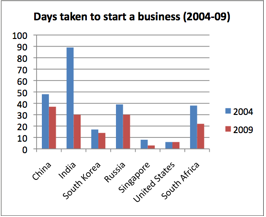
For starters, there is said to be a strong link between bureaucracy and corruption, whereby selfish civil servants are more interested in maximising gain from their individual position rather than in overall social welfare. In addition an over-officious bureaucracy can cause a nightmare of doldrums and delays and regulatory hassles hindering normal business activity. For instance, as per World Bank statistics, it takes 30 days to start a business in India after obtaining clearance from all concerned ministries while Singapore or the US takes 3 and 6 days respectively. While regulatory hassles have undoubtedly eased since 2004, scope for further improvement seems limited unless some radical measures are undertaken. A streamlining of the bureaucracy is essential not only in the interest of the economy but other aspects too, for instance, construction of strategic border roads in the Himalayas near the India-China boundary was languishing for two years, waiting for environmental clearance while China merrily continued its massive infrastructure projects.

Source – World Development Indicators 2010, World Bank

[Source: World Development Indicators, World Bank 2010]

Now, it is not a blanket truth that corruption among the bureaucracy per se leads to inefficiency and disincentives to private sector investment. What is probably more important in this context is the frequency with which bribes have to be paid to avoid regulation. A one step process may actually be efficient if the regulator or the recipient of the bribe accelerates the payer towards his destination, However when we have multiple regulators with common jurisdiction and concomitantly multiple demands at each stage, we have a problem.


The study indicates that population and income levels as measured by GSDP have a bearing on the number of civil servants, with the former showing a stronger relationship.


But, can we put specific numbers to the loss in growth? Cagla Okten did just that in a study of 99 countries over the years 1981-92. Defining bureaucracy as “multiple government units with common regulatory jurisdiction over firms” and using the number of government ministries as a measure of its size, her concern is clearly the effect of multiple regulation on firm investment and GDP. She considers the relationship between government and firms through a modified version of a Principal-Agent model. There are multiple principals (government ministries) here which want an agent (firm) to achieve some social objective. I will not go into the mathematics here, but her conclusion is that when government ministries do not cooperate, the amount of tax a firm has to pay is higher than the efficient amount, and increases with the number of regulators. If this is true when assuming that the bureaucracy is acting benevolently, one can only imagine the efficiency loss when there are multiple ministries acting out of self-interest.

Okten also conducts an empirical analysis wherein she tests the hypothesis whether the investment level of a firm is a decreasing function of the number of ministries. After taking several variables, including those related to initial GDP levels, education, government size and political stability into account, she concludes that total investment (as a share of GDP) has a negative and significant relationship with the number of ministries. In fact, an increase in the number of regulators by one unit is associated with a decline in total investment by 0.2% to 0.6% of GDP for different specifications of the investment function. Going one step further, Okten also shows a significant and negative impact of the number of ministries on the rate of growth of per capita GDP.

A natural question that follows is what factors determine the size of the bureaucracy or civil service. Rajaraman & Saha study this issue in a 2008 paper. They define the number of civil servants to include not only the glorified top tier officers in the administrative or civil services but also the middle and lower rungs of government employees. The study indicates that population and income levels as measured by GSDP have a bearing on the number of civil servants, with the former showing a stronger relationship. They also observe a “scale effect” which suggests that there may be more cost efficient in having larger states vis-à-vis multiple smaller units. This proposition makes sense – if we think that a government would require a minimum number of employees to set its wheels in motion, there should be a fixed component to the number of civil servants along with a variable component that depends on population or income levels (or both).

Returning to the original question of whether the civil service can impede growth, we see that a bloated bureaucracy, where multiple units have common jurisdiction can be a decided hurdle to economic growth by giving rise to a framework where individual accountability gets blurred. Kaushik Basu echoes a similar sentiment when he claims that a more efficient decision-making system in government through reforming the bureaucracy can help India reach double digit growth rates. Till now, the civil service has strenuously resisted attempts to reform itself, but it is now time to shake it out of the rut it finds itself in, for who will watch the watchmen if not the watchmen themselves.

(Too dynamic for the civil service?)


Anirvan Chowdhury is a Research Associate at the Accountability Initiative.

India’s Whistleblower Bill: A Comparison with International Best Practice Standards

The Commonwealth Human Rights Initiative has produced a study comparing India’s Whistleblower Bill (Public Interest Disclosure and Protection to Persons Making the Disclosures Bill, 2010) with international best practice standards. This comparison is useful to identify potential improvements that can be made to the Bill. The comparison is across similar laws operational in countries both within and outside the Commonwealth.

The study is available for download below.

Satark Nagrik Sangathan: MLA Report Cards

Satark Nagrik Sangathan (SNS) is a citizens’ group with a mandate to promote transparency and accountability in government functioning and to encourage active participation of citizens in governance. The group has been heavily involved in the campaign for the right to information and works with local communities to build their capacities on using the right to information as an accountability tool.

With the ongoing Assembly elections in Bihar, Satark Nagrik Sangathan has prepared report cards on the performance of the Members of the Legislative Assembly of Bihar. These have been prepared on the basis of information obtained using the Right to Information Act.

Satark Nagrik Sangathan is partnering with the media to disseminate the report cards. The report cards of MLAs focus on 3 broad parameters-

  • their performance in the Legislative Assembly;
  • how they allocated the development funds at their disposal; and
  • their membership in various Committees of the Legislative Assembly

Report cards that have appeared in the media can be downloaded below.

There’s no such thing as a local Plan

Recently, in a move that has been rightly acknowledged as the first tangible step toward radically overhauling the Five-Year Plan process, the Planning Commission unveiled a new approach to the Twelfth Plan, aimed at making it an inclusive and participative process. To start, the commission has put together a strategy matrix for the approach paper and invited comments through its website. Efforts are also underway to “listen to and consult with citizens’” through civil society-led consultations across the country.

Participatory planning is not a new phenomenon, and through its varied schemes, the Indian state regularly sends out invitations to citizens to participate in planning, monitoring and even auditing its activities. Moreover, the 73rd and 74th Amendments to the Constitution institutionalised participation by devolving powers to prepare plans to local governments and enabling direct people’s participation through gram and ward sabhas. Despite these invitations, meaningful participation is rare. A look at existing schemes shows us just where the problems are.

First, information is scarce and awareness is low. Sarva Shiksha Abhiyan (SSA), for instance, calls for village education committees to make annual plans for implementing SSA. But study after study has highlighted that members remain unaware of their membership — and even those in the know, know little of their powers, responsibilities and financial entitlements. This despite the fact that SSA allocates funds in its budget for community training and awareness generation.

Awareness-raising and providing meaningful, relevant information is not easy. It requires sustained, continuous local engagement, something that implementing officials — who are usually bogged down by oceans of paperwork — have neither the time nor the inclination to do. So committees are formed, because the guidelines require it; but that’s where it stops. More importantly, implementers don’t necessarily value participation. In a recent conversation with a block official in charge of SSA in Madhya Pradesh, he, while acknowledging the mandate for peoples’ plans, said plans are actually made at the block level because (to paraphrase) “we know the status of schools.” “I have’, he added, “up-to-date data.” Sharing this data with people and soliciting their participation was not on his agenda.

Information scarcity apart, the greatest hurdle to participation lies in the very design of the implementation architecture. Every time a scheme calls for participation, it also puts in guidelines that ironically create disincentives for meaningful participation. Funds arrive at the implementation level tied to very clear expenditure items and rigid norms. In SSA, for instance, although the village education committee is expected to plan, if it decides to spend more on teaching materials by using money given for painting walls, the rules won’t allow it. Why bother making a plan that takes into account local needs when there is no flexibility to make budget allocations accordingly?

If it’s not the rigidity of the funding norms, it’s conflicting rules that make planning impossible. In a recent case in Karnataka, a village plan — made under a World Bank-funded programme that provides untied grants to panchayats — for building dry latrines with covered pits suited for the water-scarce area was rejected. Instead, a concrete septic tank latrine was chosen, which required water that the village did not have, because the rules demanded it!

Tardy implementation adds to the problem. Unpredictable and delayed funding is a common problem and monies usually reach their destination well after they are needed. So even if a plan is made, chances are it will not be implemented. As part of an effort to mobilise village education committees under the SSA in rural Madhya Pradesh, for example, a committee made a plan to fix a leaky roof before the monsoon — but this couldn’t be implemented because funds didn’t arrive on time. The roof leaked through the monsoon and the parents stopped coming to meetings. Worse still, parents have no real means of redress, and local officials claimed no responsibility. Meaningful participation, at minimum, requires that the state fulfils some basic functions to deliver on plans. Lack of participation, in this case, is a symptom of state dysfunction.

The current architecture for planning complicates matters further. Participation can only be truly effective in a decentralised system; precisely for this reason, constitutionally, powers to make local plans have been devolved to panchayats and municipalities. But resources flow through sector-specific centrally-sponsored schemes (CSS) with their own parallel planning processes, resulting in multiple planning bodies and endless confusion on the ground. CSS also limits state discretion because a large pool of state resources goes toward contributing to their share of the CSS. State plans are thus tailored to central funding streams. De facto then, planning remains a centralised activity, one that by its very nature creates limited space for meaningful participation.

In soliciting participation through the website and consultations with citizens groups, the Planning Commission has taken an important step towards putting people back on the agenda. This could also be an opportunity to resolve critical institutional failures that have made meaningful participation so difficult. Perhaps what we need is a plan to strengthen people’s plans!

Yamini Aiyar is Director of the Accountability Initiative.

This article appeared on 01-11-2010 in the Indian Express.