
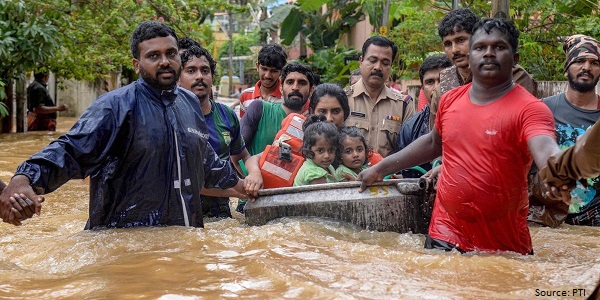
The Tough Spatial Planning Decisions to Take

This blog is part of a series on policy decisions, the causes and consquences of the Kerala floods. The first blog can be found here

In my previous blog, I had listed out the modalities by which the spatial planning process could be split, so as to distribute the responsibilities to the state and to the local governments. While the state is best positioned to undertake the perspective plan and the regional plans that covers urban and rural areas, each city town and Panchayat will have to prepare its detailed master plan. Following the preparation of these master plans, each local government will then have to prepare its CDP, the City Development Plan, which in turn will comprise implementable projects. Then, to ensure that this does not remain on paper, the projects listed in the CDP will have to be funded, by the LG budgets allocating funds for these.

Yet, is this enough for the extraordinary and grim reality that may strike us in future, due to climate change? Won’t these processes still result in haphazard development, with each local government being blissfully unaware of what is happening in the next local government, and the state unable to rein in local decisions to the extent required for the common good?

The future is not going to be easy for any state to tackle. There are several Hobson’s choices before the state, when planning for a safe and climate resilient Kerala. Besides, as I said earlier, Kerala’s approach is only a case study; each state in India is faced with making these choices in their own climatic and environmental contexts.

Let us get back to Kerala, though.

Land is at a premium in Kerala like in very few states. Caught as it is between the environmentally sensitive coast and the Western Ghats, there is very little by way of available land for future expansion. Take further into account the fact that the natural topography of the land has resulted in wetlands that are fit for nothing other than paddy cultivation, the area available for habitation expansion narrows down further. The traditional Malayali abhors high rises; never is she happier than to live in their sprawling village homes in the midst of plantations of coconut and banana. But the days when every Malayali could afford not only to dream of bucolic rural living, but actually go out and live that dream, are long gone. The compromise is an uneasy one; turn a corner in a sylvan village in Kerala and one may come across a row of flats. Urban housing in completely rural settings. This low density sprawl is the uneasy compromise that most Malayalis have reconciled themselves to; if not a coconut tree in my backyard, why not some fronds in my apartment verandah? However, the recent floods have shown that such sprawls also put a high pressure on the environment; roads that cater to these dispersed apartment blocks and housing areas cut into hillsides and destroy the environment. There is thus a strong case for Kerala to go in for more densification in its urban areas so as to prevent the medium rise sprawl spreading out into precious and environmentally sensitive rural, coastal and hill areas. Densification is an euphemism for high rise structures. Kerala will have to make the choice to enable more high rise islands of urbanisation to be developed so as to reduce the pressure on rural land. This will be a political anathema to most people and will go against traditional beliefs and practices on lifestyles. But is there a choice?

A similar choice has to be made with respect to transport as well. Anyone who travels on National Highway 47, which serves Central and South Kerala would realise that Kerala is now one gigantic traffic jam. When the floods hit the state, the road was breached between Palakkad and Trissur due to landslides. This section of road is a bottleneck as road widening has to be done after denotifying forest areas. A similar bottleneck exists between Alappuzha, Kollam and Thiruvananthapuram, where the process of land acquisition for widening the road to four lanes has been proceeding slowly and painfully. The local people do not give up their land so easily.

At the same time, the Kochi Metro has been a success of sorts; it follows more or less the path of the National Highway, from the northern to the southern reaches of the city. It begs the thought as to whether the Metro may not be extended along the spine of Kerala; it may be a cheaper and more environmentally friendly approach than widening highways, which has proven to be a bugbear in Kerala.

The third example is that of solid waste management. This issue has become a contentious one between local governments, because nobody wants to have a landfill in their locality. City municipalities have been blocked by peri-urban Panchayats from dumping their garbage in the latter’s environs. Political parties have justifiably crossed swords on this issue; which has not led to the finding of solutions but a gridlock. Even though solid waste management is a local government responsibility, the situation at present begs for the intervention of the state; as it is the state alone that may be able to find a solution to the problem of landfills. It will be the burden of the state to find place for a few landfills that cater to the requirements of all local governments in Kerala, even as the latter initiate and implement strict standards on segregation and recycling.

There will be many more such choices to be made, with respect to equal access to services, ensuring social justice and such like. But given the potential threat to Kerala from climate change, wicked problems cannot be allowed to fester. The floods have been a wakeup call. The people of the state cannot afford to go back to sleep.
Teachers’ Concerns and how these Affect Students and Educational Policies

State planners need to get at the heart of what motivates teachers to put in their best at school and address their work concerns, before piling more responsibilities on them.   

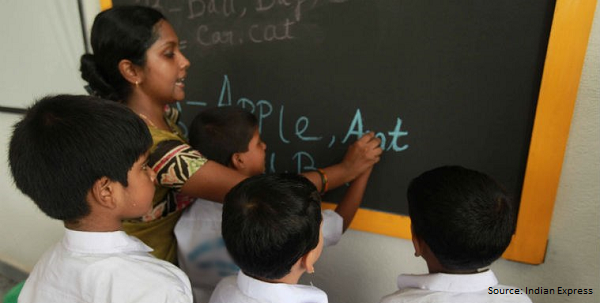
unnamed.pngA few months ago, my colleague and I conducted a focus group with seven teachers from a government school in Delhi. The discussion was conducted with the aim to get teachers to reflect on their experience of working in government schools. We kicked off the discussion by presenting a vignette of a recent graduate and professionally trained teacher, who had been newly appointed to their school. We then asked the group to address the new appointee on her first day at work and to give her any advice they felt would help her at that stage. ‘Don’t be disappointed!’ said the youngest teacher, the first to respond in the group. After a moment of silence she continued addressing the hypothetical teacher:
‘You have learnt many things in your B.Ed programme…We learn many theoretical things but reality is quite different so we need to adapt to their (students’) needs, requirements of the school…the school conditions…you will have to alter your teaching methods, working techniques according to the students… And don’t get disappointed when you don’t manage to get the results you expected from them. The background of students is low compared to what we expect so results are also low compared to what we learn in college…cooperation from parents’ side is also a bit low…don’t get disheartened. Do your best. Sooner or later you will get good results.’

The other teachers hummed and nodded in agreement as she spoke.

I found this teacher’s response quite insightful. She revealed so much about her experience as a teacher – her expectations, her disappointments, her biases – through this thoughtful reflection. As the discussion rolled on, it became apparent that her response had succinctly summarised the group’s collective experience and expectations from their job. I found myself dipping into my own knowledge of teachers’ experiences at their job, gathered over the years, and I could not help but think how government teachers across states articulated their job related interests and concerns in what seemed like a scripted fashion.  So what have I learnt about teachers’ interests and these oft repeated concerns?

Incentives of teaching in government schools

I have learnt that individuals join government schools as teachers for a variety of interlinked reasons. Some of the commonly cited reasons are for the joy of teaching or spending time with children, drawing a steady income (‘it’s just a job!’), and being able to maintain a healthy work-life balance. The last reason is particularly important for many women as they are expected to manage domestic affairs after school hours. For this reason, the profession is often touted as the most ‘appropriate for women’. The perks that come along with being employed in the public sector, such as job security, expectation that the workload will be less compared to private sector jobs, high salaries, and consistent salary increments, are compelling factors for most applicants.

Further, many perceive teaching as a noble profession and/or a vocation. For these individuals, being identified as teachers, the respect associated with the profession, and the significance of the job are ipso facto important incentives.  Yet other teachers in the public education system prioritise being a ‘government employee’ over being a ‘teacher’, and they often harbour plans to move up the government hierarchy, irrespective of the sector. In such cases, teaching at a government school is viewed as a stepping stone to bigger and better opportunities, while still being able to draw benefits of being securely employed in the public sector.

But for many teachers the experience of working in the public education system often belie personal expectations.

Teachers or government employees?

Once teachers enter the public education system, they find themselves underprepared to cope with non-teaching tasks. These include the quantum of recordkeeping work and the amount of time it takes to counsel students and parents who tend to overwhelmingly hail from economically and socially weaker sections compared to the teachers. We have frequently observed teachers filling out forms for parents and students, spending a lot of time explaining official or administrative matters to parents who are often unable to fill out paperwork themselves. Teachers also spend time educating and sensitising both parents and students about social issues such as child marriage, drug abuse, and health and hygiene.

Time spent on these activities is ‘invisible’ in that it is not accounted for by education planners. No one has a clear estimate of how much time, skill and energy such demanding yet critical tasks take up. Teachers also have to learn administrative tasks such as maintaining salary accounts, bills etc. on the job – tasks which are very different from their basic job profiles. We often hear of teachers bungling up records as a result and spending more time rectifying errors.

Teachers in many states continue to largely function in resource strapped settings, with poor infrastructure and high student density, which only add to the challenges teachers are not prepared for or expect upon entering the school system. In most states, records continue to be manually maintained in different hardcopy formats. Even in a resource rich state like Delhi, where government schools are equipped with computers and have internet connectivity, records are still maintained manually (either because they are ordered by higher officials or by habit) even though almost all information is also submitted electronically. This only doubles the time spent on non-teaching tasks. In Delhi, the issue of student absenteeism is also rampant as many students hail from families that frequently migrate, which leaves teachers struggling to effectively meet curricular expectations put on them.

46480328_10155590159202721_3717453026873573376_n.png

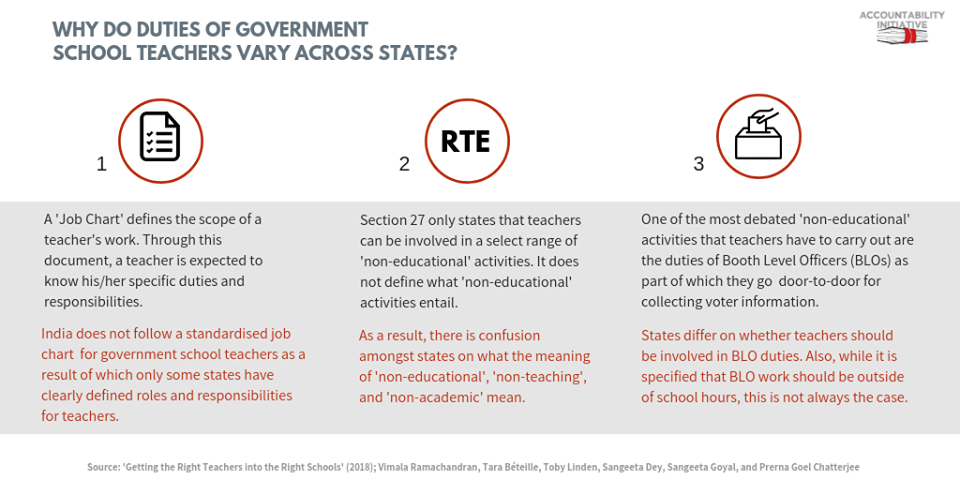
Moreover, by virtue of being government school teachers, one finds the schools enmeshed in a deeply hierarchical and bureaucratic setup. This means that schools don’t just function as organised sites for facilitating teaching-learning but also double up as last mile offices of various government departments.  The Right to Education Act (2009) allows teachers to be involved in decennial census, election and disaster management duties.

In a yet to be released report, my colleagues and I at the Accountability Initiative explore this dilemma of juggling dual professional identities – that of a teacher and of a government employee – and the consequences it has on teachers’ day to day functioning. These identities and the associated tasks often clash, and this affects teacher performance and morale. The issue is further compounded by the mismatch in teachers’ work expectations and planners’ expectations of them.

Voices that (incidentally) shape the ‘change narrative’ in schools

The impact of these intangible factors on that most popular of indicators to measure the success of teaching-learning interventions – student pass percentages – needs to be systematically studied. The effects of these factors also merit serious consideration since teachers, like any other workforce, need to feel motivated, competent and equipped for their job to meet their goals effectively. Interventions to improve teaching-learning imparted in schools continue to see limited results owing to a number of systemic roadblocks, and these include mismatch in teacher work expectations and their job preparedness vis a vis the state’s demands on them as teachers and as government employees.

In the past I have also discussed how difficult it is to develop and implement “evidence based” policies at the scale and conditions under which Indian states operate. A reflection of that is the way reform interventions continue to be designed and implemented in a formulaic manner – a thin leadership at the top plans and pushes the change agenda; basic orientation or bare minimum training is given to the workforce to execute the tasks expected of them. Monitoring is done through reports produced by frontline actors which carry quantifiable but limited indicators that do not shed light on the process by which the numbers are generated. Punitive measures are taken in cases of insubordination; and the frontline workforce continues to mechanically follow the basic acts required of them, transmitting reports upwards, without necessarily investing in the reform agenda.

“Change management” as a concept is altogether missing from the lexicon of most planners. One sees interventions being introduced and wrapped up arbitrarily, leaving frontline actors to grapple with the meaning and consequences of the same. Further, whipping teachers into action by applying punitive measures, especially in the case of interventions aiming to improve teaching-learning practices is also not effective in the long run. Such programmes require teachers to “input” intangible acts like ‘care’, ’empathy’ and ‘commitment’ in the mix of activities inside classrooms, apart from applying the technical skills of teaching. It is hard to get actors to truly care if there is little buy in for a programme or, at the outset, the implementing actors’ job expectations, job preparedness and work conditions are not in sync with the dual set of responsibilities put on of them.

The intent of this commentary was to introduce yet another layer of complexity in dialogues pertaining to education reforms. Initiating discussions on teacher interest, concerns and work conditions can and should also stimulate discussions on modifying pre and in-service training and teacher recruitment to suit the needs of the students being catered to by government schools.

Simplifying Spatial Planning

This blog is part of a series on policy decisions, the causes and consquences of the Kerala floods. The first blog can be found here

In my last blog I wrote about various new and innovative approaches to urban planning, which aimed to address the problems of traditional rigid approaches. However, we just cannot wish away the fact that implementation of plans will remain a problem as it is dependent upon broader socio-political factors outside the control of the planning system. It is not going to be easy to change the regulatory system and enforce decisions that are in the larger interest of society, because of entrenched legal rights and interests.

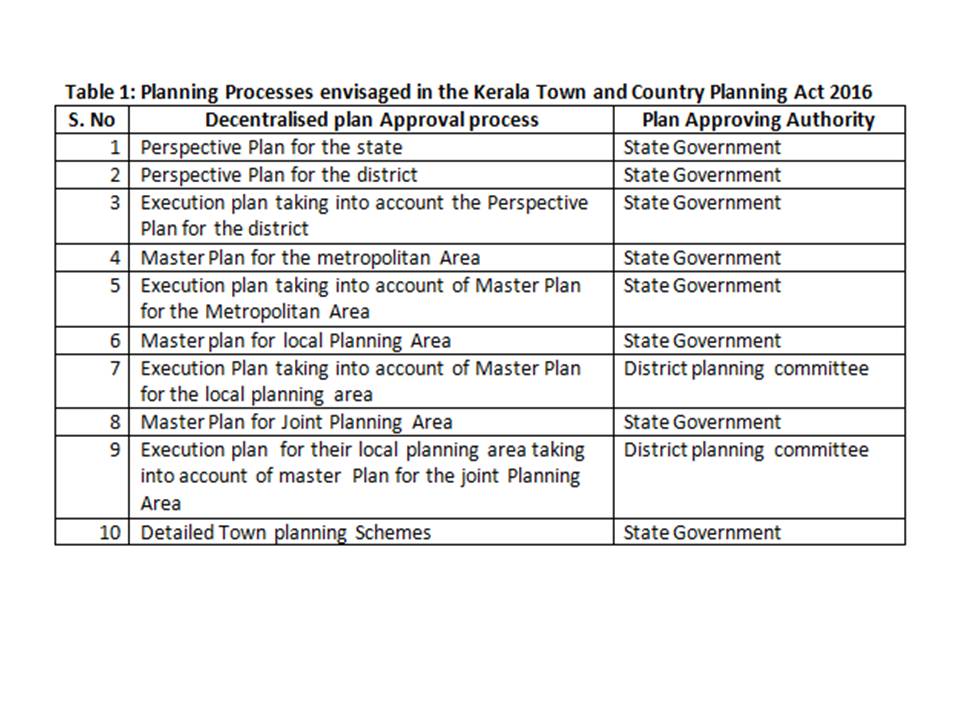
Having said that, a good place to start is to check out the different kinds of planning envisaged in the law. In the case of Kerala, as shown in the Working Group Report, there is a great deal of fragmentation when it comes to different planning exercises. The Kerala Town and Country Planning Act 2016 provides for the following kinds of plans to be prepared (Table 1):

Presentation1_9.jpg

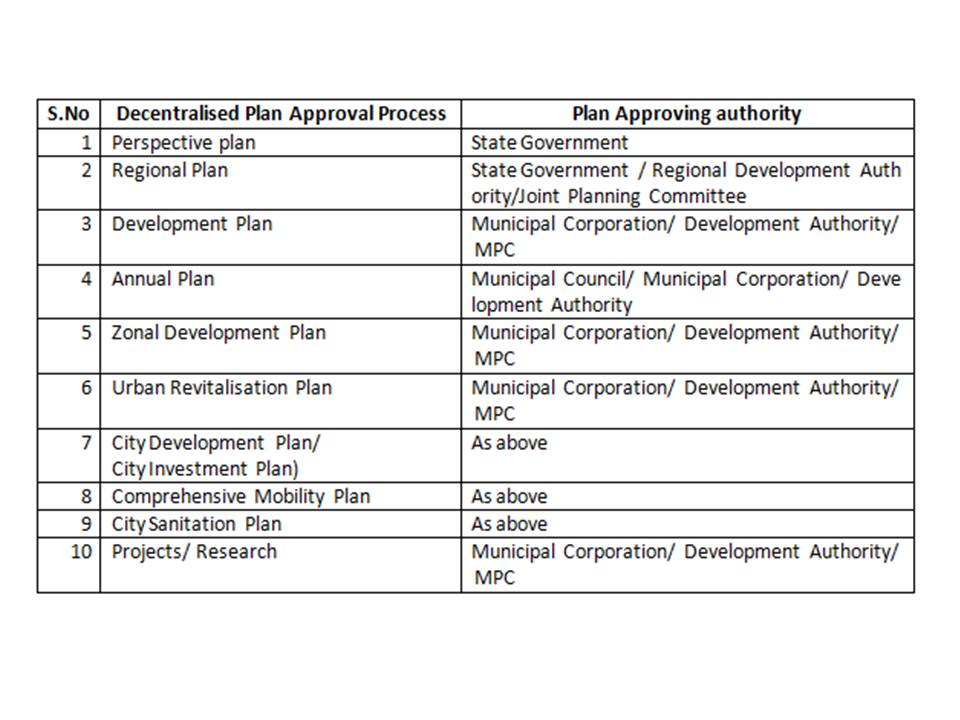
At the same time, there are other planning processes that straddle the spatial planning aspect  and that are still in vogue, either as statutory processes, or as mandated by various funding programmes for urban development (Table 2):

Presentation1_8.jpg

The dichotomy between Tables 1 and 2 illustrate the wide variation between the approach taken by the Town and Country Planning Act 2016 and the adaptive approaches to urban planning envisaged through various schemes and guidelines. This creates plenty of scope for confusion and lack of coordination.

How does one overcome this recipe for planning disaster? The best way would be to reduce the number of planning exercises to the minimum required and then ensure that they interlink with each other in a manner that is easy to understand.

It is the state’s responsibility to approve the perspective plan covering the entire physical area of the state, including both rural and urban areas. At the same time, such an exercise cannot be undertaken without consultation with citizens. The best way to do this would be for the state government to declare a Charter of Urban reforms and Urban Governance Improvement Measures, in which planning is a key component.

There must be a regional plan, which conforms to the broad non-negotiable principles enunciated in the Charter of Urban reforms. The Regional Plan would guide individual master plans for each LG within the region. The emphasis in the Regional Plan would be on recognising the potential for economic growth of the UA concerned and strategising for reaching it.

Every city, town and /or Panchayat within the UA can prepare its detailed Master Plan within the broad framework of the Regional Plan. Whilst doing so, the Master Plan for each LG should not be developed as self-contained plans in isolation of each other. The Master Plan would then become the ‘comprehensive long term development policy’ for the LG, within the overall context of the urban agglomeration.

Then would come the next level of detail, which is the CDP for each local government, with a 5 to 10 year perspective.

Finally, the CDP is split into programmes; and implementable projects.

In my last and final blog on Kerala’s spatial planning, I will lay down the institutional mechanism that could support such an approach, as also what are the Hobson’s choices before the state, when planning for a safe and climate resilient Kerala.

जन सेवा केंद्र के कुछ एहम मुद्दे

कितना अच्छा होता अगर हमारे देश के दूर-दराज प्रांत में रहने वाला प्रत्येक नागरिक सरकारी सुविधाओं तक अपनी पहुंच बना सकता और उनका लाभ ले सकता ! मेरे कहने का अर्थ है कि घंटों सफर कर सरकारी कार्यालय के बजाय नागरिक सुविधाओं का लाभ नज़दीक सेंटर से प्राप्त कर पाता, तो कितना अच्छा होता |

केंद्र सरकार ने डिजिटल इंडिया कार्यक्रम के तहत जन सुविधा केंद्र (CSC) की शुरुआत कर इस सपने को सच करने के ओर कदम उठाया है | अधिकतर राज्यों ने पिछले तीन वर्षों में ऐसे सेंटर का आरम्भ किया है जहाँ पर सूचना एवं  तकनीकी सेवाएँ नागरिकों को उपलब्ध करवाई जा रहीं है, खासकर ग्रामीण और पिछड़े क्षेत्र जहाँ पर अभी भी सुविधाओं को पहुंचाना एक चुनौती है | केंद्र सरकार का लक्ष्य है कि 2019 तक पुरे भारत वर्ष के 2.5 लाख ग्राम पंचायतों में एक जन सुविधा केंद्र शुरू हो |  यह सुविधा केंद्र मुख्य रूप से आमजन को प्रदान की जाने वाली महत्वपूर्ण सेवाओं के लिए स्थान प्रदान करेंगे जैसे सार्वजानिक कल्याण की योजनायें, स्वास्थ्य सेवाएं, वित्तीय, शिक्षा और कृषि जैसी सुविधाएं, आनलाइन पासपोर्ट का आवेदन, पैन कार्ड के लिए आवेदन, आधार कार्ड, जन्म और मृत्यु प्रमाण पत्र, और खाते से पैसे की निकासी जिस प्रकार बैंक द्वारा की जाती है | यह केंद्र उपभोक्ता को मोबाईल रिचार्ज, बिल पेमेंट और डिश टीवी की पेमेंट करने की सुविधा भी देंगे | इन सेंटर को स्थानीय उधयमी द्वारा चलाया जाएगा |

यधपि बहुत सी चुनौतियां है | इन चुनौतियों को मुख्य रूप से दो भाग में बाटा जा सकता है | पहला, क्या CSC मालिक लाभ को अधिकतम करने के साथ-साथ सार्वजनिक सेवा प्रदाताओं की भूमिका निभाते हुए व्यवसाय कर सकते हैं? दूसरा, सेंटर और सरकार की जवाबदेही | हाल ही में मैंने एक वर्कशाप में भाग लिया जिस को अज़ीज़ प्रेमजी फाउन्डेशन ने आयोजित किया था | इस वर्कशाप में झारखंड के 10 जिलों में CSC मालिकों और सेवा उपभोगता नागरिकों पर हुआ नमूना सर्वेक्षण के निष्कर्षों पर विस्तार से चर्चा हुई | कार्यशाला के प्रतिभागियों CSC मालिक, सरकार के सदस्य और सिविल सोसाइटी संगठन थे ।

चर्चा के कुछ एहम मुद्दे 

जन सेवा केंद्र के मुखिया स्थानीय गाँव के उद्ययमी होते हैं | CSC सरकारी निजी कंपनी भागीदारी (Public Private Partnership) के माध्यम से बनते हैं | अधिकतर सरकारी सेवाओं की राशि सरकार द्वारा निर्धारित की जाती है | मूलभूत सुविधाएं, जैसे बैंकिंग, मुफ्त उपलब्ध होती हैं | जन सुविधा केंद्र बड़े पैमाने में सुविधाओं का विस्तार कर सकते हैं और उनसे अपेक्षा की जाती है की सरकार के लिए जहाँ सेवाओं को पहुंचाना कठिन है, वहां CSC सेवाएँ प्रदान करें |

अधिकतर ग्रामीण स्तर के उद्यमी, जोकि झारखंड के थे, ने इस बात पे ज़ोर दिया की उनका औसतन लाभ (वर्तमान कमीशन आधारित माडल के अनुसार) Rs 3000 – Rs 6000 प्रति माह है, जोकि बहुत कम है | वह सरकार द्वारा प्रदान की जाने वाली सेवाओं के लिए निर्धारित राशि से अधिक की मांग जनता से नही कर सकते | राजस्थान के एक प्रतिनिधि ने सुनिश्चित किया कि उनका लाभ इस राशि के लगभग रहता है | ब्लॉग लिखने के समय पर भी हमारे पास इतना डाटा नही था जिससे कि हम बाकी राज्यों में जन सुविधा केंद्र की औसतन कमाई का अनुमान लगा सके | लेकिन इन बातों से यह पता चलता है की योजना के वर्तमान डिजाइन में न्यूनतम आय सुनिश्चित करना पेचीदा है । प्रश्न यह उठता है – क्या उद्यमी अपने आपको इतनी कम आय पर लम्बे समय तक टिका पाएंगे ? प्रश्न यह भी है की क्या केंद्र के मालिकों को मुफ्त सेवाओं का दायरा सीमित करना होगा? और उपभोगता द्वारा धन राशि खर्च करने वाली सेवाओं पर अधिक ध्यान देना होगा? क्या जनता से सभी सरकारी सेवाओं के लिए धनराशि वसूल की जानी चाहिए ? जबकि सरकारी कार्यालयों में यह सेवा मुफ्त में उपलब्ध करवाई जाती है | इनके जवाब आसान नहीं है |  इसलिए वर्कशॉप के दौरान चर्चा गंभीर थी  |

इसके साथ ही साथ जन सेवा केंद्र में जो सेवाएँ उपलब्ध करवाई जाती है वह आनलाईन होती है जिसके लिए पुरे दिन बेहतर इन्टरनेट स्पीड की आवश्यकता होती है | झारखंड के दूर-दराज इलाकों में खराब इन्टरनेट कनेक्टिविटी के कारण नागरिकों तक सेवाओं को पहुचाने में कठिनाई आ रही है | इसका परिणाम सेवाओं में देरी, और सेवाओं की खराब गुणवत्ता है | CSC को अपनी भूमिका निभाने के लिए ज़रुरत है बेहतर डिजिटल नेटवर्क की |

जवाबदेही के बारे में 

जन सुविधा केंद्र अगर किसी कारण सेवा प्रदान नही कर पाते है तो इसके लिए कोई शिकायत प्रणाली तंत्र नही है | उनका कार्य केवल सुविधाओं को ग्राहकों तक पहचाना है क्यूंकि PPP मॉडल के तहत, वह सरकार का हिस्सा नहीं हैं |  इसके अलावा सेवा के प्रावधान में CSC के पास कोई निर्णय लेने का अधिकार नहीं है | इस स्तिथि में, नागरिक को शिकायत निवारण के लिए सीधे सरकारी प्राधिकरण से संपर्क करना मुश्किल है क्योंकि वह अब तक CSC के साथ समन्वय कर रहे थे | अगर नागरिक जन सेवा केंद्र के खिलाफ किसी तरह की शिकायत करने का निर्णय लेते हैं तो मुख्य रूप से ऐसा कोई रास्ता नही है जहाँ से समय पर जवाब की अपेक्षा की जाए | बेशक, सरकार द्वारा फोन,  ईमेल, आनलाइन उलेखित किया जाता है, परन्तु एक समयसीमा के अंदर किसी भी तरह की करवाई सुनश्चित होनी चाहिए |

इसके अलावा यह गलतफ़हमी देखि गयी है कि जन सेवा केंद्र सरकारी कार्यालयों का विकल्प है | सर्वेक्षण में CSC के मूलभूत बैंकिंग सेवाओं, जैसे नकद जमा करना और निकासी, के लिए बैंकों के विकल्प के रूप में पेश किए जाने के उदाहरण सामने आए | एक मजबूत जवाबदेही तंत्र की अनुपस्थिति में इस तरह के अभ्यास भ्रम पैदा कर सकते है और भ्रष्टाचार को बढ़ावा दे सकते है क्योंकि बड़ी संख्या में CSC में पासबुक अपडेट की सुविधा नहीं है, जो कि कई ग्रामीण नागरिकों के लिए धनराशि को ट्रैक करने का एकमात्र तरीका है ।

तो, मैं यह महसूस कर रही हूँ कि जन सेवा केंद्र का स्थापित किया जाना एक बहुत बड़ा कदम है परन्तु इसमें ठोस परिवर्तन की आवश्यकता है ताकि इसे और जवाबदेह बनाया जा सके | एक मजबूत जवाबदेही तन्त्र शिकायतों  के पंजीकरण और निवारण के लिए औपचारिक मार्ग सुनश्चित करता है | नियमित रूप से सरकार द्वारा निगरानी और मानिटरिंग, सेंटर द्वारा प्रदान की जाने वाली सेवाओं की मूल्य सूची प्रदर्शित करना, और अनेक चीज़ों की आवश्यकता है | साथ ही, CSC मालिकों के लिए कुछ बुनियादी आश्वासन मासिक आय अर्जित करने के लिए एक तंत्र विकसित करना, और ग्रामीण इलाकों में ब्रॉडबैंड इंटरनेट कनेक्शन के सुधार और विकास में तत्काल निवेश महत्वपूर्ण होगा ।

The emerging, wider paradigm of local spatial planning

This blog is part of a series on policy decisions, the causes and consquences of the Kerala floods. The first blog can be found here.

Since my last blog, the UN report on Climate Change was made public and it predicts rough times for humanity at large, in case temperature rise is not held within 1.5 degrees of pre-industrialisation levels, by 2030. Since dramatic climate events such as the heavy rains in Kerala are now being directly related to global temperature rise, the need for behavioural change in all of us to curb and reverse greenhouse gas emissions is, not only a Kerala problem, but a worldwide one. To zoom in from these imperatives that alone will ensure our survival and looking at how we need to change our approach towards urbanisation and planning is a long shot – but it is necessary.

In the light of the fact that we are teetering on the border of imminent climate change disaster, urban spatial planning is therefore not only about how spread out or otherwise people should live, but it is about dramatically reducing energy consumption. However, even as energy efficiency takes centre stage, we also need to provide for other concerns such as gender equity, crime reduction and safety, health, education, economic activity and heritage. This needs planning to be driven from departmental activity of various wings of the government to a more holistic approach that enables greater flexibility and faster implementation. That in turn means that departments concerned may not only have to coordinate their plans but also closely link their budgets as well.

Many new ideas have emerged in this regard. One way is to go in for ‘Strategic’ spatial planning which lays down long range, broad and conceptual spatial ideas, rather than a detailed spatial design. This is what Barcelona did, in which their strategic plan only promoted a compact urban form and gave a framework within which local urban projects could be taken up. A second way is to look at spatial planning as a way of institutional integration. This is what is done in South Africa, where an integrated development planning (IDP) manager’s office in each municipality undertakes needs assessment, vision development, and aligns the plans and projects of each line department to the urban vision. Third, under the ‘New’ Master Planning approach, a bottom up and participatory approach has been adopted. To do this, in Brazil a new regulatory tool named the Special Zones of Social Interest was adopted to intervene in the real estate market to control land access and secure social housing, by protecting them against speculation that would dispossess them.

However, none of these approaches per se look at climate change as a predominant threat that needs to be tackled as a commanding priority. For that, there has been growing interest in planning for new spatial forms altogether. As a reaction against low density urban sprawl, interest has turned towards ‘compact cities, with medium- to high-built densities, mixed-use environments and good public open spaces’. Urban areas are aimed to be contained within urban edges, designed to protect natural resources beyond the urban area and to encourage densification inside it. The idea is to promote a compact form, mixed use, pedestrian-friendly streetscapes, defined centres and edges, and varying transport options. Health, retail and government services are clustered around public transport facilities and intersections.

The big question that needs to be addressed is whether Kerala, chastened by its flood disaster, could redesign its spatial planning approach. Kerala’s baseline status is not flattering. The Working Group sums up the problem statement of Kerala thus:

“Kerala’s policy makers and practitioners have failed to integrate the Master Plan, which provides a spatial framework, with (a) the CDS and CDP, which suggests a development strategy without a spatial frame and (b) the conventional participatory process, which concentrates on budgeting for, selection and implementation of projects. There is a need to interweave the spatial, service delivery and economic approaches so closely that they cannot be disentangled. It is only when we have a framework in which the economic and spatial approaches integrate that we can satisfy a range of needs and concerns of the urban population – social, economic, psychological, educational and medical. Such integration will force us to debate on some of the alternatives of development that face us in our cities, for example, on (a) whether densification and mixed use of land is necessary or otherwise, (b) whether we can afford an urban planning model founded on automobility or focus on public transportation, cycling or pedestrian access, (c) determining who has priority when physical space is contested (as for example, the access to vending areas), or (d) whether a highly decentralised model is preferred for solid waste or liquid waste management, to a centralized model. 

In tangible terms this would mean that multiple planning processes by whatever names called – City Spatial Plan, CDP, City Mobility Plan, and City Financing Plan – must be integrated rather than pursued as unrelated exercises as at present. This will call for flexible land use planning, inclusionary zoning, innovative land assembly and value capture financing. Such an approach alone will enable Kerala’s urban areas, whether cities, census towns or urban agglomerations to function as engines of economic growth while being liveable.”

How can that be done in Kerala? My next blog will focus on the recommendation of the Working Group on Urbanisation in this regard.

A spatial approach to local planning

This blog is part of a series on policy decisions, the causes and consquences of the Kerala floods. The first blog can be found here and the previous blog here

To say that there must be a spatial approach to local planning, would sound like the ultimate cliché. Is there any other approach? One might well ask. However, the fact that spatial considerations are dismissed during local planning, is clear in the kinds of violations that come to light when there is a natural disaster. The floods in Bangalore a couple of years back resulted in plenty of damage to houses along the drainage canals – the Rajakaluves. So did the floods in Uttarakhand, where houses perilously closed to the banks of the Ganga were washed away. However, in both cases, these buildings ought not to have been there in the first place; they were encroachments and unauthorised constructions.

In Kerala, the creeping occupation of paddy lands through slow conversion into coconut gardens, and then house sites, is against the law that prevents the construction of buildings in such low lying areas. However, these considerations are ignored, till damage is suffered in a flood.

It is paradoxical that in Kerala, which takes a participatory approach to the process of budgeting, there is not as much participation in the process of spatial planning. Campaign mode participatory planning approaches in the state have focused on how budgets for local governments should be spent, with little regard for where the facilities on which they are spent are to be located. This has resulted in a dichotomy, with spatial planning remaining a technocratic process, whilst budgeting has been invested with participatory processes.

Kerala passed a new Town and Country Planning Act in 2016, which provides for Perspective plan preparation at the State, District and Metropolitan areas, Master Plans for Municipalities and Panchayats and Detailed Town Planning Schemes within each local government. The master plan is the key document, and it is supposed to include a situational analysis of the present state of development, a long term development concept and strategy for about 20 years. It also includes land use proposals, development control regulations and infrastructure development plans, which covers the hierarchy of commercial areas, dispersal of commercial activities and industries, population assignment, space requirement for various activities and designating land use for various activities such as reserving land for ecologically sensitive areas. In furtherance of these, regulations for land use are also to be put down, including details like FAR, height and number of storeys and other density related matters.

That sounds wonderful, but it hasn’t worked in the past. Equal to the effort put in to make master plans, is the effort made to ignore them. Master plans are seen as narrow, regulatory instruments that impose unwarranted and inflexible restrictions on land use. Therefore, even the Municipalities that are supposed to follow them, disregard them in favour of short term, day to day approaches towards building licence sanction. There is tension between the Town Planning Department that makes master plans and the Municipalities, which choose to ignore them. Finally, the absence or violation of master planning is only noticed when large scale problems arise as in the recent floods.

Seen from that angle, the natural answer would be that Kerala needs to enforce the compliance to its master plans. However, that in itself would be hampered because many of the Municipalities do not have currently valid or updated Master Plans.

But even as we go down the conventional approach of strict compliance to master plans, internationally, there has been a growing disillusionment with conventional master planning! This is a paradox, because internationally, in the developed world, the trend is to make master planning flexible and participatory, whereas we might still be going down the path of adopting top-down, technical and expert-driven approaches to master planning and land-use zoning, which are at odds with community priorities, leading to poor ownership of master plans and implementation failure.

The Kerala report puts it succinctly when it says;

“The disconnect between people and master plans have led to two trends. Where Master Plans are strongly enforced, those who cannot afford to comply have been pushed out to areas where they can evade detection, such as slums. Where Governments have lacked the capacity to enforce master plans, it has led to a free for all where even the fundamental norms of master planning are ignored. Either way, unrealistic planning regulations have directly contributed to the exacerbation of poverty and spatial marginalization, forcing the poor to violate laws in order to survive”.

The report also points out that another reason for the discrediting of conventional master planning has been the fragmentation of the responsibility for its preparation and implementation in various departments and local government levels. In particular, this has delinked the directive aspects of spatial planning from day to day regulation and land-use management. Furthermore, when spatial plans were not linked to how budgets are prepared and funds allocated, the ensuing lack of coordination has resulted in spatial plans being simply ignored in the scheme of things. This leads to a paradox; departments concerned with urban infrastructure often ignore master plans in the face of the need to solve emergent problems, overlooking the fact that if Master Plans were indeed complied with, these problems might not have emerged in the first place.

So, if that is the case; if we are at one level opposed to master planning as it is unrealistic, but at the same time fear that the absence of some regulation will lead to a free for all with disastrous environmental consequences, is there a golden mean somewhere?

More about that in my next blog.

Government Spending is Disconnected from the Realities of Health and Poverty

How far has India progressed on securing welfare of all? This blog is part of a series which uses data to unpack the status of health, education and policy reforms in India’s 71st year of freedom. ​The first blog of the series can be found here

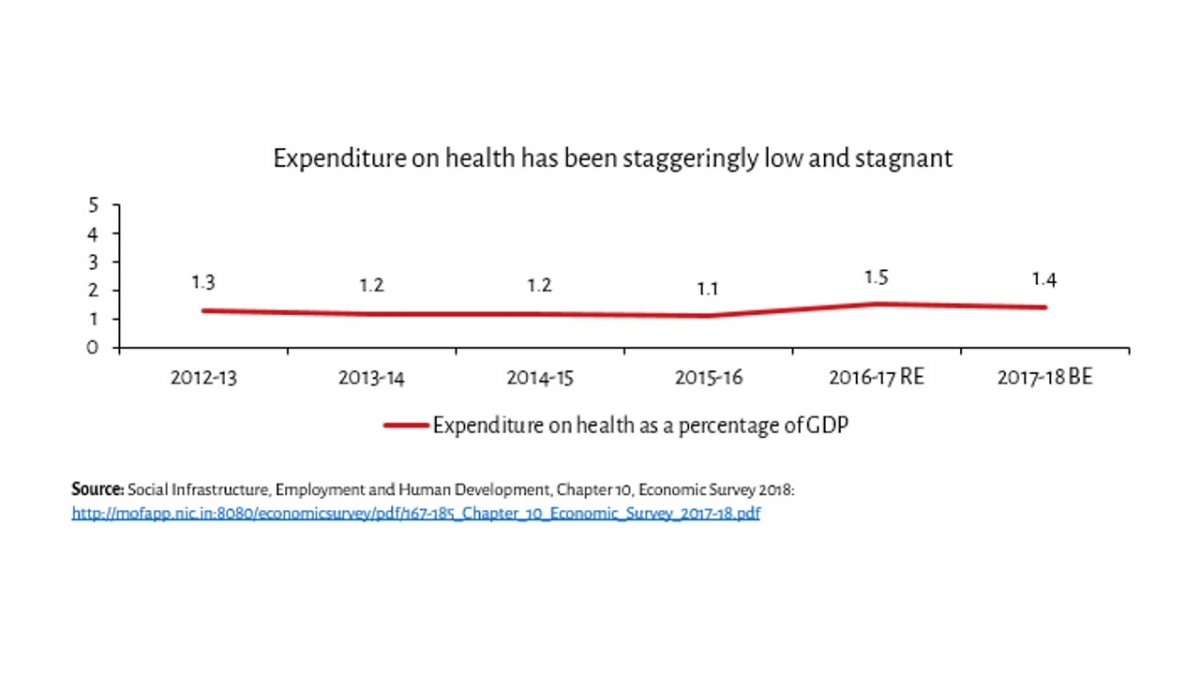
Poor health and nutritional deficiencies have become somewhat of a staple in the country. The loss of life due to ill-health are astronomical in both personal and social terms. These come along with significant economic losses to families, a large number of whom live  on the margins of society. With such deprivation and the changing shape of India’s health crisis, one would expect the government in any developing country to ramp up healthcare funding. However, these expectations are dashed while looking at government spending (state and centre combined). The share of expenditure on health as a proportion of GDP has remained stagnant over the years.

1_3.jpg

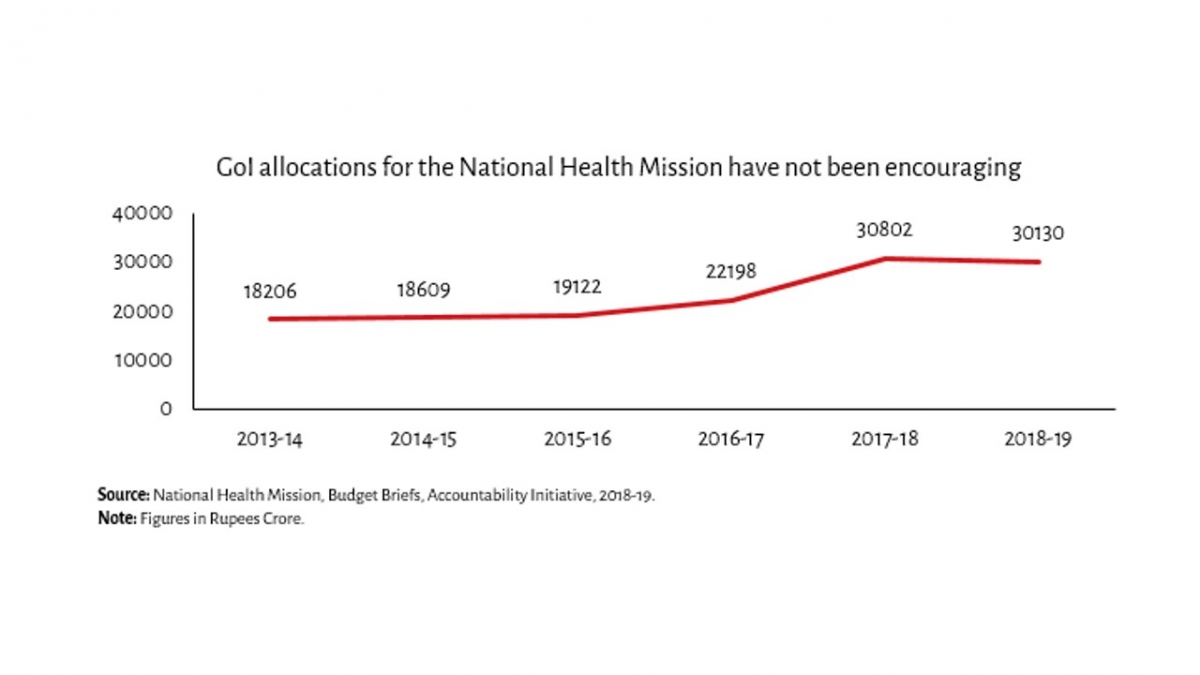
Funding for the National Health Mission (NHM), the Government of India’s largest health programme, too remained largely immobile from 2013-14 to 2016-17. While allocations jumped in 2017-18, they have decreased by 2 per cent in 2018-19, in a year when the health crisis that India faces has been in sharp focus from the government. This decline in allocations is puzzling, considering the government has launched schemes like Ayushman Bharat only recently. While spending more isn’t a panacea, a lack of spending appears to reflect the low priority of public health in the government’s agenda.

2_0.jpg

Even within the limited funds spent by the government, spending smartly would be a priority. However, there seems to be a disconnect between the disease burden in the country and the direction of funding. Curiously enough, just a trivial 4 per cent was allocated to non-communicable diseases out of the total budget in 2016-17, while 6 out of 10 deaths in India are now a consequence of non-communicable diseases. To make matters worse, only 33 per cent of that meagre amount was actually spent.

A paralysed system

The Indian health system is paralysed in myriad ways and not yet adept in tackling the shifting disease burden. Given the increase in non-communicable diseases, specialists (surgeons, physicians, gynaecologists, and obstetricians) will be required with even greater urgency. There is however a shortfall in specialists, with 82 per cent out of required posts at Community Health Centres lying vacant.

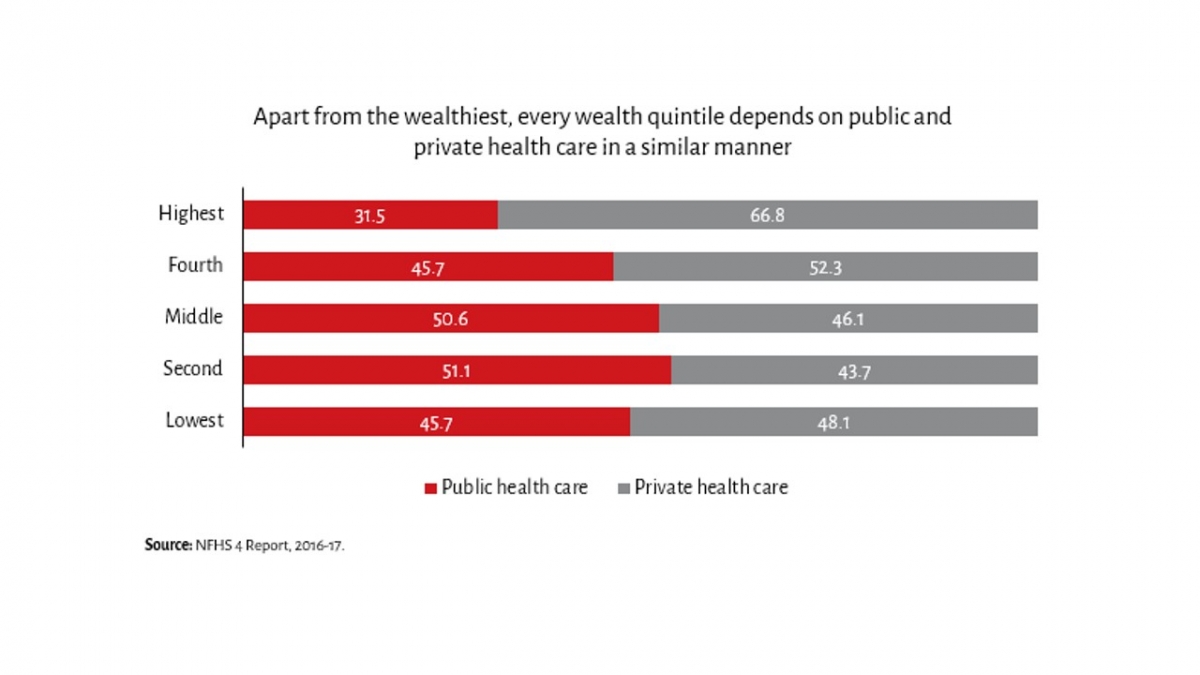
The ailing public health system has pushed several households, across the income spectrum to access private health care options according to various sources. NSS 2014 shows that there is a preference for private hospitals: In cases where hospitalisation was needed, 58 per cent used private hospitals in rural areas, while this number was 68 per cent in urban areas. NFHS 4 data shows a similar story.

3_0.jpg

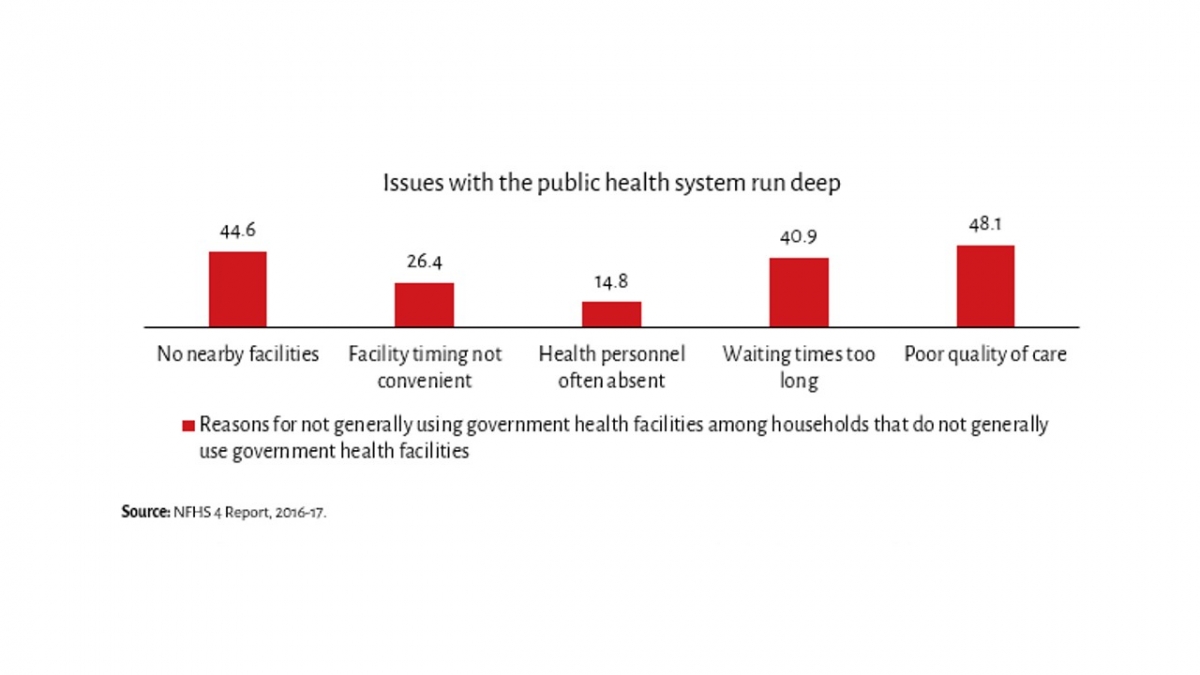
One would expect the poorest to be more reliant on government services. However, the high percentage of people even amongst the poorest accessing private healthcare and the proliferation of spurious “doctors”, without formal medical training, who are sought for up to 75 per cent of primary care visits in rural India reflects the extent to which the public health system is paralysed. This has far-reaching implications in terms of poverty and inequality.

4.jpg

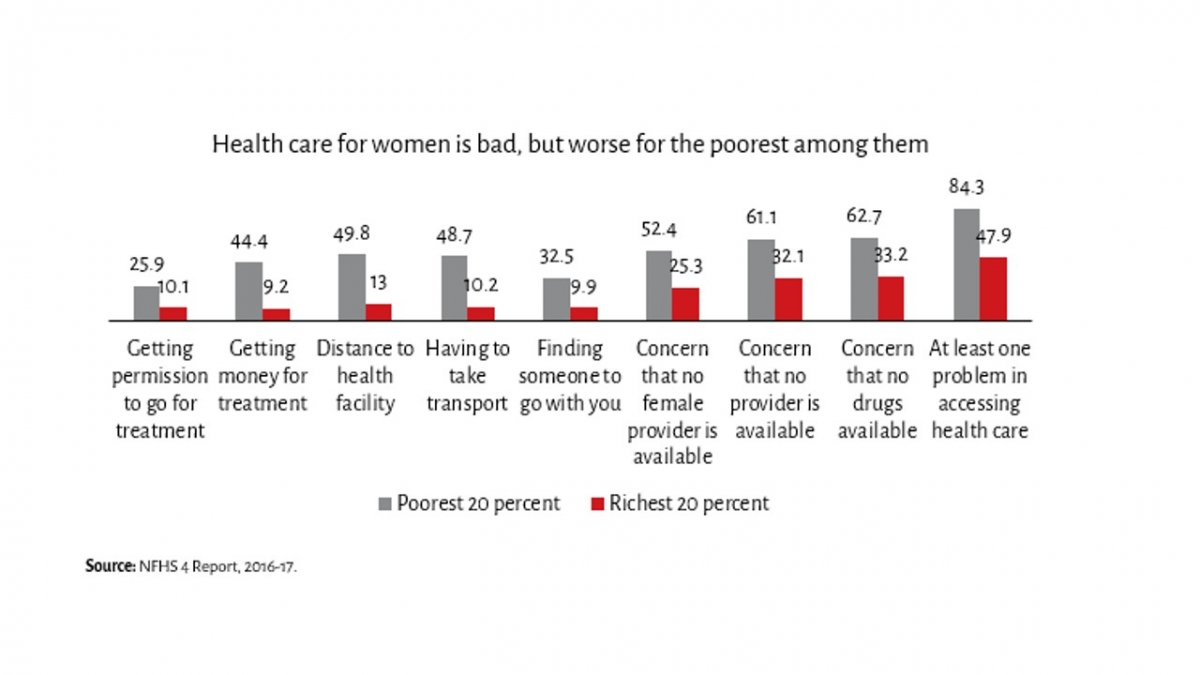
Amongst the poorest 20 per cent women, a staggering 84 per cent had at least one problem in accessing healthcare. Every single issue caused by the health system affects the poor far more than the rich. At the same time, a substantial 48 per cent women of the richest 20 percent faced at least one issue in accessing health care. The magnitude of the health care crisis that India faces is multifaceted – issues such as gender and caste discrimination and the way they play out cannot be ignored.

5_0.jpg

The maintenance of poverty

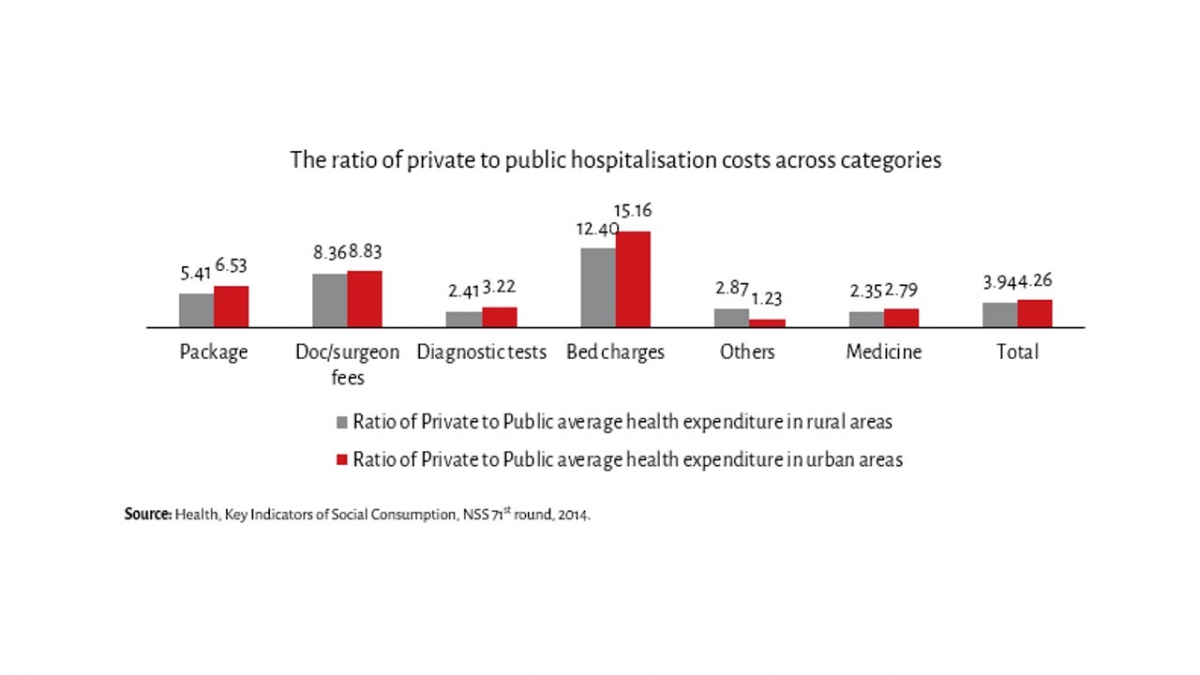
Due to obvious necessities, families end up spending far more than they would, had our public health care system been effective. The average hospitalisation cost in a private hospital is almost 4 times that of a public hospital in rural areas, and a little more than 4 times for urban areas. In particular, private hospitals charge far more for beds, doctors and surgeons, and medicines. In fact, bed charges in private hospitals are more than 12 times bed charges in government hospitals. Even private doctors are costlier than public hospitals – the average total medical expenditure for treatment per person was ₹462 in public hospitals in rural areas, versus ₹581 for private doctors or clinics. The corresponding figures for urban areas are ₹394 in public hospitals, and ₹658 for private doctors or clinics.

6_0.jpg

A shift in the disease burden to non-communicable diseases like cardio-vascular illnesses and cancer compound the problem. Out of 100 deaths in India, 28 are caused by cardiovascular diseases, 11 by chronic respiratory diseases, and 8 by various cancers. Private hospitals are four times as costly for cardiovascular diseases and chronic respiratory diseases, and three times as costly for cancer, compared to government hospitals.

This makes private health care unaffordable for many. Those that feel that private options are better end up paying a very high price for healthcare, often resorting to borrowing. As per NSS 2014, 25 per cent rural health expenditure and 18 per cent of urban health expenditure is financed by borrowings (excluding money borrowed from friends and family). Insurance may go some ways in easing the cost burden on families, but only 29 per cent households in the country have at least one member insured. This leaves a large number of people in a precarious position, susceptible to destitution due to health risks not covered by the state or personal wealth.

Since these expenditures are usually unplanned, they are a source of great anxiety for many. Imagine a household whose income is improving and may be close to escaping the clutches of poverty, but is pushed back down the income ladder due to a sudden expense. While the rich can draw on their wealth to deal with the problem, the poor often find their hard earned wealth quickly dissipating\and inequality in society persists.

Crucially, the costs of healthcare have been pushed on to individuals and families, and this has only added to the instability and uncertainty in the lives of the poor and in a mind-bogglingly unequal country, leaving people in a precarious position.

Can the Pradhan Mantri Jan Arogya Yojana (PMJAY) help? The jury is still out, but lessons from previous insurance schemes like the RSBY clearly suggest that public funding for the private sector may be an exercise in vain. The profit-seeking private sector charges a higher amount than the public sector, and the government will have to shell out the costs. Furthermore, predatory practices (over-charging or over-treating), inadequate monitoring capability, and low state capacity are just some of the hurdles that PMJAY is likely to encounter. Instead, the state must step up in a more direct way rather than leave things to the private sector, if we are serious about larger goals – poverty alleviation and achieving basic human dignity and equality.

Immense Potential of ‘Open’ School Data Untapped in India

Imagine knowing the details of how children are learning in classrooms and what facilities they are being provided in schools to experience a better learning environment. In many countries across the world ‘open’ school data – information on schools which is publicly available – are being used by parents and communities to either make the choice of which school their child will attend or to hold schools accountable for the quality of education. Indian parents too have the option to access such local data. Yet a new study by us shows that there are multiple challenges in using this valuable information by Indian citizens.

The study is part of 6 country research effort to assess how open school data is empowering people and improving accountability in public education. Accountability Initiative wanted to understand how open school data is utilised by different stakeholders in the country’s public education system, and to what extent this has acted as an enabler for citizens as well as the government. We undertook the research[1] in three states during the latter half of 2017 and our findings have now been published.

In India, the Unified District Information System for Education (U-DISE), an annual database maintained by the government, is the only source of information on the status of every school. Based on U-DISE data, school report cards (SRCs) are created and can be accessed online. Indicators covered in a U-DISE SRC include enrolment across grades, gender and caste representation, dropout rates, infrastructure facilities available in schools, teachers and their qualifications, incentives given to students and expenditure of government funds. This data provides rich insight on how the school is functioning, whether children are able to access facilities as per legal mandates and if there are enough teachers for every class. Thus, the data can help in identifying roadblocks to the provision of quality education.

The study found that this mine of information is being extensively used by the government for annual financial planning of school education and understanding the status of schools. On the contrary, only 10% of parents knew that this type of data existed and 2% actually logged on the U-DISE portal to access school-level data (based on a sample of 154 randomly selected parents of children attending public schools in the three states). The lopsided participation of parents is problematic as they are currently not in a position to use such data as evidence to demand accountability from government-run school education services or to register grievances with respect to the public education system.

Across the world, countries have faced obstacles in citizen uptake of open school data and figured simple ways to tackle them. A recent policy forum organised by UNESCO-IIEP was revealing in this respect. The event was attended by representatives from government education departments and civil society organisations from more than 10 countries ranging from developing to advanced economies. I am sharing some of their insights and the findings of the study.

Awareness generation on school report cards among citizens has been a major roadblock, especially in developing countries. This was one of the study’s findings too. Till now, there has hardly been any large-scale initiative by the Indian government to raise awareness about the existence and usage of U-DISE school report cards. The effort of government schools – another source of information sharing – is inadequate. For instance, none of the sampled schools had put up the SRC on their notice boards for public view and only some discussed it with parents and community members in their monthly management committee meetings. In the Philippines, school report cards are disseminated in school assembly meetings twice a year for parents. This is makes for an easy to implement solution.

The study also revealed how data presentation is of consequence for parents. Even if people knew of the data, it was not always presented in a manner that was easy to understand since school report cards in our country are laden with numbers and statistics. Australia has launched ‘My School’[2]recognising the potential of an easy-to-comprehend platform. It has a range of indicators about each Australian school. However, instead of displaying all information, parents have the flexibility to only look at indicators that they are interested in and that too in the form of graphs or another form of visualisation. Citizens can also look at trends in school performance over time. The uptake for such information is bound to be more promising.

In addition, capturing the kind of information that most parents want to know and the inclusion (or exclusion) of such data in the current format of school report cards is important. The study found that the top three aspects on which parents wanted information were: the learning levels of their children; the provision of basic infrastructure facilities in schools which ensure safety and hygiene; availability of qualified teachers on a regular basis. U-DISE data does not address learning levels even as it features the other two indicators among other information. Learning levels are assessed by a different government body (the NCERT) through the National Achievement Survey (NAS) based on a sample number of schools across every district in the country. As a result, the data on learning outcomes are representative at the state and district levels only, not for each school in the country.

Australia’s equivalent of U-DISE contains data on performance of students in annual national literacy and numeracy tests (NAPLAN) along with many other indicators such as enrolment, attendance, teachers and expenditure of school funds. School report cards published by the Philippines government include mean scores from a ‘National Achievement Test’. Similarly, many Latin American countries include learning outcomes in school data made available to public. The relevance of school report cards for Indian parents is likely to be less in the absence of indicators such as learning outcomes.

A fourth challenge to usage emanates from weak infrastructure.

Countries such as Australia do not have to jostle with the limited reach of online platforms as we do.  A large proportion of parents of children attending government schools in India are from rural areas, and from economically poorer sections of the society. Most of parents have low literacy levels and they may not have access to the internet. Until and unless they can access school report cards through offline modes and in local languages, the usage will be restricted. At present the only way a parent can access a hardcopy of the school report card and compare it with another school is by requesting a copy from the block level office. This involves considerable investment of time and there is no guarantee on the time it might take to have the information in hand. Increasing availability is thus of importance.

The Indian government has introduced a public participation model of accountability wherein parents and communities can be directly involved in the provisioning of education in India and get their voices heard. It is well known that India faces varied challenges in this path. Low levels of literacy among parents, low income levels which force them to prioritise a livelihood over their child’s learning, inadequate school infrastructure, lack of teachers, are only some issues. They directly or indirectly impact the usage of school data as evidence either to make school choices or to demand accountability. The experience of other countries offers insights on exactly how open school data is a useful tool for ensuring accountability in the public school system. As we recommend in the study, a multi-pronged approach is needed to solve the usage problem among citizens.


[1] Bordoloi, Mridusmita. Kapoor, Varun. 2018. Using open school data to improve transparency and accountability in India. Series: Ethics and corruption in education. Paris: UNESCO International Institute for Educational Planning.

[2] ‘My School’ is run by the Australian Curriculum, Assessment and Reporting Authority (ACARA), an independent statutory authority responsible for collecting and reporting data on Australia’s schools.

Available online at: https://www.myschool.edu.au/

आँगनवाड़ी सहायिका की दुविधाजनक स्तिथि

आँगनवाड़ी कार्यकर्ताओं और सहायिकाओं  के वेतन को बढ़ाने का महत्त्वपूर्ण कदम भारत सरकार ने हाल ही में उठाया है | लेकिन पोषण सेवाओं को अन्य और कारण प्रभावित करते हैं  | इसमें से काम का बोझ एक है और जिसमें  स्तिथि कुछ ख़ास अच्छी नहीं है |

आँगनवाड़ी देश में लाखों बच्चों और माताओं के नाज़ुक दौर में सेवाएं प्रदान करती हैं | बिहार राज्य मे सामेकित बाल विकास सेवाओं के तहत 6 सुविधाएं दी जाती हैं: पूरक पोषण, पूर्व स्कूल गैर औपचारिक शिक्षा, पोषण और स्वास्थ्य शिक्षा, प्रतिरक्षा, स्वास्थ्य जांच और रेफ़रल सेवाएं | आँगनवाड़ी केंद्र में एक आँगनवाड़ी कार्यकर्ता और एक आँगनवाड़ी सहायिका होती है | वैसे तो आँगनवाड़ी को बहुत सारे काम करने पड़ते है लेकिन कार्यकर्ता को  36 प्रकार के रेजिस्टर भरने होते है जिसमे की 12 रेजिस्टर पर हर रोज लिखना पड़ता है | इसीलिए आँगनवाड़ी कार्यकर्ता कागजों मे उलझी रहती हैंऔर उनके कुछ कामों का भार आंगनवाड़ी सहायिका के ऊपर आ जाता है |

में आपको बिहार राज्य के पुर्णिया जिले के एक आंगनवाड़ी केंद्र के बारे में बताना चाहता हूँ जहां मैंने देखा की आगंवाड़ी कार्यकर्ता अपने कागजो को पूरा करने मे व्यस्त थीं | आँगनवाड़ी सहायिका बहुत सारे काम कर रही थीं जैसे बच्चों को खाना देना, किसी-किसी बच्चे को खाना खिलाना | बीच–बीच मे आगंवाड़ी कार्यकर्ता कुछ अलग काम करने को बोल देती जैसे की किसी लाभार्थी को घर से बुलाना है तो आंगनवाड़ी सहायिका को जाना पड़ता | ऐसे में बच्चों की देख भाल और बाकी कामों के बीच का संतुलन बिगड़ जाता |

आँगनवाड़ी सहायिका का मुख्य काम है 3-6 वर्ष के बच्चों को आंगनवाड़ी केंद्र पर घर से लाना और उनके लिए गर्म भोजन पकाकर खिलाना | आँगनवाड़ी सहायिका स्थानीय होती हैं | इनका चयन पंचायत स्तर पर मुखिया और बाल विकास परियोजना पदाधिकारी के द्वारा किया जाता है | आँगनवाड़ी सहायिका की योग्यता बहुत ही निम्न होती है और अधिकतर आँगनवाड़ी सहायिका पढ़ी लिखी नहीं होती हैं |

जब मैंने आँगनवाड़ी सहायिका से बात की तो पता चला की जब उनका इस पद के लिए चयन हुआ था तब सिर्फ एक बार प्रशिक्षण हुआ था | आज इनका 12वां साल है काम करते हुए ,बीच – बीच मे पोषण संबंधी क्या बदलाव हुए हैं इसकी उन्हें कोई जानकारी नही है | जैसे – जैसे आँगनवाड़ी कार्यकर्ता का निर्देश होता है वैसे – वैसे काम करती हैं | यह भी एक समस्या है की सहायिकाओं को कोई ज़्यादा नहीं प्रशिक्षण नहीं मिलता | यह तब जब वह सेवा को लाभार्थी तक पहुचाने की एक मुख्य कड़ी हैं | अगर उनको बच्चों के पोषण के बारे में ज़्यादा पता ही नहीं तोह वह बच्चों की देख-रेख कैसे कर पाएंगी, उनमें से कुछ बच्चे तोह गंभीर रूप से कुपोषित होते हैं!

काम का भार और प्रशिक्षण – इन मुद्दों के ऊपर ध्यान देना अब आव्यशक है जिससे ज़मीनी स्तर पर सेवा मे सुधार किया जा सके और सामेकित बाल विकास सेवाएँ का उधेशय पूरा हो |