Direct Benefit Transfer, Jan Dhan, Aadhaar and Mobile, GOI, 2017-18

Direct Benefit Transfer (DBT) is a Government of India (GOI) initiative to transfer cash benefits such as wage payments, subsidies and incentives for a number of government programmes directly into bank accounts of beneficiaries through electronic systems. DBT was designed with the objective of minimising delays in fund flows, ensuring accurate targeting of beneficiaries, and curbing leakage and duplication. A key role in large-scale, real-time implementation of DBT has been envisaged for the JAM trinity: Jan Dhan accounts, Aadhaar numbers and Mobile numbers. Jan Dhan bank accounts aim to ensure universal financial inclusion, Aadhaar numbers provide a means for identification and authentication, and mobile banking offers an alternative mechanism of payment and withdrawal.

Using government data, this brief reports on the following parameters:

  • Trends in coverage of DBT and JAM
  • Extent to which these are being used by government and citizens.

Mahatma Gandhi National Rural Employment Guarantee Scheme (MGNREGS), GOI, 2017-18

Mahatma Gandhi National Rural Employment Guarantee Scheme (MGNREGS) is the flagship rural employment scheme of the Government of India (GOI). It aims to provide 100 days of employment per rural household.

Using government reported data, this brief reports on:

  • Trends in allocations and expenditures
  • Trends in employment provided and wages paid
  • Coverage and participation

National Health Mission, GOI, 2017-18

The National Health Mission is the Government of India’s largest public health programme. It consists of two sub-missions: (1) National Rural Health Mission (NRHM) (2) National Urban Health Mission (NUHM).

Using government data, this brief reports on:

  • Trends in allocations, releases and expenditures for NHM
  • Trends in infrastructure and human resources in the rural health care system
  • Trends in maternal and child health

Pradhan Mantri Gram Sadak Yojana, GOI, 2017-18

The Pradhan Mantri Gram Sadak Yojana (PMGSY) was launched by the Government of India (GOI) on 25 December, 2000 to provide all-weather road connectivity in rural areas. PMGSY is administered by the Ministry of Rural Development (MORD).

Using government data, this brief reports on PMGSY progress along the following parameters:

  • Overall trends in allocations and expenditures
  • Trends in sanction of projects
  • State-wise progress on road works completed
  • Overall progress in ensuring rural connectivity

Sarva Shiksha Abhiyan, GOI, 2017-18

The Sarva Shiksha Abhiyan (SSA) is the Government of India’s (GOI) flagship elementary education programme. Launched in 2001, it aims to provide universal primary education to children between the ages of 6 to 14 years. SSA is now the primary vehicle for implementing the Right of Children to Free and Compulsory Education Act (RTE).

This brief uses government reported data to analyse Sarva Shiksha Abhiyan (SSA) performance along the following parameters:

  • Overall trends in GOI allocations and expenditures
  • Expenditure performance across key SSA activities for 6 states
  • Compliance with Right to Education (RTE)
  • Outcomes

Swachh Bharat Mission – Gramin, GOI, 2017-18

The Swachh Bharat Mission- Gramin or SBM-G is the Government of India’s (GOI) flagship rural sanitation programme.

Using government data, this brief reports on trends for SBM-G along the following parameters:

• Allocations and expenditures

• Physical progress of toilets built

• Expenditures incurred under Information, Education and Communication (IEC) activities

• Coverage and open defecation (OD)

Swachh Bharat Mission-Urban, GOI, 2017-18

The Swachh Bharat MissionUrban (SBM-U) is Government of India’s (GOI) nationwide flagship programme targeting universal sanitation coverage in urban areas.

Using government data, this brief reports on:

  • Allocations and releases
  • Physical progress of toilets built and Solid Waste Management (SWM)
  • Funds released for Information, Education and Communication (IEC) activities
  • Progress towards ending Open defecation (OD)

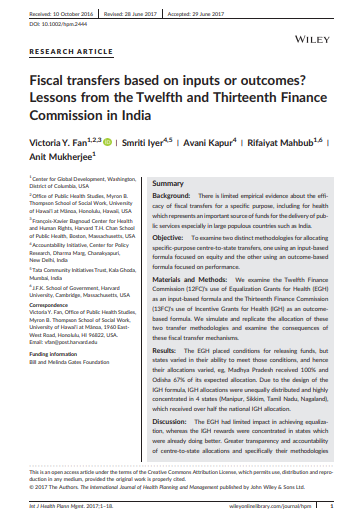
Fiscal Transfers based on Inputs or Outcomes? Lessons from the Twelfth and Thirteenth Finance Commission in India

There is limited empirical evidence about the efficacy of fiscal transfers for a specific purpose, including for health which represents an important source of funds for the delivery of public services especially in large populous countries such as India. The objective of this paper is to examine two distinct methodologies for allocating specific‐purpose centre‐to‐state transfers, one using an input‐based formula focused on equity and the other using an outcome‐based formula focused on performance.
Decentralisation, Governance and Development: An Indian Perspective

About the Book

India believed it could take development closer to its people, make the government more accountable, and empower women and oppressed communities through decentralisation—the provision of political and financial autonomy at the local level through the three-tier Panchayati Raj structure.

Fifteen years after the 73rd and 74th Amendments that brought in this innovation, what is the performance of the local government in India? Decentralisation, Governance and Development provides a comprehensive assessment that answers this question.

Drawing from the examples of the two states where decentralisation has been most successful—Kerala and West Bengal—this volume explores the causes and effects of failures in implementation and issues of governance. These essays by scholars from diverse disciplines, as well as policymakers and practitioners, will equip readers with both a theoretical understanding of the issues concerning local government, and the practical problems of designing and implementing policy framework in the field.

This book will be useful to students and scholars of development studies, economics, political science and sociology, and public servants and policymakers.

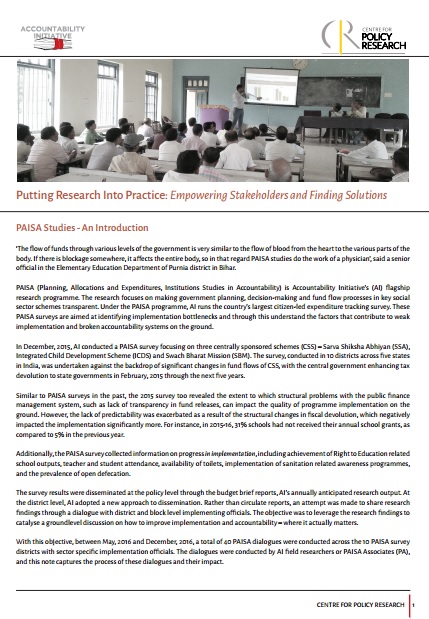
Putting Research Into Practice: Empowering Stakeholders and Finding Solutions

PAISA (Planning, Allocations and Expenditures, Institutions Studies in Accountability) is Accountability Initiative’s (AI) flagship research programme. The research focuses on making government process: planning, decision-making and fund flows in key social sector schemes transparent.

Under the PAISA programme, AI runs the country’s largest citizen-led expenditure tracking survey. In December, 2015, AI conducted a PAISA survey focusing on three centrally sponsored schemes (CSS) – Sarva Shiksha Abhiyan (SSA), Integrated Child Development Scheme (ICDS) and Swach Bharat Mission (SBM).

Between May, 2016 and December, 2016, the results of this survey were taken to frontline sector specific implementation officials. A total of 40 PAISA dialogues were conducted across the 10 PAISA survey districts with them. This note captures the process of these dialogues and their impact.