The budget is a vital tool to support the government in executing various programs and schemes in a methodical and strategic manner. Most importantly, it is the document that informs citizens of how taxes are collected and resources are prioritised and spent — how much and on what? But the process by which the budget is prepared and the details of the budget document itself, are not easily comprehensible.
Health budgets (or budget documents in general) have traditionally been viewed as an accounting or administrative document, instead of a strategic policy document. Now, there is growing recognition that many aspects of the budgeting process are deeply embedded in India’s health system performance. Yet India’s 29 health budgets (Government of India plus 28 states) are complex, varied, and poorly understood. Thus, there is value in enhancing our collective understanding of how health budgets are formulated, executed, and evaluated; and in describing the implications of budget processes and structures for undertaking policy-relevant analysis
The main objective of this primer is to offer the reader a way to understand and interpret India’s Union and state health budgets.

The 14th Finance Commission’s (FFC) recommendations, accepted by the Union Government in February 2015, set the stage for a radical overhaul of India’s fiscal architecture. The recommendations were designed to enhance fiscal autonomy of states by increasing the vertical tax devolution of the divisible pool of taxes from 32 per cent to 42 per cent. Consequently, the Ministry of Finance (MoF) allocated Rs. 5.24 lakh crore as tax devolution. This was significantly higher than the 2014-15 allocation of Rs.3.38 lakh crore (RE). This increase in devolution was accompanied by several changes in the mode of state transfers, including cuts in centrally sponsored schemes (CSS), the Union Government’s primary vehicle for financing social sector investments in the country.
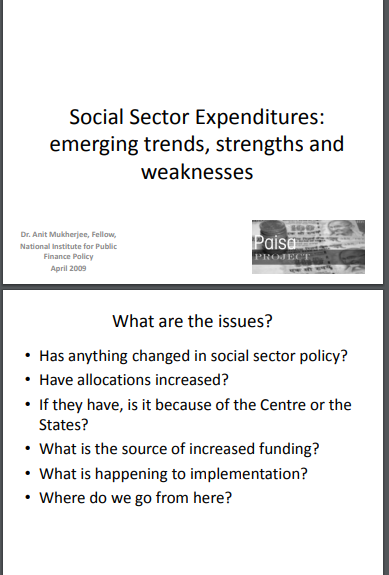
What are the implications of these changes? Did increased tax devolution result in enhancing the fiscal space available to states? Or was this offset by cuts in CSS and other grants? How have states responded to these changes? Have we seen any changes in the investment patterns of the states? Crucially, has the changed fiscal structure resulted in any visible shifts in social sector investments at the state level?
Based on an analysis of 19 state budgets, this brief presents a preliminary evaluation of the impact of the FFC recommendations on state finances and social sector expenditure.
This brief looks at the legislative framework pertaining to oversight agencies or Ombudsman in select Commonwealth countries such as Australia, New Zealand, Pakistan, South Africa and United Kingdom, whose mandate entails investigating complaints against administrative action of the government and its agencies.