In the 15 years that have gone by, India has seen a significant transition in the social sector, and lived through a pandemic. At the Accountability Initiative, Centre for Policy Research, we have tracked the provision of welfare services and entitlements since 2008, in-step with the country’s evolution over these years. The year 2023 marks a moment to pause and reflect for us as we celebrate our 15th anniversary, and the Centre for Policy Research reaches its milestone of 50 years.
But, aside from our legacy of evidence-based knowledge sharing, this reflection is important in one more way. In 2024, India will choose a new government. A lookback on welfare spending and outcomes is an essential first step to understanding future priorities and pathways to development.
Drawing from previous Union Budgets, this Special Brief will dive into six major aspects. Firstly, reviewing the sources of funding available with the government. Secondly, analysing trends in expenditures including social sector allocations for key ministries and schemes. Thirdly, the devolution of funds to states who are primary spenders on welfare services. Fourthly, unpacking social sector schemes over the years. Fifthly, analysing select outputs and outcomes over time. Lastly, we offer our own experience by providing a snapshot of the changes in government Management Information Systems which are critical to monitoring welfare schemes, among other aspects.
For the purpose of this Special Brief, we are covering the period from 2009-2023. Actual Government of India (GoI) expenditures have been used till Financial Year (FY) 2020-21. For FY 2021-22, figures are Revised Estimates (REs) and Budget Estimates (BEs) for FY 2022-23.

In Financial Year (FY) 2021-22, the Government of India (GoI) restructured the Integrated Child Development Services (ICDS), POSHAN (Prime Minister’s Overarching Scheme for Holistic Nourishment) Abhiyaan, and the Scheme for Adolescent Girls (SAG) into Mission Saksham Anganwadi and Poshan 2.0, also known as Poshan 2.0.
This brief uses government data to analyse:
■ Required funds, allocations, and releases;
■ Governance, including human resources;
■ Changes in coverage; and
■ Outcomes.
In Financial Year (FY) 2021-22, Government of India (GoI) restructured the Integrated Child Development Services (ICDS), POSHAN (Prime Minister’s Overarching Scheme for Holistic Nourishment) Abhiyaan, the Scheme for Adolescent Girls, and the National Creche Scheme into Saksham Anganwadi and POSHAN 2.0 to converge nutrition-related initiatives across ministries and strengthen outcomes.
Against the backdrop of the COVID-19 pandemic, this brief uses government data to analyse:
■ Required funds, allocations, and releases;
■ Changes in coverage and service delivery; and
■ Malnutrition status.

Integrated Child Development Services is Government of India’s (GoI’s) flagship programme aimed at providing basic education, health, and nutrition services for early childhood development. It has now been combined with POSHAN Abhiyaan to form Saksham Anganwadi and
POSHAN 2.0.
Against the backdrop of the COVID-19 pandemic, this brief uses government data to analyse:
■ Required funds, allocations, and releases;
■ Changes in coverage and service delivery due to the COVID-19
pandemic;
■ Human resources; and
■ Malnutrition status
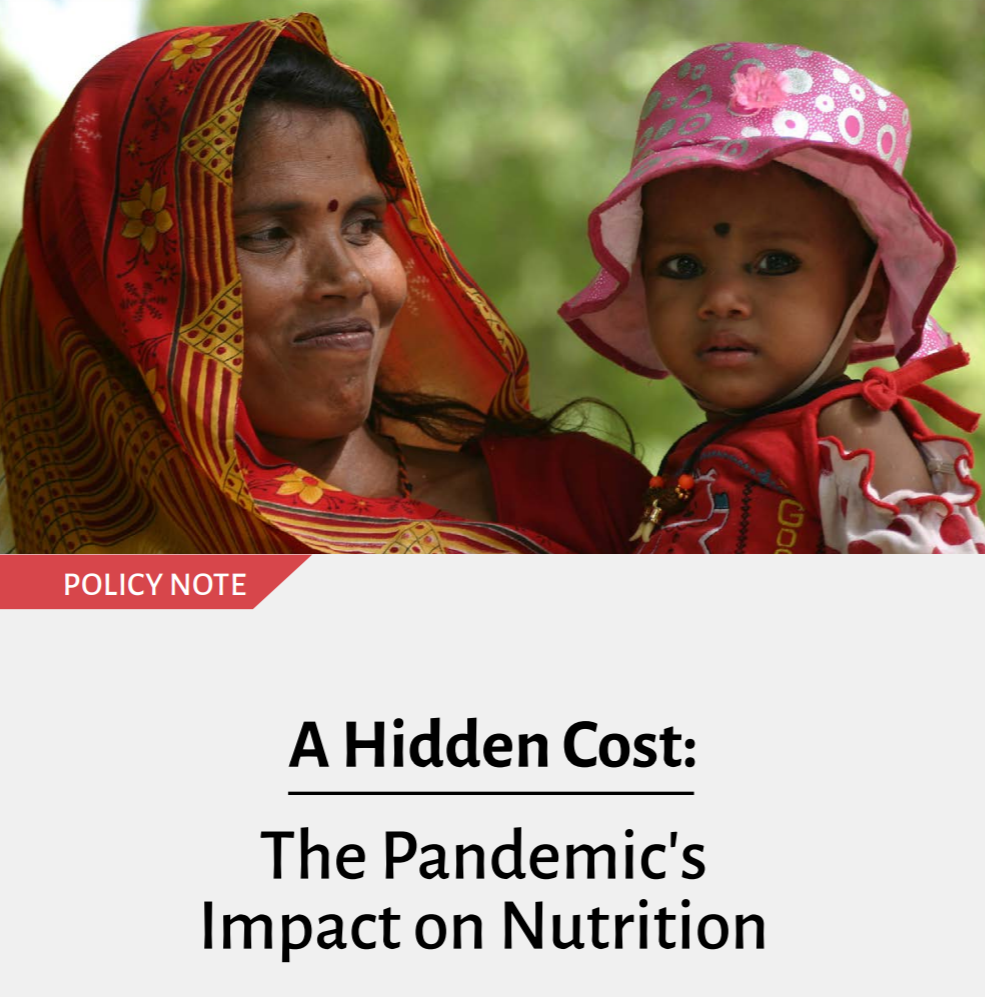
This brief provides an overview of the nutrition sector prior to the pandemic, the changes and impact due to the pandemic, and briefly discusses what can be done to get nutrition interventions back on track.
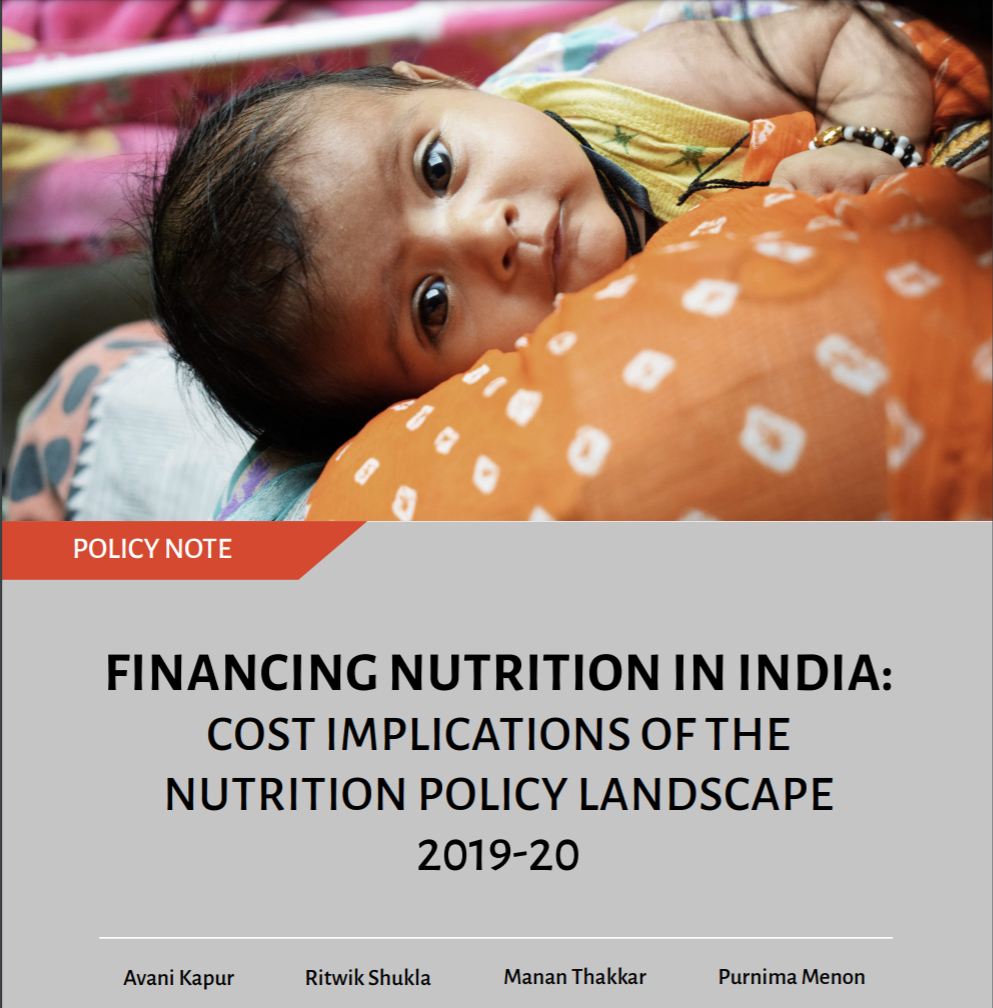
India should have spent at least ₹38,571 crore in 2019-20, across Union government ministries and State government departments to fully finance a set of core direct nutrition interventions (DNIs), at scale.
In this study, you will find information on nutrition costing. It carries forward critical studies that costed for nutrition interventions.
In recent years, we have seen positive developments in policy, funding and outcomes on child nutrition in India. Now, when the Covid-19 pandemic has placed a significant strain on our already vulnerable populations, it is time is institute a far more decentralised, agile and equitable nutrition financing architecture.

The Poshan Abhiyaan earlier known as the National Nutrition Mission is Government of India’s (GoI’s) flagship scheme that aims to holistically address the prevalence of malnutrition in India through the use of technology, convergence, behavioural change, training, and capacity building.
This brief uses government data to report on the following:
■ Trends in GoI allocations, releases and expenditures;
■ Trends in expenditure of selected individual components of Poshan Abhiyaan;
■ Trends in participation by gender and activities conducted under the Mission.

The National Health Mission (NHM) is Government of India’s (GoI’s) largest public health programme. It consists of two sub-missions:
■ National Rural Health Mission (NRHM), and
■ National Urban Health Mission (NUHM).
Using government data, this brief reports on:
■ GoI allocations and releases;
■ Incentives and penalties to states under conditionality framework;
■ NHM approvals and expenditures as per programmatic components; and
■ Outputs and outcomes.
The Integrated Child Development Services is Government of India’s (GoI’s) flagship programme aimed at providing basic education, health, and nutrition services for early childhood development.
This brief uses government data to analyse ICDS performance along the following parameters:
■ Allocations, releases, and expenditures,
■ Component-wise trends,
■ Human and physical resources,
■ Coverage, and
■ Malnutrition status.