India embodies many perplexing contradictions in development. A middle-income country with a powerful diplomatic and economic presence at the global level, and citizens in business, science, and the arts with world-class contributions, India is also home to more desperately poor people than all the nations of Sub-Saharan Africa combined. India also matters for global health, accounting for about a fifth of the global population and a fifth of the global disease burden too, much of it preventable. But the central government spends only 1 percent of gross domestic product (GDP) on health, over three-quarters of which is sub-national, raised and spent by states.
Health status, access, and care vary greatly across states, and the decentralization of health systems and spending to date has had at best mixed results. For many years, the Center for Global Development (CGD) in Washington, D.C., has worked on global health financing issues and—separately—has drawn out lessons that India teaches the world, and the Accountability Initiative at the Centre for Policy Research in New Delhi has promoted informed and accountable financing and expenditure in India itself.
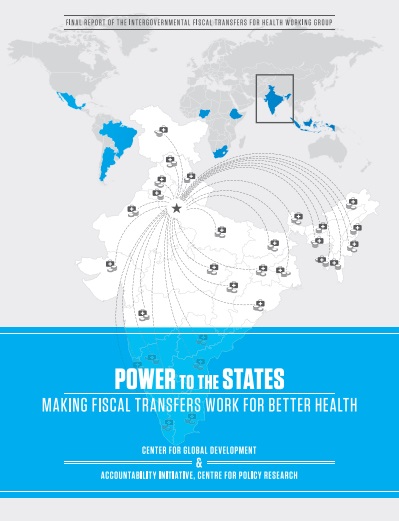
Now, we have partnered in a joint working group in one area that makes a difference for both organizations: how the relationship between the center and the state in a large federal country like India can be shaped in a way that is most likely to improve outcomes for people’s health. This working group report assesses past efforts to reform India’s fiscal and health policies and makes a set of actionable recommendations that may also be relevant to other countries and development partners facing similar challenges. The recommendations recognize that power and money in India have shifted to the states and that the center’s role should move away from direct service provision financing toward a focus on public goods and minimum guarantees in health—using the system of intergovernmental fiscal transfers as a lever and an enhanced set of data, research, and accountability mechanisms as enablers.
CGD and the Accountability Initiative are longtime advocates of outcomes-based approaches to improve the quality and local accountability of funding, such as through Cash on Delivery Aid, and that emphasis is reflected in this report as well. CGD and the Accountability Initiative will continue to monitor what the Indian Prime Minister, the Ministry of Finance, the National Institution for Transforming India Policy Commission (NITI Aayog), and the Ministry of Health do to move ahead on these recommendations, so crucial for building India’s leadership in global health. Each has a role to play but must first align on a vision where states are in the lead on service provision and the center uses its tools to enhance incentives for more rapid progress on health.