Mahatma Gandhi National Rural Employment Guarantee Scheme (MGNREGS), GOI, 2017-18

Mahatma Gandhi National Rural Employment Guarantee Scheme (MGNREGS) is the flagship rural employment scheme of the Government of India (GOI). It aims to provide 100 days of employment per rural household.

Using government reported data, this brief reports on:

  • Trends in allocations and expenditures
  • Trends in employment provided and wages paid
  • Coverage and participation

Mahatma Gandhi National Rural Employment Guarantee Scheme (MGNREGS)

Mahatma Gandhi National Rural Employment Guarantee Scheme (MGNREGS) is a flagship scheme of the Government of India (GoI) which aims to provide at least 100 days of guaranteed wage employment in a financial year (FY) to every rural household that demands work.

Using government reported data, this brief reports on :

■ Trends in allocations and expenditures

■ Trends in employment provided and wages paid

■ Coverage and participation

Pradhan Mantri Awaas Yojana – Gramin

Pradhan Mantri Awaas Yojana – Gramin (PMAY – G) is Government of India’s (GoI) flagship ‘Housing for All’ scheme. The scheme was launched in November 2016 and aims to provide monetary assistance for the construction of a pucca house with basic amenities to all rural houseless households and those living in dilapidated and kutcha houses.

Using government data, this brief reports on trends in PMAY-G along the following parameters:

■ Allocations, releases and expenditures

■ Beneficiary selection

■ Physical progress of house construction

■ Payments to beneficiaries

Decentralisation, Governance and Development: An Indian Perspective

About the Book

India believed it could take development closer to its people, make the government more accountable, and empower women and oppressed communities through decentralisation—the provision of political and financial autonomy at the local level through the three-tier Panchayati Raj structure.

Fifteen years after the 73rd and 74th Amendments that brought in this innovation, what is the performance of the local government in India? Decentralisation, Governance and Development provides a comprehensive assessment that answers this question.

Drawing from the examples of the two states where decentralisation has been most successful—Kerala and West Bengal—this volume explores the causes and effects of failures in implementation and issues of governance. These essays by scholars from diverse disciplines, as well as policymakers and practitioners, will equip readers with both a theoretical understanding of the issues concerning local government, and the practical problems of designing and implementing policy framework in the field.

This book will be useful to students and scholars of development studies, economics, political science and sociology, and public servants and policymakers.
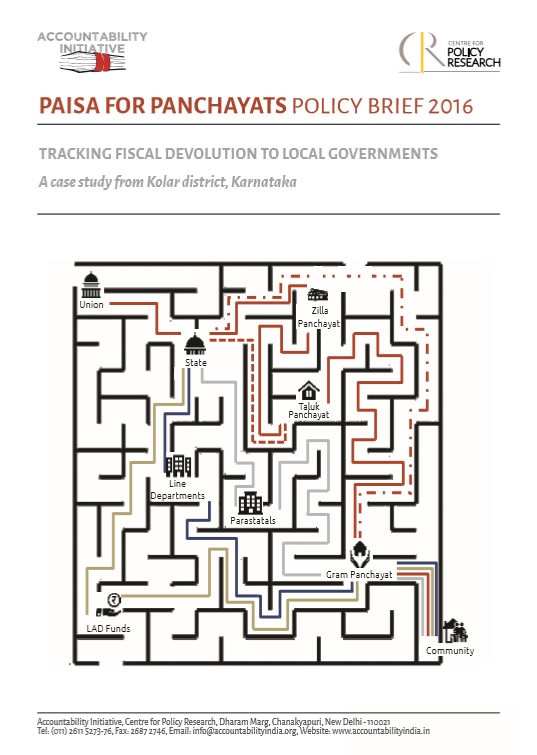
PAISA for Panchayats Policy Brief

The PAISA for Panchayats research project extends AI’s PAISA methodology to track fund flows and implementations processes at the Panchayat level. By focusing on understanding the state of fiscal devolution to rural local governments, this paper answers 2 key questions:

  • What are the overall trends in fiscal devolution to Panchayati Raj Institutions (PRI) in Karnataka?
  • How much money do Gram Panchayats actually receive?

To answer these questions we studied 30 Gram Panchayats (GP) in Mulbagal taluk, Kolar district, Karnataka. Our research shows that despite the State’s pioneering efforts in improving intergovernmental fiscal transfers, the system clearly falls short of the State’s vision for effective devolution to Panchayats. The 30 GPs in Mulbagal spent only 3 percent of all the money spent by the government within each GP’s jurisdiction. Not a single GP was aware of the nature or extent of expenditure made by other entities (like state line departments, parastatals, district and Taluk panchayats) in their jurisdiction. Further, these other entities do not track or maintain records of their fund flows at a GP level leading to inefficient expenditures which are non-transparent and non-accountable.

Based on our research, we recommend that the Karnataka Government make efforts to ensure there are no unfunded or overlapping (with other state bodies) mandates for panchayats and that their proportion of discretionary spending be increased. Also, as the old adage goes – What cannot be measured cannot be monitored. It is hence imperative to work towards creating and disseminating information on fund flows to relevant stakeholders through a holistic and open record keeping system that can measure in real time the allocations, releases and expenditure at a GP level.

Access the full report here.

PAISA for Panchayats Report

The PAISA for Panchayats research project extends Accountability Initiative’s PAISA methodology to track fund flows and implementations processes at the Panchayat level. By focusing on understanding the state of fiscal devolution to rural local governments, this paper answers 2 key questions:

  • What are the overall trends in fiscal devolution to Panchayati Raj Institutions (PRI) in Karnataka?
  • How much money do Gram Panchayats actually receive?

To answer these questions we studied 30 Gram Panchayats (GP) in Mulbagal taluk, Kolar district, Karnataka. Our research shows that despite the State’s pioneering efforts in improving intergovernmental fiscal transfers, the system clearly falls short of the State’s vision for effective devolution to Panchayats. The 30 GPs in Mulbagal spent only 3 percent of all the money spent by the government within each GP’s jurisdiction. Not a single GP was aware of the nature or extent of expenditure made by other entities (like state line departments, parastatals, district and Taluk panchayats) in their jurisdiction. Further, these other entities do not track or maintain records of their fund flows at a GP level leading to inefficient expenditures which are non-transparent and non-accountable.

Based on our research, we recommend that the Karnataka Government make efforts to ensure there are no unfunded or overlapping (with other state bodies) mandates for panchayats and that their proportion of discretionary spending be increased. Also, as the old adage goes – What cannot be measured cannot be monitored. It is hence imperative to work towards creating and disseminating information on fund flows to relevant stakeholders through a holistic and open record keeping system that can measure in real time the allocations, releases and expenditure at a GP level.

To access data sheets used for the study click here. 

Rural Local Body Core Functions and Finances

In 2013-14, Accountability Initiative(AI) was tasked by the Fourteenth Central 14th Finance Commission (FFC) to examine several aspects of the structure of devolution of powers, responsibilities and finances by states to rural local bodies (RLBs), based on the data provided by them to the FFC. Our study covered all decentralization models, namely, the panchayat system, the extension of the panchayat system to the 5th Scheduled Areas, Autonomous District Councils under the Sixth Schedule and other state specific arrangements.

While ascertaining the status of actual devolution of tasks and responsibilities relating to the basic civic functions of water supply, sanitation, solid waste management, drainage, roads, streetlights, community assets such as parks, burial and cremation grounds, and other means of communication such as waterways to rural local bodies, it was discovered that most states had legally endowed village level RLBs such as Gram Panchayats with regulatory and implementation powers to provide core public services. However, wide variations existed between states in the range of powers devolved upon intermediate and district level RLBs, with some states narrowing their ambit to merely undertake planning or providing advice.

The report analyses the fiscal transfers from states to RLBs by studying the frameworks governing them, and assesses the strength of the systems of public financial accountability applicable to RLBs. It particularly looks at whether states subsumed earlier Central Finance Commission grants into their own state level transfers or treated these as additional grants; an important input for the FFC. Trends, performance and efficiency of all RLB revenue sources (Tax and non-tax revenues, and transfers from State and Central governments) were analysed by looking at the financial flow data provided by states. Trends of expenditure incurred by RLBs on core functions-were covered in detail in the study of their finances.

The study was hampered by inconsistent and incomplete data received from states, in spite of follow ups alongside the FFC staff. Though the researchers attempted to check the data for consistency and normalize it, in the case of some states, regular procedures could not be followed and the data considered the most consistent was studied.

The report estimates the gap in resources for delivering core services by RLBs for 2015-2020, using benchmarks set by the state and the union Government. It ends with AI’s suggestions on strategy options, including tax and non-tax measures, for bridging the gap between core function expenditure needs and available revenues. The suggestions include that a greater proportion of central grants and shares of buoyant state and central revenues ought to be provided to RLBs, so that they can close the fiscal gap and provide local core services that meet benchmarked standards. Concurrently, local revenue collection must be incentivised. In particular, property taxes remain largely untapped by RLBs.

AI’s report was a critical input that was relied upon by the FFC to recommend increasing the amounts allocated to local governments from the divisible pool of taxes from Rs. 86161 crore to Rs. 287436 crore, an increase of 234 percent over the grants recommended by the 13th FC. This amounts to a 344 percent increase in the allocation of basic grants, from Rs. 56335 crore to Rs. 249978 crore. In the case of performance grants, which, as a proportion of the total grants has been brought down to 10 percent and 20 percent in the case of rural local governments and urban local governments respectively, the increase is relatively modest; from Rs. 29826 crore to Rs. 37458 crore. All in all, this amounts to an increase in the FFC grant to local governments, from 2.28 percent to 4 percent of the central divisible pool of taxes. This is big money, translating at the Gram Panchayat level for instance, to an increase from Rs. 5 lakhs to Rs. 25 lakhs per year, depending upon the size of the Panchayat concerned.

Do GPs get their money?

A Case Study of Gram Panchayat Fund Flows in Birbhum District, West Bengal

Analytical studies on rural local government finance are few and far between in India. The paucity of reliable data and the lack of transparency in Panchayat finances and associated difficulties in accessing data are important reasons for this. These data gaps are well known and successive Finance Commissions have highlighted this problem with little effect. This PAISA Gram Panchayat (GP) study: ‘Do Gram Panchayats Get Their Money?’ is a small step towards filling this analytical gap. This study analyzes GP level finances in Birbhum district of West Bengal by asking the following questions

  • Do GP’s get their money?
  • If so, do GP’s get all their money? i.e. their entire entitlement?
  • When do GP’s receive their funds? i.e. do funds arrive on time?
  • Do GP’s spend their money?
  • If so, what do GP’s spend their money on? And does this expenditure reflect local needs and priorities?

This PAISA study investigates these questions in the context of untied funds– funds that do not impose any specific rules regarding their utilization on the spending agency. Untied funds typically constitute less than 10% of a GP’s resource pool, but are significant because they have the potential to enable GPs to prioritize activities that reflect local needs and preferences.

The study tracks the fund flow process and expenditures incurred through 3 untied funds in a sample of 20 GPs in Birbhum district over a 5 year period from 2005-06 to 2009-10. In addition, it tracksthe receipt of SRD funds at the GP level. As a point of comparison, the study also tracks receipts and expenditures of tied funds – funds which are to be utilised strictly as per the rules or guidelines framed by the Central or State government, and thus, provides no flexibility to GPs.

Administrative Decentralisation in India – The 3Fs

In 1992, the Government of India passed the 73rdand 74th amendments to adopt a decentralised model of governance.The Panchayat Briefs series examines the impact of these reforms in the context of new research on decentralisation in India. The second in this series examines the state of administrative decentralisation in India and the extent to which states have devolved the 3F’s (functions, funds and functionaries) to Panchayats