
The Right to Health is a Crucial Step to Achieving Universal Health Care

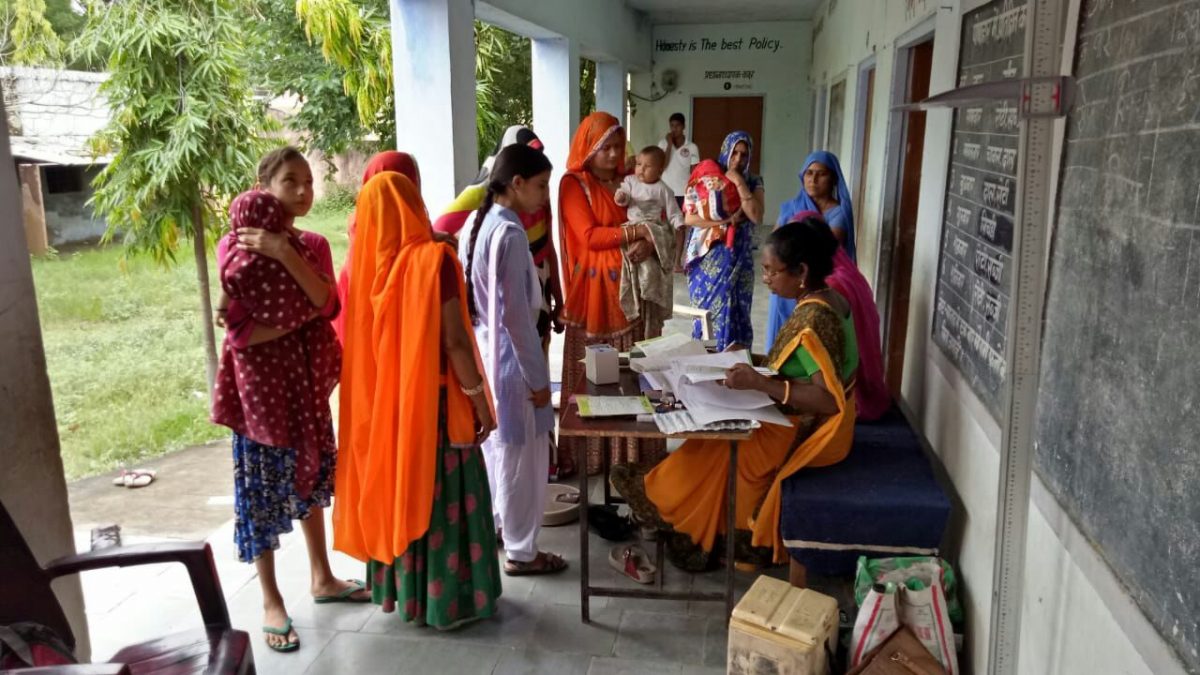
The Government of India has committed to Universal health care multiple times. With the launch of several schemes like the Pradhan Mantri Jan Arogya Yojana (PMJAY), this commitment has been given tangible form. In its election manifesto for the 2019 Indian elections, the Congress promised to enact a Right to Healthcare Act to guarantee every citizen the right to health care services if they won. This was to cover free diagnostics, out-patient care, medicines and hospitalisation through a network of public hospitals and enlisted private hospitals – similar to PMJAY. Clearly, the government in power and the opposition believe that health care is important.

Several declarations have been made about increasing spending, to no avail – the government has been spending around 1.5 per cent of GDP on health, a far cry from what is required. Higher spending isn’t a panacea, but it is a necessary condition to build adequate health infrastructure. This might include more health facilities in places where people need them the most. According to the World Bank, otherwise poor performing sub-Saharan African countries spend twice the proportion of their GDP than India does. Countries outside South Asia spend a higher proportion of their GDP than India, highlighting how India lags behind in terms of spending.

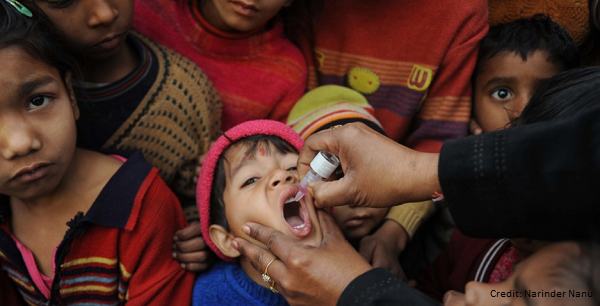
Consequently, India is one of the worst performers in health outcomes, globally. India’s public health system is paralysed which has led to citizens (both rich and poor) preferring private health care. The costs of health care have been pushed on to individuals and families, which has added to the uncertainty in the lives of the marginalised and in an unequal country, leaving people in a precarious position.

In this context, the fundamental question is: What is the right to health and can making health care a right, push governments to spend more and work towards better outcomes?

What is the right to health?

The right to health is inclusive, and goes beyond merely providing access to health facilities. It includes things like safe drinking water, adequate nutrition, housing, safe environmental conditions, among others. It entails freedom for individuals, such as the right to be free from non-consensual medical treatment (experiments, forced sterilisation, etc.) and from degrading treatment. Furthermore, it contains entitlements including the right to a system of health protection, providing all residents access to essential medicines, basic health services, and related information. Lastly, the right to health should be guaranteed to all socioeconomic groups without discrimination.

The United Nations and WHO define the right to health as the right to the enjoyment of the highest attainable standard of physical and mental health.

How can passing the right to health improve outcomes in India?

Making health a basic right with constitutional backing changes things significantly. Firstly, the government’s priorities change. Enforcing the right to health will require governments to spend a substantial amount on building basic health care facilities. At the moment, the government is not mandated to spend heavily on health – there is no law stating that the government must spend a certain amount on health every year. However, making it a right can bring about the requisite change. The passing of the Right to Education with well-defined norms regarding the distance of a school from habitations, for instance, pushed governments to build more schools in areas that lacked them. Perhaps we can expect something similar on health at the centre and state levels.

Secondly, instituting the right to health locks in multiple governments to the same objective. Governments often avoid planning over a longer time horizon. If the outcome to a project or scheme is only realised after the next round of elections occur, then the government cannot use its work to campaign and get re-elected. Therefore, governments focus on delivering services and schemes that can be completed before the next round of elections. Furthermore, different governments have different campaign promises and priorities. The government today may want to focus on health, but the next government may be more concerned with business and foreign investment. This difference may arise across time, such as the government today and the government tomorrow, or across levels in the same year, such as the central and state governments. However, making health a basic right will guarantee that all governments across levels and time periods have to prioritise health in the short and long-run.

Thirdly, well-defined norms on the right to health will set benchmarks against which the government can be held accountable. This can take the form of clear rules about who is eligible for services, the time period in which the service is to be provided, the minimum quality of that service, among others. In the absence of clear expectations of the government, people are unsure about what to demand as entitlements. However, with clear rules, people know exactly what the government should provide, and can make very specific demands. Constitutional authority backing the right to health will ensure that governments have to deliver.

The right to health care is distinct from the right to health: the latter is wider in scope and definition, while the former focusses strictly on providing certain health services like hospitalisation.

Fourth, the right to health can allow the most marginalised in the country to access health care without falling into heavy debt. The right to health would place obligations on the government, leading to an expansion of public health centres and facilities. By targeting aspects like quality, the right to health could also bring about stricter regulatory practices for both public and private health providers. Good health is a public good – if there are unhealthier people are in an area, the likelihood of diseases spreading increases as well. Therefore, maximum coverage is necessary, and can be brought about by the right to health which focusses on inclusion.

Commitments about universal health care sound great, and are necessary but must be backed by serious legislation. Achieving universal health care is ambitious, and therefore requires a concrete platform and framework from which to build on – something that a well-designed and clearly articulated right to health can provide.

About the Writer

Ritwik is a Research Associate at Accountability Initiative.

The views expressed do not represent an institutional stand. 

A Case Study on Reducing Over-the-Counter Corruption

In my last blog, I wrote about Klitgaard’s formula, C=M+D-A, in which the pathway to eliminate corruption becomes evident. If Monopolies are dismantled and discretion is reduced, while increasing accountability, corruption will come down. But in practical terms, even if such moves are made through policy, if citizens do not seek recourse to them and insist upon their rights to obtain corruption free services, corruption will persist.

A few years back, while working with ipaidabribe.com, I led a team that undertook research into corruption prone government processes. One of the most corruption prone was the registration of flats and land sales. Sub-Registrar offices in Bengaluru city were cited by citizens through their experiences filed on ipaidabribe.com, as a place where corruption was inevitable. This happened in spite of these offices being digitised through a software suite known as ‘Kaveri’. The problem was that the software digitised the functioning of the sub-Registrar’s offices, but did not take away either the monopoly character of these offices nor reduce the discretion of the officers to deal with the public.

Sub-Registrar offices were service area monopolies; with each office having a footprint jurisdiction. All owners of properties within each such area had to come to the sub-Registrar having the jurisdiction over it, in order to register sale deeds. In spite of this dismal picture, the department had undertaken some reforms to put it on the path to reducing and finally eliminating corruption, even if milestones and targets for the implementation of these reforms were not met. The details of the reforms that aimed to reduce the scope for corruption were:

  • A reduction of the registration fee to 6 per cent along with the introduction of fixed area wise guidance values – which means that regardless of the value on the sale deed, one has to pay the stamp duty as per the guidance value (or the sale deed value, whichever is higher). This, at least on paper, diminished the discretion of the sub-Registrar to refuse a registration on the ground of undervaluation.


  • E-stamping of stamp papers which enabled selected Bank outlets to stamp the appropriate  stamp  value  on  any  plain  paper,  while  collecting  the  stamp  fee, reduced the scope for delays in registration because payments of stamp fee through cheque had to wait for the cheque to be cleared.


  • Increase in the number of sub-Registrar’s offices (in Bengaluru from just 12, to more than 50) reduced the pressure and rush in these offices; while also decentralised corruption, perhaps.


  • Bringing registration services under the Right to Services Act brought in a legal obligation upon the sub-Registrar to complete any sale transaction in 2 hours 20 minutes; i.e., 20 minutes to verify the market value of property, 1 hour for preliminary scrutiny of documents and 1 hour for admission of documents and recording signatures.


Yet corruption happened, because in practice citizens were still overawed and submissive when they went to the sub-Registrar’s office. Many of them passively submitted to corruption out of nervousness and a misplaced sense of fear. Purchase of immovable properties is for most people, a once-in-a-lifetime activity and therefore they do not want any ‘trouble’.  They  blindly  take  the  advice  of  touts  and  middlemen  and  are  willing  to  pay  a ‘facilitation charge’ rather than fight corruption. To cure these, ipaidabribe.com made a few suggestions, based upon a practical application of Klitgaard’s formula.

Also read: Brokering Public Service Delivery in Delhi

We first suggested that the department introduce the system of ‘Anytime-Anywhere’ registration. Under this system, a citizen should be able to go to any location in the city to register a property. This will reduce the service area monopoly of the offices and give a choice to all citizens to go to more efficient offices. We also felt that such an approach would incentivise officials to improve the service delivered  by  their  offices  and  bring  about  a  sense  of  competition  amongst  them.  In other words, we aimed to reduce the value of ‘M’, in Klitgaard’s formula.

We also suggested that there should be no discretion given to the department to make citizens wait. Every day, each office should make available clear time slots for registration of properties. Citizens should be able to go onto the website and choose the time slots on their own. Once the time slot is chosen by the citizen and he/she turns up at the given time in the sub-Registrar’s office, they must have no discretion. They must register the property. If there is any hurry for some reason, then there should be a tatkal system by which citizens can jump the queue (like in the passports and railway ticketing systems). In other words, we aimed to reduce the value of ‘D’ in Klitgaard’s formula.


Corruption happened, because in practice citizens were still overawed and submissive when they went to the sub-Registrar’s office.


As to increasing accountability, we felt that in spite of the stipulations in the Right to Services Act to complete registration within a specified, committed period of time, this by itself does not make registration  any less complex,  time  consuming  and  cumbersome than before. We suggested that some of the processes that are now done in the sub-Registrar’s office can be done online, prior to the actual registration. For instance, standard sale formats can be made available on the website, which  people can  download and use to prepare their sale deeds themselves. Second, photographs of the parties can be taken in advance and sent online to the office, at the stage of taking the appointment for the registration.  The preparation of the sale deed and photography online will reduce the time spent by citizens in the registration office. The less time an individual spends in a government office, the less the chance of corruption, we felt.

We also suggested other measures for increasing transparency, such as displaying the guidance values on maps so that citizens can understand   them easily and make use of them while calculating the stamp duty to be  paid, and proper signage and displays.

However, these suggestions, even if implemented would not have worked, in retrospect. We discovered another pernicious problem that went beyond the simple edict of the Klitgaard formula; a private-public partnership in corruption. More on that in my next blog.

This blog is part of a series. The first blog can be found here.

Brokering Public Service Delivery in Delhi

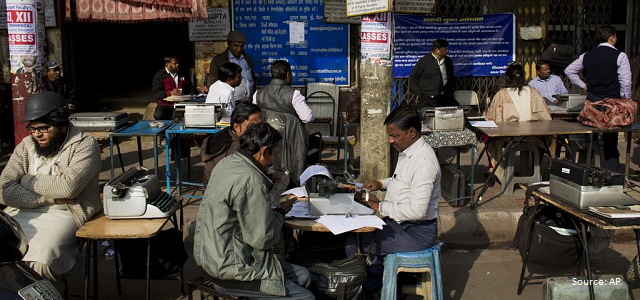
Informal mediation peopled by brokers, touts, middlemen has over the years embedded itself within public service delivery. Even as they are not within the government system, brokers have come to play an important role, and have reshaped it. The Municipality of Delhi is no exception. Who are these people, and how do broker practices impact governance?

I met Pankaj Sharma, 36, while researching a paper on informal institutions. For the past 15 years, he has been assisting people to complete their documentation for any work they may have at the zonal office of NDMC in Karol Bagh, a popular locality in the national capital. He is not employed by the government, and carries out his business sitting on a boulder or under a tree. He likes to be known as a Consultant, but came into this line of work by accident as a result of unemployment. A literate man, he started helping out an influx of people filing applications after a change in property tax norms in Delhi in the early 2000s.

“It was during that time that my friend asked me to come and help on these property tax applications for people i.e. filling the form, calculations and preparing paperwork, and we made a good Rs. 100 for every case,” he says. Pawan gradually gained familiarity with other government departments and operations, and became a viable bridge for citizens who came to the NDMC zonal office in Karol Bagh for any service.Sharma is part of a network of informal governance systems. The need for bureaucratic mediation such as his emerges due to monopolisation and weak accountability of institutions. Such weakness perpetuates the existence of ‘windows of opportunity’.

In simple words, brokers exist not just because of citizen demand, but also because of a system in which government service delivery cannot be easily held accountable by ordinary citizens.

Driven mainly by patronage networks, brokers, fixers or touts behave as ‘gatekeepers’. They may block or expedite access to public services based on the payment of a fee based on his/her special position as an access provider (Kumar & Landy, 2012: 130-131). Brokers and other such informal networks effect a new understanding amongst citizens seeking to make use of public services – that services are out of reach for citizens if not for them.

With respect to the citizen services at South and North Municipalities of Delhi, service seekers had trouble finding their way in the maze of departments, and thus preferred approaching the broker sitting outside to optimise their use of time (based on quantitative survey of service seekers) at a nominal fee. The officers within the institutions viewed these brokers as a complementary part of service delivery. The brokers themselves however felt that they should be institutionalised as service partners due to the high volume of services seekers, usual technical glitches, steep learning curve for officials to keep up with systemic interventions, and the general acceptability of the public as long as they don’t feel harassed by them.

The three perspectives point to a gap in the accountability of service providers to citizens, and the attempt of citizens to question the former on deficient or delayed service delivery.

The Helmke & Levitsky (table below) framework offers an understanding of the linkage between informal institutions and formal government systems.

The typology provided by Helmke and Levitsky (2004: 728) is based on the outcomes of informal rules and effectiveness of the formal rules in a given context. The outcome variables dictate whether the result of these rules are in line or against what one may expect from strict adherence of formal rules. The effectiveness variable on the other hand is the extent to which the formal rules are realised in practice. It is understood that, where the rules and procedures are ineffective, the probability of enforcement will be low (Helmke and Levitsky, 2004: 728).

The study findings based upon service-seeker surveys & interviews confirmed a direct dependence on these brokers outside any and every municipal office in New Delhi. A sample of 30 service seekers across two municipal zone offices conveyed that 80% of them usually approached brokers to speed up the process of their work at a minimal fee irrespective of their economic status. While the less educated clients seemed more vulnerable to exploitation, the educated, upper class clients too waited for their turns for calculation of property tax, if not for arrangement of paperwork to obtain birth/death certificate. When the corresponding public official was asked about a possible institutionalisation of these service providers, it was an easy ‘no’ considering there was no incentive to engage in process reformation, unless nudged by the concerned administrative reforms department.

“It could be you helping them (service seekers) out with paperwork, at a fee or not is none of our concern. In my opinion we are well equipped to serve everyone who come work any work and if these people (brokers) think they can expedite their job, and if the clients engage, it is their choice. I still don’t think there is any mistrust or capacity issue” – A health official, Zonal Office, North Delhi Municipal Corporation

In my research, the modus operandi of broker-led governance was further mapped against the recent doorstep delivery of public services policy initiated by the Government of NCT of Delhi (GNCTD) to understand the inherent complexities in the system of delivery of public services. The doorstep delivery of public services was a set-up where mediation was institutionalised as part of the system to prevent exploitation of service seekers by the brokers, who established ‘temporary power centres’ (Media reports in 2017-18).

The study further triangulated effects of  patronage-led mediated governance on how current practices fare along the good governance principles of state’s accountability, transparency, effectiveness and efficiency (UNESCAP: 1 & Gisselquist, 2012). Mediated governance has no accountability to its users but brokers are usually risk averse and efficient in delivering services to ensure the leverage of positive marketing and maintaining their space in the ‘mediation market’.

In other words, the system is far from being transparent as nobody knows the legitimacy of the means used by fixers. The mediation of public services may well be offering services to citizens at a price in the short-term, but it is a larger reflection of the lack of capacity, complacency and poor design of service delivery systems in the long-run.

References

Gisselquist, R.M. (2012) Good Governance as a Concept, and Why this Matters for Development Policy. WIDER Working Paper

Gupta, A., 2012. Red tape: Bureaucracy, structural violence, and poverty in India. Duke University Press.

Helmke, G. and S. Levitsky (2004) ‘Informal Institutions and Comparative Poli-tics: A Research Agenda’, Perspectives on politics 2(4): 725-740

Kumar, G. and F. Landy (2012) ‘Vertical Governance: Brokerage, Patronage and Corruption in Indian Metropolises’, ‘Vertical Governance: Brokerage, Patronage and Corruption in Indian Metropolises’, Governing India’s Metropolises, pp. 127-154. Routledge India

About the Writer

Sushant is a Senior Programme Officer at Accountability Initiative.

How to Control Over-the-Counter Corruption

One of the best known simple remedies for corruption has been provided by Robert Klitgaard, an academic and researcher who familiarised himself with how corruption operates in a variety of environments. He made the observation that corruption follows a formula – C equals M plus D, minus A; Corruption equals Monopoly plus Discretion, minus Accountability.

A look at the Klitgaard formula shows that the strategies for reducing corruption are self-evident. Reduce monopoly and discretion, increase accountability, and corruption will decrease.

Do these strategies work in real life? Perhaps in a text-book fashion, when it comes to over the counter or service delivery corruption. While many of the services offered by the government look at first sight to be natural monopolies, it is not beyond the realm of possibility that they can be demonopolised. For instance, telephony services used to be for long a natural monopoly. Only the government offered it. There were long waiting periods and bribery, even though it was of a low order, was widespread. Influence was used for people to jump the queue and linemen were tipped generously to keep the lines in order. Then came the technology revolution of mobile telephony and the monopoly of the government service provider was blown away.

Today, corruption is unknown in the interphase between the citizen and the mobile service provider. The relationship is ruthlessly market driven; citizens have a choice between service providers and that change in the relationship makes corruption impossible at the citizen interphase.

In contrast, one has to only look at the electricity supply or water supply system, which is both networked services that are not yet fully demonopolised. While in the power sector, it is possible for consumers, particularly bulk consumers to have private power supply contracts with generators, the wires that transmit this power is in the hands of a natural monopoly. Most private consumers of power have no choice but to obtain power from the distribution company, which, even if privatised, is a service area monopoly.

Accountability is strengthened only when citizens have stronger rights to demand services and appeal to authorities higher up, in case the service provider does not deliver.

The service area monopoly characteristic of the water supply system is even more markedly a natural monopoly. One does not have a choice of buying water from multiple suppliers, unless one orders water supply by tanker. The pipeline and the water source are both controlled and operated by the same natural monopoly; the water utility concerned. It is therefore no accident that both the electricity supply and water supply systems are corruption prone at the citizens’ interphase. One has to pay bribes for obtaining connections, converting the connection from a temporary one to a permanent one, transferring a connection to another consumer, closing a connection, or increasing the authorised load attached to a connection.

Can such natural monopolies be demonopolised? Yes, of course. If tomorrow technological advances enable electricity to be produced at the consuming point, say by highly decentralised methods such as solar generation, fuel cells or wind energy, then there will be no need for transmission wires. All the corruption associated with the running of the natural monopoly of the wires, will wither away.

Yet, not all service delivery monopolies can be demonopolised. In such cases, doing away with the wide discretion that is available with service delivery providers can reduce corruption dramatically. Ticketing is one area where this approach has worked. Prior to online ticketing being the norm, buying a railway ticket, particularly for long distance travel was a harrowing experience. People hired agents and paid them a commission to have their tickets booked, because they saw the convenience in this approach. The agent knew how to handle the clerk at the counter, or her boss, in order to ensure that tickets were available. Now, with online booking, there is no need for an agent, or the necessity to meet and deal with a clerk who has the discretion to deny or delay your ticket.

Examples abound of services that have rapidly become relatively corruption free, due to the reduction of discretion vested in government officials. Taxation is an area where there has been a great deal of reforms. For the ordinary citizen at least, online filing of returns and supporting documents, followed by automatic examination and refunds if any, flowing directly to their accounts, has reduced the possibility of corruption to a great extent by eliminating interaction with officials, with respect to these transactions.

However, there are many services where neither is it possible for the monopoly character to be reduced, nor is it advisable for discretion vested in an official to be removed completely. In such cases, the best way to reduce corruption is greater vigilance, transparency and oversight. Accountability systems work effectively only when there is a modicum of punishment that befalls the one who transgresses the rules. Furthermore, accountability is strengthened only when citizens have stronger rights to demand services and appeal to authorities higher up, in case the service provider does not deliver.

There are many reforms that have been introduced to increase accountability; they range from making the entitlements of citizens to receive services in a timely fashion legally enforceable, through right to services laws, to mandating transparency with respect to where the service application is pending in the government. The appointment of higher level bodies tasked with dealing with public grievances is also a way of ensuring that accountability systems become stronger.

Do these strategies work automatically, once they are put in place? Obviously they don’t. The onus is still on citizens to make use of these instruments to demand their right to receiving over the counter services without corruption.

In next week’s blog, I will examine case studies where corruption was reduced through intelligent application of Klitgaard’s formula. I will also look at systems where efforts to reduce over the counter corruption did not bear fruit, and other problems were thrown up, as a result.

This blog is part of a series. The first blog can be found here.

Corruption, Hardly ‘Petty’

The daily experiences of corruption that people suffer in their transactions with the government, is often termed ‘Petty’ corruption. It is anything but that. While each bribe, in relative terms may be a small amount, the multitude of such transactions that happen daily results in a huge transfer of financial resources to a few frontline service providers who are the face of the government, as far as the large majority of the people are concerned.

Many departments offer government services ranging from certification, licencing, collection of bills, disbursal of subsidies, registering of complaints, redressal of grievances and so on, to ordinary people. Many of these services are in the nature of natural monopolies, none other than the government is authorised to deliver them. Many of these services are based on convoluted rules that mandate multiple back end transactions, each one of which is an alibi for the demanding and collection of bribes.

The table below gives a list, by no means a comprehensive one, of bribe prone services and transactions pertaining to a list of typical departments that operate in a city. The nature of the reason for the collection of a bribe are also listed.

Click for table

Why do these bribes get paid? It ultimately boils down to citizen subjugation. When citizens do not demand public services as their entitlements and look upon them as favours dispensed from above, the tendency is for such forms of corruption to persist.

Considering the persistent nature of such forms of corruption, there is a strong school of thought that believes not only that such corruption is incurable, but that it is even beneficial in the short run, because it enables a modicum of service delivery to continue and flourish. That is a fallacy.

Pernicious petty corruption destroys the national character. As citizens face corruption at every step in their daily lives, they cultivate passive acceptance as a survival strategy. This even evolves into a perverted justification of corruption as an essential thing; something necessary to keep the wheels of the economy moving. This attitude destroys the quality of citizenship. People who tolerate corruption also tolerate injustice. They accept bad quality of government services. They look away when their environment is plundered. They tolerate, even collaborate, in the debilitating of a nation.

Thus the tackling of petty corruption is not merely a way of making services cheaper in real terms to citizens, it is a very important step in building our national character. How can citizens, both as a group and as individuals become intolerant of corruption and be able to successfully resist demands for bribes? More of that, in my next blog.

The first part of this blog series can be found here.

A Taxonomy of Corruption

Like diseases and pathogens, it is essential that various types of corruption are identified and classified, based on their characteristics. The analogy with medical care goes further, because different types of corruption require different strategies – medications – for being effectively curbed and controlled, if not eliminated altogether. Several authorities have classified corruption based on appropriate criteria, such as who they impact, what processes they affect and how they may be best tackled. A simple classification is based upon a combination of these criteria and a good place to start is to separate acts of corruption into those that primarily affect state actions and those that affect the private sector. Of course, this is not a neat, water tight separation – plenty of corruption involves the interphase between the government and private corporate or professional entities; I shall explore these in greater detail in future blogs.

Let us look at public sector corruption at first. The most common experiences of corruption are those that concern the daily transactions that a citizen may engage with the government. For example, certification and identification services and licencing. The ordinary citizen requires several certifications at different stages in their lives. Birth, death and life certificates come readily to mind. Then there are others too, like caste certificates, residence certificates and domicile certificates, those that certify that a person is not insolvent such as income certificates, insolvency certificates, or that properties are not subject to any encumbrances or that a particular individual has a greater claim to properties, through a succession certificate.

The variety of certificates that an individual may require, certainly in a procedure gridlocked country such as India, may exceed more than 50, over any individual’s life span ranging from those that certify a certain status or identity, like a driving licence, a passport, a ration card, to licencing services concern the permissions that an individual may require to undertake certain actions, such as constructing a house, or commencing a business.

Clearances may be required from various departments, such as the Pollution Control Board, the Municipality, power utility, water utility and so on, before someone starts a new business venture. Government also delivers many services, such as food rations at subsidised prices, education, nutrition and protection. Accessing these services, say, to obtain admission in a school run by the government, or filing a police complaint or reporting a crime is a transaction that can be prone to corruption.

The second kind of corruption touches the procurement actions of the government. The government is typically the largest buyer in the market; procuring a spectrum of products and services ranging from paper clips to dam building contracts, from fighter aircraft to road laying contracts. Typically, these transactions, if corrupt, can increase the burden on the taxpayer’s money, but this is not something that an individual will experience first hand, unlike say the obtaining of a certificate or the issue of a licence. Procurement corruption requires an entirely different strategy on their control.

The third kind of transaction that may be corruption prone is the converse of procurement transactions; namely, when the government sells goods and services. These also cover a wide range of scale and value. The government sells waste paper for recycling and also bandwidth on the airwaves for mobile telephony. Mining rights are sold, so also electricity, tourist locations, government land, and such like. Again, corruption related to these transactions do not affect citizens directly, but short selling by the government of assets such as mineral resources, or air waves, can seriously compromise citizen interest.

The fourth kind of corruption involves the regulatory activities of the government. Gone are the days when only the judicial arm of the government dealt with the settlement of disputes. A plethora of generalist and specialist regulatory authorities now adjudicate in issues and disputes relating to various transactions, whether it is delay in obtaining a service, filing an application for admission to a school under the Right to Education Act, disputes relating to tariff fixation for power supply, insurance related disputes, house dwelling related conflicts, and matters of domestic relevance such as marriage, divorce, inheritance and succession.

A fifth kind of corruption concerns the political arena. These do not necessarily fall squarely in the domain of the public sphere, but nevertheless, in a democracy, can seriously undermine the setting and execution of policy. That in turn leads to corruption that is so large, overarching and yet nebulous – the corruption that relates to matters concerning the nation as a whole, a kind of corruption that is a mélange of all other forms of corruption; namely, Policy Corruption and State Capture.

Each one of these forms of corruption requires a different approach to be tackled effectively. In my next blog I attempt to explore the phenomenon of over the counter corruption, which touches many aspects of service delivery. This is what citizens see the most, and tackling this form of corruption is often what sets citizens perceptions on how best corruption can be controlled.

The first part of this blog series can be found here.

Where do we Stand on Corruption?

As voting begins for a fractious and keenly contested election to the next Lok Sabha, the three ‘C’s that dog India’s political and social milieu, Caste, Communalism and Corruption, again take centre stage. Political debates have raged around these issues with all parties accusing the others of not doing enough to address them, and also of actively promoting and exacerbating the problems associated with each one of these. When it comes to corruption, we have seen the Prime Minister taking this as the centre point of his campaign, asserting himself to be the ‘Chowkidar’ that is ever vigilant to prevent corruption and leakage. The opposition has, with equal energy, pooh poohed his efforts and that of his party, pointing out facts that are in their view, evidence that the ruling party actively abets and promotes corruption.

The ordinary public, buffeted by propaganda, tall claims and opinions masquerading as facts, has very little to go by in order to form a clear opinion on whether corruption is being tackled effectively.

This blog series aims to unpack the vast area of prevention of corruption, and explores whether India is on the right path towards tackling it effectively.

Different forms of corruption demand different strategies of treatment; indeed, what may work to curb one form of corruption may not only be ineffective in another case, but may even be counterproductive if employed mechanically.

The first thing to note, if international experience is to be relied upon, is that corruption takes time to be tamed, controlled and reduced, if not eradicated. There are several examples of rapid reduction of corruption, but most such experiences have been achieved in extraordinary circumstances, where there has been not only large scale public support to the reduction of corruption, but also relied upon leaders of exemplary vision, drive, tenacity and courage, who have not been deterred by adversities. More often than not, most countries have reduced corruption through decades of chipping away at it; with several failures strewing the arduous path to eventual success.

It would be accurate to say that quite often, corruption has not deterred economic progress, overall; indeed, corruption might have spurred and catalysed economic progress to some extent, in many emerging economies. What it has done, however, nearly universally, is to put wealth in the hands of the undeserving, which has created social tension – indeed, it is this social tension that has built up pressure for governments to work on policies of reducing corruption.

One of the popular fallacies that persist in the minds of ordinary citizens, is that corruption is a large, single, homogeneous disease that can be best cured if there is a concerted effort to improve the morals of a society. While this seems self-evident, starting with improving the morals of society has not been a very effective way of curbing the menace of corruption. This is not to say that morals and value systems do not play a part in the reduction of corruption; but that from a public policy perspective, government money is demonstrably better spent in other strategies, which have proven to be much more effective in reducing corruption.

Before we embark upon an exploration of the different ways in which corruption may be effectively tackled, it is educative to see where India stands in a comparative scale with respect to the intensity and persistence of corruption.

The most long standing country wise comparison is undertaken by an international civil society organisation, Transparency International, which annually prepares a Corruption Perception Index, ranking 180 countries and territories by ‘their perceived levels of public sector corruption, according to experts and business people’. The index uses a scale from zero to hundred, with zero indicated a highly corrupt state and 100 one of a country virtually free of corruption. Overall, the results are not encouraging. More than two thirds of the countries scored less than 50 on the scale in 2018 and the average score was a shade below 43.

India’s score has not been anything to make the country proud. In 1995, India stood high on the ranking at the 35th position, but that slipped to the 72nd rank in 2007, more due to the comparatively better performance of many countries that overtook India in that period. In 2008, India’s ranking slipped to the 85th position and we stayed there till 2014. There was an improvement in 2015, as India surged to the 76th position, but since then we have slipped to the 79th rank in 2016 and the 81st rank in 2017, before showing a slight improvement to the 80th rank in 2017 and the 78th rank in 2018. From the marks perspective, India has shown a steady, slow improvement. In 2012 and 2013 India’s score was 36 out of hundred. That improved to 38 in 2014 & 2015, 40 in 2016 and 2017 and 41 in 2018. Too slow, and too little, but still, an improvement.

The first step in understanding how corruption may be best tackled is to look at the different kinds of corruption that exist. Contrary to popular perception, as I said earlier, it is not a homogenous, all pervasive phenomenon. There are different forms of corruption, and each has its own characteristics. Like diseases, the pathogen is to be first identified before a proper and effective diagnosis can be effected and a treatment prescribed. Different forms of corruption demand different strategies of treatment; indeed, what may work to curb one form of corruption may not only be ineffective in another case, but may even be counterproductive if employed mechanically.

In my next blog, I unpack the phenomenon of corruption into different categories and explore how each type of corruption may be effectively tackled. I will also touch on what India has done in the recent past, and what remains to be done in the near future.

Revisiting Hum Aur Humaari Sarkaar’s First Open Course

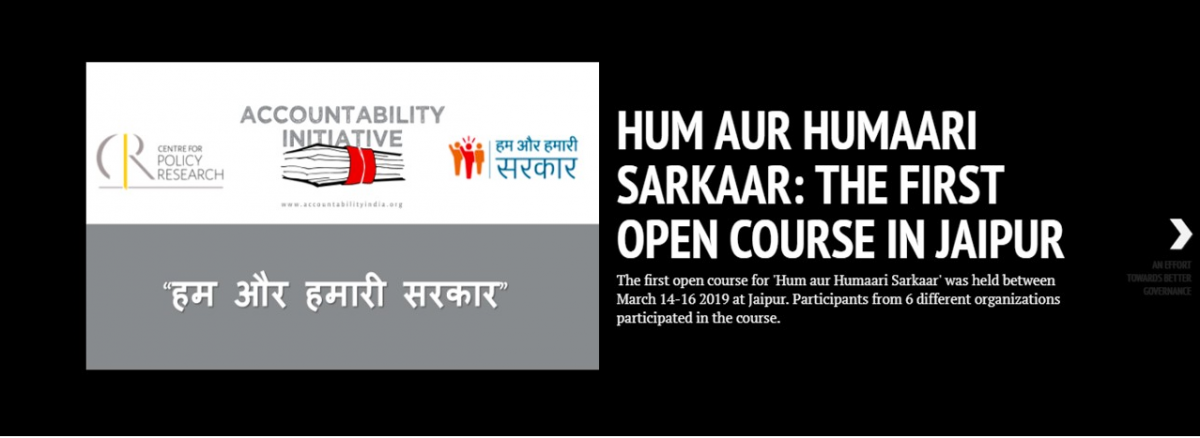
Field staff from 6 NGOs and students participated in the first ‘open’ course of Hum Aur Humaari Sarkaar. The participants were selected on the basis of their previous experiences and potential to be change agents. This was the first time that the course was made available to the public. The course was held between 14-16 March 2019 in Jaipur, Rajasthan.

Click to see an interactive blog

Accountability Initiative in 2018

The year 2018 witnessed several milestones for us. Among them was the 10th year of Accountability Initiative and a change of leadership from Yamini Aiyar to Avani Kapur. Through our research, we continued to deepen understanding of key sectors, engaged the public and built the understanding of existing and future administrators. At AI, we see 2019 as a year of renewed vigour on working for accountability and good governance.

January 

10 years of Budget Briefs

2018 marked the 10th anniversary of our flagship Budget Brief series which analyse the Union Budget and its monetary impact on India’s welfare programmes. In this year’s volume we looked at the allocations, expenditures and progress of 9 key social sector schemes including the Sarva Shiksha Abhiyan (SSA), National Health Mission (NHM), Swachh Bharat Mission (SBM) and the Pradhan Mantri Awaas Yojana- Gramin (PMAY). A special website was created to mark the occasion. Download all the volumes of the series which has become an invaluable source of insight for development practitioners from here. Opinion pieces published can be found here.

Contribution to the the Economic Survey of India

AI was invited by the Chief Economic Advisor to contribute a section on gaps in panchayat finances as part of the chapter titled “Reconciling Fiscal Federalism and Accountability: Is There a Low Equilibrium Trap” in the Economic Survey of India. The chapter can be downloaded from here.

February

Studying the public health system in Uttar Pradesh

Since January 2018, AI has been working closely with the National Health Mission (NHM) Mission Director and the Technical Support Unit (TSU), Government of Uttar Pradesh to understand the reasons for low utilisation of funds and diagnose bottlenecks in implementation of health interventions. Findings from the research have regularly been shared with the Mission Director and the TSU to determine key action areas. After an analysis of mission expenditure over two years, as well as interviews with key government officials across levels, recommendations were offered for improving expenditure performance in UP,  several of which were accepted and adopted.

Training efforts

Two staffers were selected as part of the first cohort of Tech4Good Fellows, and Avani Kapur, Director, AI, conducted an In-Service Training on Public Expenditure and Accountability for the AIS (IAS, IPS, and IFS officers).

March

Developing insight on Delhi’s education system

Preliminary findings from ongoing research on Delhi’s education reform interventions were presented at the Annual Comparative and International Education Society Conference in Mexico. The Conference saw participation from education researchers from over 100 countries.

April

Marking Civil Services Day

A panel discussion on “Training India’s Civil Services” was livestreamed on the occasion of Civil Services Day. The discussion was on the realities of bureaucratic life and why there is a need to look at challenges that the country’s civil services face, including training needs. The panel included retired IAS Officer, Ms. Rashmi Shukla, Mr. Vaibhav Pandey, Programme Director at Kaivalya Education Foundation, and Ms. Vincy Davis, Senior Research Associate at AI. The discussion was moderated by Ms. Rajika Seth, Learning & Development Officer, AI. The discussion, which has been viewed by over 600 people, can be accessed here.

Capacity Building of ICAS officers

Avani Kapur, Director, AI and Rajika Seth, Learning & Development Officer, AI conducted a session on Public Expenditure Accountability and Social Audits as part of the probationer training for ICAS (Indian Civil Accounts Service) organised by NIPFP.

May

AI’s specialised learning opportunities

The course Hum Sarkaari Adhikaari was conducted with 50 Panchayat Secretaries and other frontline functionaries from Dharamshala Block in Himachal Pradesh. The course takes AI’s research learnings on decentralised governance to local governments, fills knowledge gaps and facilitates a reflection on the current reality of local governments and the causes for dysfunctionality in government functioning. Hear what one of the participants had to say.

In addition, guest lectures were given on improving public finance management for the health sector as part of the ‘Indian Flagship Course on Health System Strengthening and Sustainable Financing to Senior Health Officials in India’. The course was organised by Harvard School of Public Health and LBS Academy.

June

Engaging the next generation of development practitioners

Two guest lectures conducted with the current batch of Vedica Scholars, reaching out to a class of 60 young women on Evidence Based Decision Making and Communicating Research.

Launch of a new discussion series

The first Policy In-Depth session was held this month to provide a platform for development sector practitioners and the public to engage on the implementation of key welfare programmes in India using research-backed evidence. The first session unpacked the issue of delayed payment of wages to beneficiaries in the government’s largest rural livelihood programme – the Mahatma Gandhi National Rural Employment Guarantee Scheme (MGNREGS).

July

Studying nutrition services in 6 states

The month saw intense preparations for the first phase of a process tracking study to track planning, budgeting, fund flows, and governance structures which impact implementation of key nutrition specific interventions (focusing mainly on ICDS but also looking into Vitamin A supplementation, deworming). The aim is to try and determine bottlenecks and better practices across states or even across districts. The study is being undertaken in 2 districts each across Uttar Pradesh, Bihar, Maharashtra, Karnataka, Rajasthan, and Odisha.

August

First phase of the study was launched, and citizen volunteers recruited in 3 districts (2 in Rajasthan, 1 in Maharashtra).

Insights on the Kerala floods

In a blog series, T.R.  Raghunandan unpacked the increased vulnerability of Kerala  due to colonial policies and present day urban development patterns. Read more here.

September

Analysing India’s efforts to restructure centre-state relations

Avani Kapur, Director, AI and Yamini Aiyar, Founder, AI published a paper titled ‘The centralization vs decentralization tug of war and the emerging narrative of fiscal federalism for social policy in India’ in a special issue of Regional & Federal Studies. The paper examines the relationship between fiscal federalism and social policy in India through an analysis of the effects of a recent effort to increase fiscal decentralisation to state governments on the nature of social policy investment at the sub-national level. The paper can be found here.

Understanding the education policy landscape

The second Policy In-Depth session explored the newly launched Samagra Shiksha Abhiyan (SMSA). Subsuming 3 big budget programmes -the Sarva Shiksha Abhiyan, Rashtriya Madhyamik Shiksha Abhiyan and Teacher Education, its intent is to significantly improve quality of learning from pre-school to class XII. The key speaker for this session was Dr Manisha Priyam, Associate Professor, National Institute of Educational Planning and Administration.

October

Training young minds

The course Understanding State Capabilities was conducted with the current batch (60)  of ISDM students. The course highlights the root causes of administrative and fiscal dysfunctionality on the ground, equipping participants to apply a systems approach to on-ground interventions, engage with evolving nature of government functioning and interact with the state from a perspective that responds to the current state of weak capability while simultaneously also bridging this capability gap.

Deepening insight on the education system

200 teachers from 39 government and municipal schools in Delhi were surveyed between December 2017 and April 2018 to unpack their role and work related perceptions, and to map the time spent by them on various school activities. The report will be launched by the DCPCR this year.

Another study attempted to understand how school level data can be used by different stakeholders in India’s public education system as an accountability tool. Findings were presented in an international policy forum, and was published by UNESCO IIEP. The study can be found here. The key findings of the report along with insights from AI’s fund flow tracking research experience are expected to be included in School Management Committee trainings in Madhya Pradesh in the future.

November

The month saw the starting of the second phase of the nutrition survey in 1 district of Maharashtra and 2 districts of Bihar.

Understanding the state of water resources

AI is currently undertaking an appraisal of existing financial mechanisms, especially in the context of three states, namely Maharashtra, Punjab, and Karnataka. A further deepdive into the performance of 4 key Centrally Sponsored Schemes will follow to recommend effective structures for central assistance. As a part of the study, a roundtable conference and workshop were conducted, bringing together key experts in the water sector.

December

Exploring PMJAY

The third Policy In-Depth session unpacked the Pradhan Mantri Jan Arogya Yojana (PMJAY) which has the mandate to deliver health insurance coverage of Rs 5 lakh per family per year to over 10 crore poor and vulnerable Indian families. The key speaker of the session was Dr Jeffrey Hammer, Non-Resident Senior Fellow at NCAER.

New research endeavours

As part of a World Bank project on ‘Benefit Incidence Analysis’ of public spending on health and education India, AI is studying detailed treasury data of two states, classifying it by district, and different components and levels of expenditure within each district. The joint report is likely to be out by early next year.

In addition, research on understanding the implementation and outcomes of the consolidation of government schools taken up by Rajasthan education department is underway. The findings are likely to be published as a working paper soon.

AI is working with the Safai Karmachari Andolan and the SCIFI team at CPR to understand the outcomes and bottlenecks in the implementation of the scheme for rehabilitation of manual scavengers. This study is being conducted in two districts in Punjab with the possibility of replication in other states. Adopting a multipronged approach, the study aims to survey beneficiaries of the scheme and understand their experiences. At the same time, the study will also seek to identify manual scavengers who are presently excluded from the SRMS net and understand the barriers to access.

Findings from a study on the Swachh Bharat Mission- Gramin in Udaipur, Rajasthan have been triangulated with the SQUAT survey 2018, of the research institute in compassionate economics (rice), to release a working paper on SBM processes and outcomes. The findings were shared with the district administration in 2017 to help them address the gaps in ODF GPs and to improve the implementation process in the remaining district. In 2018, findings from this research