

Tracking expenditure through budget documents requires an understanding of the expenditure responsibilities within and across Central and State governments. Public Expenditure Tracking For Social Sector Programs in India: Case Study of Sarva Shiksha Abhiyan in Nalanda, Bihar talks about the challenges and the way in which budget can be tracked by using SSA as an example.
Release Year: 2010
TSC GOI 2010-11
Information Commissions – Selection and Appointment
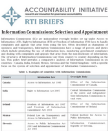
This brief provides a comparative analysis of Information Commissions in six countries Canada, India, Ireland, Mexico, Slovenia and the United Kingdom with a specific focus on the system of selection and appointments of Information Commissioners.
Proactive Disclosure – Best Practices from Mexico
This brief examines the proactive disclosure of information or Section 4 under the Right to Information Act 2005 and highlights best practices in information disclosure from Mexico.
What is driving the Indian middle class towards electoral politics? Evidence from Delhi
Neighborhood Associations have assumed an important role in public policy decision making as the principal voice of the middle class across urban India. In recent years, these associations have sought a more formal role in policy making by contesting for political office in local elections in at least five major cities. This is significant not only because of its newness and implications on public policy but also because it represents a blurring of boundaries between the civil society, traditionally characterized by its apolitical nature, and the political society which has largely been the domain of the poor. Using the case of Delhi and drawing on examples from other metropolitan cities, this paper attempts to understand the factors that have led to the rise of middle class neighborhood associations and their subsequent advent into formal politics.
Bottoms Up: To the role of Panchayati Raj Institutions in Health and Health services
India is currently witness to two trends that have the potential to significantly improve the health of its people. The first is the growing recognition that the system of public delivery of health services is in crisis. And the second is India’s bold efforts to strengthen the voice of the rural poor through decentralization to local governments.This paper argues that these two ostensibly separate trends can converge to generate real reform in the health sector in India through the potential for increased accountability that local governments can provide. The argument is that decentralization brings governments closer to people thereby allowing them to respond more effectively to local needs and preferences. Thus efforts at rural decentralization (post the 73rd amendment) have been undertaken within the context of strengthening accountability in governance structures. Moreover, proximity encourages better monitoring and enforcement.
In the specific context of the health sector, a decentralized institutional structure that emphasizes a bottom up, participatory approach can indeed help to redress some of the key failings in the sector such as absenteeism and corruption by strengthening accountability. As Dr. Jaiprakash Narayan, member of the National Advisory Council has put it: “The struggle for better health, the fight for accountable democracy, the quest for peoples sovereignty and the urge for best value for public money spent are all inseparable.” Given GoIs renewed emphasis on decentralization, this paper aims to analyze the specific role that decentralization can play in strengthening accountability in the public delivery of health care and offers some suggestions at how best this may be achieved.
Bottoms Up: To the role of Panchayati Raj Institutions in Health and Health services
Rural Development, GOI 2010-11
Health Sector, GOI 2010-11
Budget Brief-Education Sector, GOI 2009-10

Right of Citizens for Redressal of their Grievances
This brief analyses the key features of The Right of Citizens for Time Bound Delivery of Goods and Services and Redressal of their Grievances Bill, 2011 (referred to as the GR Bill in the Policy Brief). The bill was introduced in the Lok Sabha in December 2011, in the wake of the public furore over the Lok Pal Bill. It forms a critical part of the wider institutional mechanisms being developed to address corruption and is likely to have far-reaching consequences on citizens’ day-to-day interactions with government. However, unlike the Lok Pal, this bill has received scant attention and analysis on the grievance redressal mechanism proposed has been limited. This brief attempt to address this gap.