
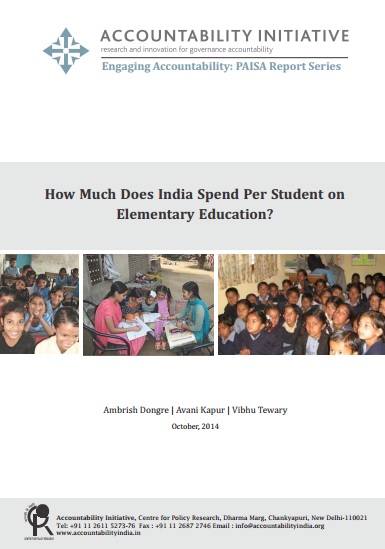
How Much Does India Spend Per Student on Education?

Recent years have seen significant changes in the landscape of elementary education (EE) in India. Yet, updated estimates on public and private expenditure on EE are not available. This paper fills the gap by providing a methodology and estimates of per student public expenditure on children enrolled in government schools, and per student private expenditure on children enrolled in private unaided schools, for major states in India for the year 2011-12. The paper also provides estimates of total (public and private) expenditure on EE.

Our findings indicate that India spent 1.75% of the GDP (centre and states combined) on EE, while private expenditure was at least 0.71% of the GDP in 2011-12. Richer states spent less on EE as a % of their GDP but more in terms of absolute amounts, compared to the poorer states. Preliminary analysis indicates a strong relationship between per student public expenditure and learning levels. But this does not mean that more expenditure is needed to improve learning levels because government expenditure on EE is highly inefficient. It produces low levels of outcomes at high expenditure.

Changing this requires prioritising learning outcomes and demanding accountability toward learning outcomes from all officials, above everything else.
Closing Feedback Loops and Enhancing Accountability

Interactive Voice Response System: Closing Feedback Loops and Enhancing Accountability in the Mid- Day Meal Scheme

The field notes series seeks to document the implementation of accountability mechanisms built into key government programs for service delivery. The current note summarises the key issues affecting the Mid-Day Meal Scheme in Uttar Pradesh and Bihar, and suggests policy recommendations for improving the scheme. It focuses primarily on how the Interactive Voice Response System (IVRS) can be used to strengthen the Scheme.

School Management Committees

Section 21 of the Right to Free and Compulsory Education Act 2009 (RTE), mandates the formation of School Management Committees (SMCs) in all elementary government, government-aided schools and special category schools in the country. The RTE Act envisions an SMC as the basic unit of a decentralised model of governance with active involvement of parents in the school’s functioning. This policy brief highlights the successes, challenges and opportunities in the functioning of School Management Committees as envisioned in the RTE Act.

Do Schools Get their Money? PAISA 2012

Between October and November 2012, PAISA went to 14,591 government run elementary schools across India to ask the following questions: Did you get your money? When did you get your money? Did you spend the money? And if so, what was the output of that expenditure? The PAISA survey is conducted as part of the annual ASER survey that tracks learning outcomes and is implemented entirely by citizen volunteers and civil society organizations. This makes it the first and only citizen led effort to track development funds. “Do Schools Get Their Money? (PAISA 2012)” offers a snapshot of findings from the 2012 survey.

PAISA District Surveys: Mid-Day Meals

The Mid Day Meal (MDM) scheme is the world’s largest school based feeding program covering around 12 crores children in over 12.65 lakhs elementary schools across the country. Since its launch, MDM has been rigorously evaluated by academics and policy practitioners from the perspective of its impact on key parameters such as student enrolment and attendance and on student nutrition levels.However; there is relatively little rigorous empirical work on the day to day governance of the scheme.

This PAISA study is an attempt to fill this gap. It examines governance questions with a focus on the budgeting and financing system in MDM. Through a combination of primary survey work and secondary analysis of government documents, this study tracks releases, grain and fund flows and expenditures from Government of India all the way down the schools for the financial year 2011-12. The study is based on data collected from two districts each in Uttar Pradesh (Hardoi and Jaunpur) and Bihar (Nalanda and Purnea).

Do Schools Get their Money? PAISA 2011

The PAISA survey is conducted annually through the Annual Survey of Education Report–Rural. This is the third PAISA report. In 2009, the survey covered a total of 14,231 Primary and Upper Primary Schools in rural India. The 2010 survey covered 14,240 schools and the PAISA 2011 survey covered 14,283 schools across rural India To contextualise school level expenditures and provide a flavour of the larger planning and budgeting process, PAISA 2011 also reports on overall trends in Sarva Shiksha Abhiyan (SSA) allocations and expenditures across three years from 2009-10 and 2011-12.

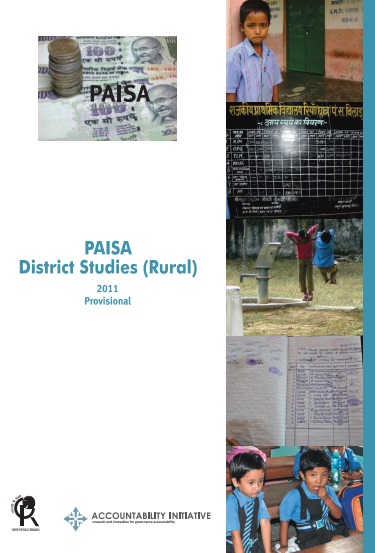
PAISA District Studies: 2011 Provisional

Between May 2011 and August 2011, the PAISA team went to around 1300 schools in 9 districts spread across 7 states  to do a detailed PAISA study on elementary education financing. The study focused on tracking the flow of funds from their point of origin (Central and State Governments) to their final point of expenditure. The 9 districts covered by the PAISA study are: Medak (Andhra Pradesh), Nalanda and Purnea (Bihar), Kangra (Himachal Pradesh), Sagar (Madhya Pradesh), Satara (Maharasthra), Jaipur and Udaipur (Rajasthan) and Jalpaiguri (West Bengal). More details can be found in the attached report.