
The main assumptions underlying the research are as follows: First, open data initiatives are powerful tools to improve transparency, hold schools accountable, and reduce corruption risks in education. Second, government-led initiatives are less likely than citizen-led initiatives to respond to users’ needs, engage them, and generate real impact, since they are often more supply- than demand-driven. And third, all users do not benefit equally from open data initiatives.
Sector Scheme Level: National
State of the Nation: RTE Section 12(1)(C)
This report describes the status of implementation of the constitutional mandate under the Right of Children to Free and Compulsory Education Act (Section 12(1)(c)) for private unaided schools (non-minority) and special category schools to keep aside at least 25 per cent of their seats for children from economically weaker and disadvantaged sections of society at no fee to the children. The report focuses on its application for the private unaided non-minority schools.
Trends in Public Expenditure on Elementary Education in India
Trends over the last 25 years suggest that nearly 80% of the social sector spending has come from state budgets. Taken together with other economic happenings in the country, the centre’s role in financing social welfare, including elementary education, is likely to decline further.
State of the Nation: RTE Section 12(1)(c) Provisional
This report titled State of the Nation: RTE Section 12(1)(c) purports to provide an overview of the status of implementation of Section 12(1)(c) of Right to Education Act. Section 12(1)(c) mandates that private unaided schools keep aside 25 percent of their entry level seats for children belonging to economically weaker sections and disadvantaged categories. The clause represents an instrument to increase equity in educational opportunities and create a more integrated and inclusive schooling system. The mandate currently has the potential to impact 1.6 crore children from EWS and DG categories in the next eight years.
The Post Office Paradox
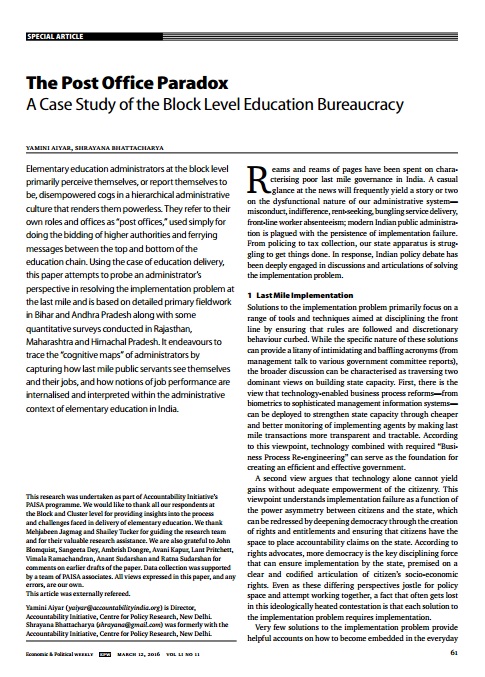
Elementary education administrators at the block level primarily perceive themselves, or report themselves to be, disempowered cogs in a hierarchical administrative culture that renders them powerless. They refer to their own roles and offices as “post offices,” used simply for doing the bidding of higher authorities and ferrying messages between the top and bottom of the education chain.
Using the case of education delivery, this paper attempts to probe an administrator’s perspective in resolving the implementation problem at the last mile and is based on detailed primary fieldwork in Bihar and Andhra Pradesh along with some quantitative surveys conducted in Rajasthan, Maharashtra and Himachal Pradesh. It endeavours to trace the “cognitive maps” of administrators by capturing how last mile public servants see themselves and their jobs, and how notions of job performance are internalised and interpreted within the administrative context of elementary education in India.
Right to Education in India: Resources, Institutions and Public Policy

The book presents a comparative perspective across regions and states and evaluates the effective delivery of SSA at the grassroots level. Using rich empirical data, not yet available in the public domain, it provides valuable lessons for the planning and financing arrangements of SSA-RTE between the centre and the states, and towards understanding access, equity and quality of education. Read More
Rules vs Responsiveness
Elementary education policy in India is undergoing an important transition. For decades, the primary goal of the Indian Government’s elementary education policy was to create a universal education system through the provision of school inputs. This resulted in a significant expansion of India’s elementary education infrastructure – enrollment in India is near universal and most states in the country have constructed schools in every habitation. But even as this infrastructure was being put in place, it became increasingly clear that schooling was yet to translate into learning.
In May 2015, Accountability Initiative (AI) published a paper analysing trends in elementary education financing. The paper is based on data collected through AI’s flagship PAISA district surveys. It presents a detailed analysis of the survey findings and proposes an alternative, outcomes based financing system for elementary education in the country.
State of the Nation: RTE Section 12(1)(c) 2015
Section 12(1)(c) of the Right to Education Act imposes a legal obligation upon private unaided schools to reserve 25 percent of the seats in the entry level class for children from Economically Weaker Section and disadvantaged categories. The intention behind this provision is to ensure that the states as well as other stakeholders in society share the obligation of realizing the right to free and compulsory elementary education. The increased prevalence of unaided private schools makes them a natural stakeholder to the fulfillment of this obligation.
The mandate should also be understood as an effort to arrest the increasing segregation in Indian schooling and promote an environment of knowledge sharing between different sections of society to encourage the narrowing of current societal divisions. It has the potential to impact 1.6 crore children from EWS and DG categories in the next eight years. However, the implementation of this provision faces numerous challenges.
This report looks at Section 12(1)(c) from the administrative, legal, and financial perspective to highlight the challenges and to recommend suggestions for improvement.
Do Schools Get their Money? PAISA 2014
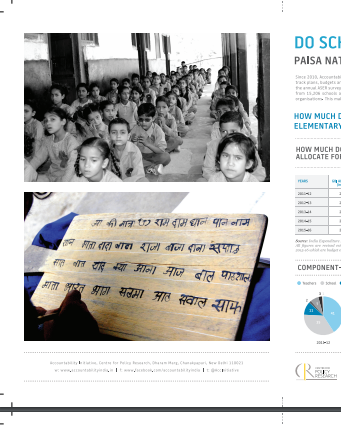
Between October and November 2014, PAISA went to over 14 thousand government run elementary schools across India to ask the following questions: Did you get your money? When did you get your money? Did you spend the money? And if so, what was the output of that expenditure? The PAISA survey is conducted as part of the annual ASER survey that tracks learning outcomes and is implemented entirely by citizen volunteers and civil society organizations. This makes it the first and only citizen led effort to track development funds. Do Schools Get Their Money? (PAISA Report 2014)” offers a snapshot of findings from the 2014 survey.
PAISA District Study: Bihar
This report analyses education resourcing in Bihar; and examines fund flows, entitlements, infrastructure and governance of schools in Nalanda and Purnea.