
Now that the Supreme Court has upheld the constitutional validity of reservation of 25 per cent of admissions at the entry-level in private unaided schools for disadvantaged sections, focus should shift to the implementation of this provision. The Right to Education Act stipulates that private unaided schools shall be reimbursed expenditure so incurred by it to the extent of per child expenditure incurred by the state, or the actual amount charged from the child, whichever is less. So if the state spends Rs 1,500 per child and a private unaided school charges Rs 2,000,the school would be reimbursed Rs 1,500 per child admitted under the reservation policy. However, to implement this clause effectively, we need to know precisely how much both state and private schools spend on a per child basis. Unsurprisingly,given the paucity of data,this information is difficult to find and hence has become a hotly contested issue.
Tag: Education
Visible government for invisible people
India has a strong, vibrant economy with a confident middle class, but governance — especially the capacity to deliver basic amenities such as education and health — is its greatest weakness. For India’s burgeoning middle class, the solution seems to lie in the market, but what of the poor?
The Post Office Paradox: A Case Study of the Block Level Education Bureaucracy
Elementary education administrators at the block level primarily perceive themselves, or report themselves to be, disempowered cogs in a hierarchical administrative culture that renders them powerless. They refer to their own roles and offices as “post offices,” used simply for doing the bidding of higher authorities and ferrying messages between the top and bottom of the education chain.
Using the case of education delivery, this paper attempts to probe an administrator’s perspective in resolving the implementation problem at the last mile and is based on detailed primary fieldwork in Bihar and Andhra Pradesh along with some quantitative surveys conducted in Rajasthan, Maharashtra and Himachal Pradesh. It endeavours to trace the “cognitive maps” of administrators by capturing how last mile public servants see themselves and their jobs, and how notions of job performance are internalised and interpreted within the administrative context of elementary education in India.
Building an outcome-focused approach to elementary education financing in India
In this article, Yamini Aiyar, Director of the Accountability Initiative at the Centre for Policy Research, proposes a novel approach to governing public financing of elementary education that would give more flexibility to states over planning and budgeting, and incentivise them to work towards learning goals.
Reservation under RTE: Status of implementation and way forward
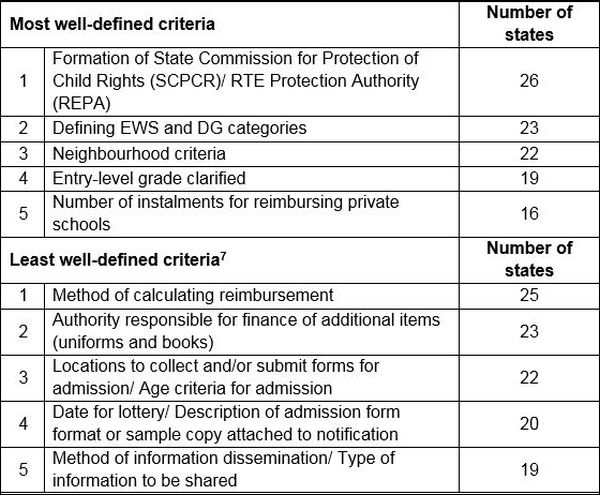
This column analyses the current status of implementation of Section 12(1)(c) of the Right to Education Act, and suggests ways to overcome hindrances in effective implementation and make the education system more inclusive.
The wrong way to fix government schools
Solution is not to force people with power to participate in government schools, but, to grant power to the people who already do
Study picks holes in midday meal scheme
A study by Accountability Initiative – PAISA district survey of MDM – in Bihar and Uttar Pradesh has found significant problems with the way MDM is managed in two states.
Less than 30 per cent pvt school seats reserved under RTE
Less than 30 per cent of the seats earmarked for disadvantaged students in private schools under the RTE norm has been filled up.
Private schools fill just 29% of 2 million seats for kids from poor families
Survey finds that Delhi (92%), Madhya Pradesh (88%) and Rajasthan (69%) were among states that fared better
Only 1 pc schools implemented RTE Act in A.P.
Less than one per cent of seats were filled in the schools in the combined Andhra Pradesh under the mandatory 25 per cent reserved seats as per the Right to Education (RTE) Act.