


India’s Financial Drain

Rishiv Khattar

Global Financial Integrity recently published a study, The Drivers and Dynamics of Illicit Financial Flows from India: 1948-2008, that found that India has lost $462 billion in illegal assets during the period, as a result of corruption, bribery and tax evasion. $125 billion dollars were lost in just the past decade, and nearly half the total losses were incurred after economic liberalization in 1991.

At first glance, the figure put out by this study may raise eyebrows—how can illicit financial flows possibly be measured to the point of a concrete figure? The study uses the World Bank Residual Method and the IMF Direction of Trade Statistics to arrive at outflows of $213 billion, which when adjusted for accumulated interest increases to $462 billion. The study admits that the authors regard this figure as a conservative estimate—with outflows due to smuggling and trade mispricing not considered, and disparities in trade statistics not taken into account. If these factors were included, the figure would inevitably surge. At its core, the study is a situation model examining the interplay of various factors (economic, structural, governmental) that underlie the transfer of illicit financial capital; but due to the inherent randomness of illicit financial flows, the model is not predictive—i.e. it provides indications but cannot be used to chart out the future direction of these flows.

The real value of this study then lies in its laying out of a formal approach to understanding the drivers of illicit flows and how they are dynamically engaged with one another. The motivational drivers in this context are of course difficult to test empirically—illegal financial flows are not recorded, and motivations to build hidden stockpiles of wealth are difficult to measure. The proportional interplay of these forces is what is ultimately illuminated; a perhaps first of it’s kind map of the extraordinary financial toll of corruption, bribery and tax evasion the country has incurred since its’ independence.

An interesting finding of the study is that governance and structural issues carry more of the blame for these flows than India’s macroeconomic policies. Budget deficits and inflation, while playing their roles, were only a minor contributor to the scale of illicit outflows. The consequences of these outflows described by the study—draining currency reserves and reducing tax collection—contribute toward the widening income inequalities India’s population has faced over decades.

The policy challenges this presents are immense—accelerating income inequalities have widespread consequences beyond the economic for India’s social growth and civil unrest, and the rise of money-laundering rackets have implications for national security (funding terrorism) and social health (drug and human trafficking). The government must strengthen anti-money laundering efforts and provisions to combat the financing of terrorism—efforts that the Financial Action Task Force notes are relatively young. The government also needs to aggressively collect and utilize internationally available data on banks, and pricing of imports/ exports to detect abusive transfer pricing. India also needs to strengthen existing laws in order to widen its tax base and ensure that higher income groups do not get away with tax evasion and avoidance.

A recent conference I attended on Understanding the Politics of Taxation in India, had several speakers from various civil society organizations pointing toward tax reform as a means to curb illicit outflows. There was also anger at the accommodation of hot money in island tax havens, where many claimed that billions of dollars are funneled from the private wealth of Indian citizens and then transferred back into the country for investment, in what becomes an unaccounted for vicious cycle of transfers. Moves toward domestic tax reform, would then be helped by “internationally agreed tax standards” such as those proposed at the London G20 Summit in 2009 that led to the drawing up of a tax havens blacklist. The GFI report recommendations echo this when they point toward both developed and developing countries needing to uphold standards of financial integrity with their institutions so that domestic efforts in the developing world are not undermined by weak policies on the part of developed nations.

Globalization and liberalization have led to a widening of the illicit tax haven circuit—Alex Cobham in his Oxford Council on Good Governance Report “The tax consensus has failed!”, claims that the proportion of assets in tax havens belonging to residents of developing nations like India are similar to the share of these nations in World GDP. His results show that developing countries as a whole lose approximately $50 billion annually from the use of tax havens to evade tax. As income inequalities in India become more severe, wealth becomes more concentrated within a small group of high net worth individuals—a group the GFI study claims are the “main drivers of illicit financial flows”. Apart from the use of tax havens, corporate entities also use mispricing and tax planning to help with “profit shifting”—a practice that results in the loss of tax revenue as well as capital flight. The GFI study recommends that financial institutions should be required to identify in their records the natural (real) persons that own a financial account or any legal entity that owns a financial account. Policies geared toward creating a more equal income redistribution (addressing factors like the promotion of regressive taxes, the failure to charge all income to tax), would be significantly aided by large-scale efforts toward a corporate culture that promotes giving and discourages tax evasion and avoidance.

Redistributive policies and tax reforms in India to curb illicit financial flows are  urgently needed to begin to address the country’s rising shadow economy and ensure that income generated is inclusively shared by the population. These measures must be matched by strong international financial laws and institutions as well as engagement with the endemic corruption across Indian institutions and measures to improve private sector attitudes toward taxation. Given the sheer scale of financial outflows, a commitment to the policy guidelines set out by Global Financial Integrity would be a step toward addressing stagnating poverty levels and improving performance on human development.


Rishiv Khattar is a Research Intern at the Accountability Initiative.

Explore AI’s Document Library

Our website www.accountabilityindia.org is designed as a comprehensive source on the state of accountability in India with information on civil society experiments, accountability tool kits, and relevant research and analytical work.

An important component of the website is the Document Library. This is a collection of conceptual, analytical and empirical literature on the broad subject of governance and accountability from India and around the world. It is designed as a one-stop source of information for students, researchers, academics, practitioners and policymakers interested in these issues.


We believe that a collection of documents such as in our library can be a valuable resource for student researchers working on governance issues.

The documents are organized into different categories including Decentralization, Democracy and Citizenship, Service Delivery Reforms (Education, Health), International Case Studies, Corruption, Right to Information, Budgets, Media, and so on. Most of the documents can be downloaded from the website. Where this is not permitted/ possible, a link is provided to the website hosting the document or information is provided about how to access it.

Selection criteria: We monitor a wide range of publication sources regularly, including Universities, Research and Policy Institutes, NGOs and Donors. Materials are carefully selected by our research team to ensure that they are relevant to the topic areas, demonstrate good practice or significant insight and represent a range of perspectives. Only the most credible and policy-relevant research, toolkits, analyses and case studies are included.

We believe that a collection of documents such as in our library can be a valuable resource for student researchers working on governance issues. We invite you to explore the library and make use of it.

The Accountability Initiative Team

We regularly update the collection in the library. If you would like to recommend any new publications for inclusion, please email us at [email protected]. Please supply a link to the full text online if possible so that we can review the document and link to it. Alternatively, if you are the copyright holder you can send us an electronic copy of the document if you would like us to review it and possibly host it on our web site.

New RTI Act Rules Top Secret?

Venkatesh Nayak

It appears that the Government of India is attempting to draft a new set of Rules under the Right to Information Act, 2005. The minutes of a  meeting held at the Central Information Commission (CIC) on 16th November 2010 indicate that it has been asked to comment on a set of draft RTI Rules prepared by the Government of India.  Specifically, the minute’s state:

 “Agenda 1: Draft RTI rules- for discussions

Commission discussed the draft rules and suggested some modifications. The changes as suggested by the Commission shall be incorporated and sent to the Government at the earliest. (Action: Secretary/JS (law)) “

In the 21st century where the RTI Act seeks to establish a regime of transparency, rules governing the processes of seeking and obtaining information are being discussed by only a handful of people behind closed doors. There is no official word on what the draft RTI Rules contain. Till date neither the Department of Personnel and Training (DoPT) the administrative department for the RTI Act, nor the CIC, have taken any steps to consult with the people of India on these draft Rules. The people of India are the primary stakeholders  in India’s democracy and have a deeply vested interest in ensuring that there is transparency in the administration, especially in policy making and implementation. The secrecy surrounding the draft RTI Rules is in clear violation of two decisions of the CIC emphasising the duty of public consultation while drafting laws and policies. Whether the CIC has reminded the DoPT about the imperative of public consultation on these Draft RTI Rules in not publicly known.

Public Consultation is necessary while drafting legislation or policy: CIC directs the Delhi Government

In July 2010 a single member bench of the CIC directed the Government of the Delhi to fully comply with Section 4 of the RTI Act while formulating draft laws and policies. In this decision the CIC observed as follows:

A plain reading of Section 4(1) (c) of the RTI Act suggests that every public authority is required to publish or disclose all facts and circumstances which are relevant and taken into account while formulating policies and taking decisions that would affect the public. Section 4(1)(c) of the RTI Act requires proactive disclosure of proposed laws/ policies and amendments thereto or to existing laws/ policies to enable citizens to debate in an informed manner and provide useful feedback to the government, which may be taken into account before finalizing such laws/ policies. Given that the DP Bill” (Delhi Police Amendment Bill) “is a significant legislative change, the relevant public authorities involved in drafting of the said bill had a duty to proactively disclose its contents under Section 4(1)(c) of the RTI Act… The public authority should have disclosed the contents of the DP Bill suo motu and by omitting to do so, the very purpose of Section 4(1) of the RTI Act stands defeated.

 Public Consultation is necessary while drafting legislation or policy: CIC full bench directs the Central Government

In September 2010 a full bench of the CIC reiterated this stand and directed the Cabinet Secretariat under the Government of India and the DoPT to take steps to create a mechanism for public consultation on draft laws before they are tabled in Parliament. In this decision the CIC observed as follows:

“The Commission further recommends u/s 25 (5) that Cabinet Secretariat considers amending Part V of Circular No. 1/16/1/2000-Cab of 15.4.2002 to allow for public consultation in appropriate form.”

What does Part V of Circular No. 1/16/1/2000-Cab of 15.4.2002 contain?

The Cabinet Secretariat issued a circular in April 2002 instructing all departments and ministries under the Government of India on the methodology of preparation of Cabinet notes. Drafts of proposed laws or amendments to existing laws are attached to draft Cabinet notes and circulated to the relevant ministries and departments for consultation. Part V refers to the procedure for conducting such inter-ministerial consultations. During such consultations with various ministries the draft Cabinet note is circulated with the classificatory label – “TOP SECRET“. So save a handful of senior officers, all other citizens of India are excluded from this consultation process. The full bench of the CIC directed the Cabinet Secretariat to amend this portion of the circular and create appropriate spaces for public consultation.

Despite the principle of mandatory public consultation having been laid down by the CIC, the DoPT has not yet begun consultation with the people of India on the draft RTI Rules. If the draft is ready for consultation with the CIC which is a body outside of Government, surely it can be opened up for a more widespread consultation with the people of India who are using this law every day. Surely no harm would be done if people’s views are elicited on so important a subject. The Rules lay down the detailing of the framework for accessing information under the RTI Act. The people of India have a right to be consulted on the draft Rules as they are the primary users of the RTI Act. THE PEOPLE OF INDIA HAVE THE RIGHT TO BE CONSULTED NOW.

Venkatesh Nayak is the Programme Coordinator of the Right to Information Programme at the Commonwealth Human Rights Initiative, New Delhi. For CHRI’s alerts on the RTI and related issues click here  


Despite half-hearted reforms, there is a revolution waiting to happen.

So far, the story that I have related in this series of blogs is one of half-hearted reforms. Each of the adventures embarked upon so far – unbundling, privatization and the promotion of energy markets – has not eased the travails of the consumer. It is easy to say that the inability to bite the bullet on power tariffs, and in particular, the fear of charging farmers for the power they consume, has been the bane of the power sector. However, on a closer look, power subsidies to farmers are like any other policy of subsidizing them. It is possible to provide – though it might be difficult to sell the idea to them – a complete basket of subsidies in the form of cash transfers, and then withdraw service wise subsidies, such as in power, or irrigation, or fertilizer.

The real bane of the power sector has been the absence of metering, not the supply of subsidized power. When one does not meter electricity supply, one has no idea of how much is being consumed by the subsidized category. As power supply is not visible to the naked eye, the unmetered supply of electricity to any category of consumer is an open invitation for theft.


A few institutional reforms, aided by the fact that some technologies for generation hitherto considered un-economical have gathered a critical mass, might catalyse a new wave of reforms in the sector, bridging at last, the persistent gap between demand and supply.

Stealing power is as dangerous as it is rampant. All it requires is a couple of wires to be hooked on to the transmission lines, using wooden poles to maneuver them. Frontline officials in the electricity supply business, whether government owned or private, are powerless to take action because of threats from local politicians. Worse, they often collude in enabling such theft. In Karnataka state, which is considered to be better governed than other States in India, the number of unauthorized agricultural water pumps that await regularization, has always exceeded a hundred and fifty thousand at any given time. No sooner are they regularized, following political pressure, than a fresh lot of illegal connections sprout. It is hard to believe that such pumps are connected to distribution lines without the active collusion of ground level officials, such as line men and local engineers.

With rampant theft caused by un-metered supply, power utilities are cash strapped. This leads to long waiting periods for payment of bills to suppliers. That in turn creates a premium for jumping the queue for payment of bills, a factor that adds another layer of corruption to what is already considered a fairly corrupt system.

However, let me not paint a universally grim picture of the sector. A few institutional reforms, aided by the fact that some technologies for generation hitherto considered un-economical have gathered a critical mass, might catalyse a new wave of reforms in the sector, bridging at last, the persistent gap between demand and supply.

First, many governments have now begun to isolate the non-paying consumers from the rest, through special distribution lines meant only for them. This approach was led by Gujarat, which took the pragmatic decision to provide separate distribution lines meant only for farmers, who were supplied un-metered power. Since politically it was unacceptable to meter each individual farmer, the distribution companies decided to meter the distribution line instead; a sneaky, but effective way of tracking how much power was being consumed by agricultural water pumps. A few days back, I visited a village in Karnataka where such a project was under implementation. People were happy, because they had un-interrupted power for their homes, through a separate line meant only for non-agricultural consumers. As far as farmers were concerned, they were provided power only during non-peak hours, from midnight to dawn. Curiously, none of them complained; they were willing to face the inconvenience of power supply at night, provided they had good quality power of the appropriate voltage. By isolating the lines for agricultural supply and providing off-peak power to them, the ESCOM was also able to better manage the load curve.


A lot depends upon visionary managers in the power sector, who see the unfulfilled potential of new technology and the institutional latitude provided by the Electricity Act 2003 and capitalize on that opportunity.


The second revolution in waiting is the one heralded by access to new technologies of generating, controlling flow and metering power. Solar energy has so far not lived up to the promise of being a magic wand. The capital cost of solar photovoltaics is high, even considering that they do not require any maintenance. Besides, even if a consumer was able to afford the initial capital cost of solar power, the necessity for expensive batteries to store the energy for future use, rendered it uneconomical for most consumers. That position might change dramatically, if the experience of Germany is an indication. More than a decade back, the Germans encouraged individual householders to generate power using solar panels on rooftops. Instead of storing such power for use later, this generated power was pumped back into the grid. Consumers were fitted with reversible meters, which recorded both the generation of power by the consumer and the consumption, thereby enabling the utility to bill the consumer for the net energy consumed. Through its pricing policies, consumers were encouraged to generate power. Last year, Germany was able to generate nearly three quarters of its power requirements from renewable sources. For India, with its abundant access to sunlight, the potential for such generation could be limitless.

The Panchayats and Municipalities can emerge as the institutions that can transform this dream into a reality. As detailed in my last blog, Panchayats and Municipalities can obtain exemptions from licences to undertake distribution of power. Small local area loops, owned and managed by Panchayats, can bridge the requirements of local consumers. Furthermore, Panchayats might have the scale and financial clout to invest in somewhat larger scale generation projects, co-owned by its citizens and supply surplus power back into the grid. For the distribution companies, this would make a lot of administrative sense for them, as they will not need to manage large numbers of frontline workers, who are engaged in the expensive task of metering and billing. A single meter at the Panchayat level would suffice, with operations below being owned and managed by the Panchayats themselves.

Whether these reforms actually happen, depends on two possible scenarios. A lot depends upon visionary managers in the power sector, who see the unfulfilled potential of new technology and the institutional latitude provided by the Electricity Act 2003 and capitalize on that opportunity. Alternatively, the whole present system, teetering as it is on the brink of bankruptcy, might implode and in the resultant chaos, a decentralized system of generating and distributing power might emerge as a Phoenix from the ashes. Either way, it will augur well for the future.

A new legislative framework for electricity generation and supply (and why it’s no big deal, yet)

From the late nineties onwards, States began to use the concurrent powers bestowed to them under the Constitution to deal with the power sector, to enact laws for power sector reforms. These amendments freed up generation for the private sector, unbundled the monolithic electricity boards into separate entities for power generation, transmission and distribution and constituted electricity Regulatory Commissions, which would set tariffs and standards for generation and distribution.

In 2003, the Government of India replaced the nearly century old Electricity Act and the post-Independence Electricity Supply Act, with a new legislation; the Electricity Act.

The Act attempted to do everything that reforms pundits were seeking. In my previous blog I had described how, no sooner than the idea of unbundling and privatization of the electricity sector was being considered, than the new idea of a competitive energy market emerged on the horizon. The Act enabled both to happen, simultaneously.


A decade after these institutional reforms, nothing much has changed for the individual consumer. Large swathes of rural areas have wires strung up everywhere, but suffer from grievous power cuts.


At the outset, the 2003 Act mandated that the government would bring out a power sector policy and tariff plan from time to time, that would lay out its more detailed road map for power sector reforms. Acting in furtherance of the unbundling and privatization idea, it de-licenced generation and by virtue of that step, it extended a new liberalized regime for setting up power generation plants to those States as well, which had not enacted power sector reforms laws. Hydro power plants, given that their construction and operation would affect other public uses of water, were still mildly regulated; they had to be cleared by the Central Electricity Authority. During the long years of power shortage, captive generation of power had also emerged as a significant contributed to power supply; so that activity was also delicenced.

The Act did not de-licence transmission or distribution; though it did create an important window for de-licencing. In a ‘back to the future’ decision, it envisaged that the Central Electricity Authority could exempt any ‘local authority, Panchayat Institution, users association, co-operative societies, nongovernmental organizations, or franchisees from the necessity of obtaining a licence for distribution’. The clubbing together of such entities of varying descriptions into an exempt category is indeed interesting. While the exception carved out in favour of Panchayats and local authorities makes sense – the Constitution envisages that Panchayats can be entrusted the task of power distribution – with respect to private institutions, there is a strong bias in favour of delicencing of those entities that are not organised as limited liability companies.

In furtherance of the idea of creating a competitive energy market, the 2003 Act defined a new entity that could be licenced for operation, namely, the ‘electricity trader’, who could buy and sell electricity over the wires, linking generation entities with consumers. In order to enable such contracts to function, it mandated that the wires would be open to free access. Envisaging an era where there would be simultaneous transfer of power from generation companies to unbundled distribution entities, as well as power trading contracts entered into by power traders being implemented, the Act envisaged that three levels of ‘Load Dispatch Centres’ at the National, Regional and State levels, would act as traffic policemen, ensuring that power would be released and drawn from the grid in accordance with the plethora of arrangements that were enabled by the Act.

So, for all practical purposes, the law served the larger ideas of slicing large unwieldy monoliths into smaller and more efficient entities, and of creating an energy market. Yet, a decade after these institutional reforms, nothing much has changed for the individual consumer. Large swathes of rural areas have wires strung up everywhere, but suffer from grievous power cuts.

Why did these reforms not lead us to the promised land of abundant power? Blame it on the familiar tendency to keep things as they are, even as far reaching changes are promised.

Game theories relating to corruption describe how vested interests can stymie the best laid out plans for reducing corruption, by not seeming to oppose them at all, but playing along and destroying the essence of what reforms hope to achieve, from within the system. Those theories can easily be applied to the larger issue of institutional reforms as well.


The biggest impediment was the fact that many consumers for power did not pay and the government did not have the guts to seek the imposition of higher tariffs for them.


The idea of unbundling Electricity Boards into smaller transmission and distribution entities was greeted with enthusiasm. For one thing, there would be more jobs for the boys and girls; more Chief Engineers and IAS officers could occupy the jobs of Managing Directors of these entities. More board positions were available for distribution to political interests too; so political parties were quite happy. However, physical unbundling did not result in accounting separation straight away.Most of these entities were in reality protected and supported by the larger transmission monopoly, which was the remnant of the core of the earlier Electricity Board. Systemically, therefore, a soft budget constraint applied across all these entities. No pressure developed upon an electricity distribution company to collect tariffs, because there was no pressure for it to pay the generator. The same financial latitude that was expected to be eliminated from the system continued as before.

The delicencing of generation did not do much for the sector either. Even though companies aspiring to set up generation stations did not have to obtain licences under the Electricity Act, they still had to run an obstacle race of obtaining other clearances; for obtaining land, importing machinery, linking up to the grid and for its environmental mitigation measures. The biggest impediment was the fact that many consumers for power did not pay and the government did not have the guts to seek the imposition of higher tariffs for them. For these reasons, the rush of entrepreneurs expected to crowd into the generation sector, did not happen.

What about electricity traders and the entry of local authorities and Panchayats into the electricity generation and distribution business? That did not happen, either.

Yet, we might be on the threshold of a huge revolution in the power sector. More about that in my next week’s blog.

Planning Commission: Call for inputs on Approach Paper for XIIth Plan

The Planning Commission, Government of India, is accepting inputs for inclusion in its Approach Paper for the XIIth Five Year Plan. The Approach Paper is prepared before a new Plan commences to outline the major targets, potential challenges in meeting these targets, and the broad framework for achieving the targets. It is approved by the Cabinet and the National Development Council. The Approach Paper is essentially a blueprint for the Plan itself.

All interested people can participate in the formulation of the Approach Paper by sending in their suggestions at this link. Responses will be accepted until the 10th of December, 2010.

Suggestions can be made on any or all of the following areas:

  • Citizens’ Expectations
  • Governance and Institutions
  • Markets
  • Global Developments
  • Demography and Skills
  • Science and Technology
  • Information
  • Land, Climate and Environment
  • Innovation and Enterprise
  • Financing the Plan


Estimating earmarking of funds

It is common for governments to conceive of new schemes at the drop of a hat and then make grandiose pronouncements of the money allocated to these. It is another matter altogether to actually make that money available to the implementing agencies, whether they be local governments or departmental offices at the sub-District levels, so that the programme can be implemented. This problem becomes even more acute when politicians are fond of making off the cuff pronouncements on the launch of new programmes.

There is a reason why Finance Department Secretaries are generally impassive and Sphinx-like. An excitable Finance Secretary is a liability, both to her family and to the government. If a Finance Secretary were to have an apoplectic fit on coming to know that the Chief Minister announced a big allocation, say, for the breeding of Angora rabbits (it has happened), it would not be conducive to the former’s personal health. Besides, it is the task of a Finance Secretary not to reveal his personal feelings about government programmes, however much it might rankle that it looks idiotic in the first place and that he was not consulted before the impromptu announcement was made. In such circumstances, Finance Secretaries take the simple expedient path of agreeing to release money for every in a non-committal fashion and then refuse to do so when formal orders are sought.

Therefore, it is no wonder that programmes announced in Budgets rarely pan out the way they ought to, unless there are urgent political motives to be seen as being effective.

We came across a classic case of the tendency of the government to announce a programme and then apply their mind later on to find the money to run it, during the Paisa for Panchayats research programme in Kolar District, Karnataka State.

The Government of Karnataka announced a new scheme named ‘Krishi Bhagya’ in the 2014-15 budget, aimed at providing insurance cover to small and marginal farmers. However, it took five months for the government to get its act together; the scheme was launched only in September 2014.

Quite clearly, the Finance Secretary had out-sphinxed the Sphinx.

When the money for the scheme was finally provided in September, only district allocations were made by the State. From the district level, from the point of view of both transparency and administrative efficiency, it would have made a great deal of difference if the district allocation was split up into block-level allocations. However, no such thing was done.

As a result of the delay and the absence of a publicly shared game plan to implement the programme, the release of funds by State government was random from month to month and peaked towards the last four months of the financial year. Expenditure increased drastically in the months of February and March, as shown in the figure.

The delayed releases and the skewed expenditure resulted in a significant backlog of Rs. 2433.1 lakhs of unutilised funds, largely due to Krishi Bhagya, remaining unspent with the Agriculture department at the end of the fiscal year, comprising of 71% of the total funds released under the State Sector for Agriculture in 2014-15 to Kolar district.

This did not trouble anybody. The farmers who might have benefited from this programme did not know enough to complain.

Could the programme have been run in a more beneficiary friendly way?

Indeed, the starting point for implementation of the scheme, even if its launch was delayed by the State Government, would been to sub-allocate the district allocation of Rs. 2390.5 lakhs to each taluk on the basis of an informed study of the possible demand. The total numbers of small and marginal farmers in each of Kolar district’s taluk is available in the government’s Agricultural Census of 2011. Based on the inter-se ratios of such farmers in each taluk, the district allocation could have been sub-divided to each taluk. This would have given each taluk a head start in implementing the programme and offset the delay.

But no such thing was done.

Who is there to ask?

Whistleblowers: Whose Protection?

As the debate rages on about whether or not US whistleblower Edward Snowden should be extradited from Russia to the USA and about the protection he deserves (or not) for leaking sensitive data on the National Security Agency (NSA)’s surveillance activities, questions have arisen in my mind these past few weeks about the kinds of legal provisions that exist in different countries for the protection of whistleblowers. Recent articles and debates centre more on whether Snowden even qualifies as a whistleblower (see here and here). Questions remain as to why countries such as Russia, Nicaragua and Venezuela have offered Snowden protection, especially with the threat of US sanctions. This blog, however, offers a quick comparison of the legislation enacted or proposed in select countries to encourage and protect public interest disclosure.

“Whistleblowing” or “public interest disclosure” entails disclosure made in good faith that the information revealed is true, serves the interest of the public at large, and increases accountability within Government (and/or the private sector, depending on the legislation). Most countries vary on the types and scope of subject matter that are covered, with some countries clearly defining the scope and others, such as India, leaving it more vague. Coverage for protection also ranges from only Central Government employees, to both State and Central Government employees, to Government contractors and the private sector.

While countries such as the USA and the UK had enacted laws to ensure whistleblower protection in the late 1980s and late 1990s (respectively), the early 2000s saw a surge in such legislation around the world, such as in South Africa (2000) and Japan (2004). At the same time, the Right to Information and anti-corruption movements gathered speed around the world. The United Nations’ Convention against Corruption (UNCAC) was also set up in 2005 and part of the Group of 20 (G20)’s Anti-Corruption Action Plan drafted in Seoul in 2010 specifically focused on whistleblower protection.


In India, for example, while the proposed Public Interest Disclosure and Protection to Persons Making the Disclosure Bill, 2010 (PID Bill, 2010), was passed by the Lok Sabha (Lower House) in 2010, it has not yet been ratified by the Rajya Sabha (Upper House) of Parliament.


There are still several countries, however, including India and Russia, which have yet to enact such legislation. In India, for example, while the proposed Public Interest Disclosure and Protection to Persons Making the Disclosure Bill, 2010 (PID Bill, 2010), was passed by the Lok Sabha (Lower House) in 2010, it has not yet been ratified by the Rajya Sabha (Upper House) of Parliament. The following table compares Indian and US whistleblower protection legislation with that in the UK, Japan, and South Africa, which are considered to be more comprehensive laws.[1] The comparison includes a separate Act in the USA for the Intelligence Community in particular.

International Comparison of Legislation on Public Interest Disclosure and Whistleblower Protection

India USA (1) USA (2) UK Japan South Africa
Title of Legislation
Public Interest Disclosure and Protection to Persons Making the Disclosure Bill, 2010 (PID Bill 2010) Whistleblower Protection Act of1989 (WPA 1989) Intelligence Community Whistleblower Protection Act of 1998 Public Interest Disclosure Act, 1998 (PIDA 1998) Whistleblower Protection Act, Act No. 122 of 2004 (WPA 2004) Protected Disclosures Act , 2000 (PDA 2000)
Definition & Scope of Whistleblowing / Public Interest Disclosure
–   “in good faith”

–   by a public servant or any other person, including a non-governmental organisation, “on any allegation of

corruption or wilful misuse of power or wilful misuse of discretion against any public

servant” relating to the subject matters listed below

–  “to serve the public interest”

–  by federal employees to serve the public interest by assisting in the elimination of fraud, waste, abuse and unnecessary Government expenditures

–    by employees or contractors of  intelligence agencies (mentioned below) of wrongdoing within the Intelligence Community with respect to an “urgent concern” as listed below –  by a worker in the reasonable belief that information concerned  shows or tends to show violations concerning any of the subject matters listed below –     by workers without the intention of causing damage to others or obtaining wrongful gain or any other wrongful purpose –     by any employee or employer who has reason to believe that the information concerned shows or tends to show misconduct of any employee or employer concerning the subject matters listed below
Definition & Scope of Subject Matter of Public Interest Disclosure
Complaints against a public servant about: (i) violation of the Prevention of Corruption Act of 1988; (ii) deliberate misuse of power or of discretion leading to “demonstrable loss” to the Government or “demonstrable gain” to the public servant; and (iii) attempt to commit or commission of a criminal offence by a public servant.


Disclosures on matters covered by the Official Secrets Act, 1923, or relating to the Armed Forces, to intelligence or counter-intelligence, or telecommunications are not covered.

Disclosures of: (i) violations of ay law, rule or regulation; (ii) gross mismanagement or gross waste of funds; (iii) abuse of authority; (iv) or a substantial and specific danger to public health or safety.

These disclosures would only be considered if they are not specifically prohibited by law or if the information disclosed is “not specifically required by Executive order to be kept secret in the interest of national defense or the conduct of foreign affairs.”

“Urgent concern” about: (i) a serious or flagrant problem, abuse, violation of law or Executive order; (ii) a deficiency relating to funding, administration or operations of intelligence activity involving classified information; (ii) false statement or deliberate withholding from Congress on issues relating to(ii) above.


Does not include differences of opinions concerning public policy matters.

Information on: (i) criminal offence; (ii) failure to comply with legal obligations; (iii) miscarriage of justice; (iv) endangering of health or safety of individual(s); (v) environmental damage; and (vi) deliberate suppression of information revealing any of the above. Relating to violations of laws or dispositions concerning (i) agricultural & forestry product standardization; (ii) environment conservation, (iii) consumer protection; (iv) fair market competition; and (v) individual citizens’ health, safety, property & other interests Information concerning an employee or employer committing any one of the following: (i) criminal offences, (ii) failing to comply with legal obligations; (iii) miscarriage of justice; (iv) endangering health & safety of individuals; (v) damaging environment; or (iv) discriminating

unfairly

Coverage for Protection
Employees of Central and State Governments “or any other persons” including NGOs.


Disclosures must be made in writing or via e-mail.

Anonymous disclosures not to be considered.

Employees, former employees, or prospective employees (applicants) of Federal government agencies. Intelligence Community members (see adjacent column) not covered. Employees of or contractors employed by the following agencies (collectively known as the “Intelligence Community”): National Security Agency (NSA), Federal Bureau of Investigation (FBI), Central Intelligence Agency (CIA), Defense Intelligence Agency, National Imagery and Mapping Agency, and through Presidential determination, any other executive agency with the primary function of foreign intelligence or counter-intelligence Public and private sector employees.


Independent contractors also covered

Public and private sector employees, including temporary (“dispatch”) employees Public and private sector employees.


Independent contractors  not covered

Reporting and/or Enforcement Authority
Central Vigilance Commission, State Vigilance Commissioner, or any public servant from the Central or State Governments deemed “Competent Authority” to deal with these matters Office of Special Counsel (OSC) Inspector General of the Department of Defense or Justice, or his designee; Director of agency; Permanent Select Committee on Intelligence of the House of Representatives; Select Committee on Intelligence of the Senate. Those intending to disclose information to Congress directly must first notify the Inspector General/Director/ designee their intention to do so. Employer or another responsible person in organization; legal adviser; Minister of the Crown; any other prescribed person; police; Members of Parliament; media. Employer, Cabinet Office, the Imperial Household Agency, related institutional entities established under various laws to exercise such authority; or organs of local public entities (excluding assemblies) Legal adviser, employer, Cabinet or Executive Council, Public Protector, Auditor-General, or any other person or body prescribed to examine such matters
Types of Protection
No person or public servant making a public interest disclosure is to be “victimised” because of this.


Competent Authority must not reveal identity of whistleblower unless he/she has already revealed it. During investigations, the Head of the concerned Department/ organisation must not reveal identity either.


Any person who deliberately (“mala fidely”) reveals whistleblower’s identity would be punishable by law.

Protection from “prohibited personnel practices” (not defined in the Act but separately) and from “adverse consequences” as a result of such practices; prevention of reprisals. Also provides for protection of witness or other individuals from harassment during investigations. None mentioned Right not to suffer from “detriment,” including unfair dismissal; can complain to employment tribunal and receive compensation (i) Annulment of dismissal; (ii) reversal of  cancellation of temporary employment contract; (iii) prohibition of any “disadvantageous treatment,” such as demotion, pay cut, discrimination, etc. Whistleblower not to be threatened with or subjected to the following “occupational detriments”: (i) disciplinary action; (ii) dismissal, suspension, demotion, harassment or intimidation; (iii) transfer against will or refusal of transfer; (iv) refusal of promotion; (v) refusal of reference or provision of less favourable reference; (vi) given disadvantageous term/conditions of employment or retirement; (vii) denial of appointment to employment/ profession/ office; (viii) any other adverse effects related to employment, profession or office, including employment opportunities and work security
Specific Provisions for Public Sector Whistleblower Protection
None mentioned All government bodies must provide information on the Act to their employees All agencies must provide information on the Act to their employees None mentioned Provisions from existing public sector legislation would be applied as necessary to prevent dismissal of public sector employees and members of national legislature (known as Diet Officers) All public sector institutions must provide a copy of the Act’s guidelines to their employees
Specific Provisions for Private Sector Whistleblower Protection
None mentioned None mentioned. Covered by other laws (such as Dodd-Frank Wall Street Reform and Consumer Protection Act of 2010, and Amendments to the Securities Exchange Act of 1934) None mentioned None mentioned None mentioned None mentioned


As can be seen from the table above, countries such as South Africa, Japan and the UK are more comprehensive in their scope, coverage, and types of protection for whistleblowers, with clearly outlined definitions. For instance, the proposed PID Bill, 2010, in India actually does not define the types of victimization that it would provide protection against; on the other hand, the South African PDA, 2000, explicitly states the kinds of “occupational detriments” it provides protection against.

What is of most interest here is that the US has not one but two legislations on public sector whistleblower protection, including one which specifically covers employees and contractors from the intelligence agencies. Yet, in the eyes of the US Government, these laws are not the key ones that are to be upheld in Snowden’s case. The case is complicated by the classified nature of the information he has revealed, making it not merely a legal issue, but also a political one; and the repercussions are already being felt across the globe. Whether Snowden will be considered a whistleblower or a traitor, only time will tell, but for now the issue of whistleblower protection has again been brought to the forefront. Who qualifies as a whistleblower? To what extent can a State impose restrictions on disclosure? What are the implications for civil liberties and citizens’ right to reveal information that they consider is in public interest but is also classified? What kind of protection can such people expect? How can the fear of reprisals be minimized? At the same time, how can the misuse of such laws be prevented? These are just some of the questions that would need to be answered to ground sound policies for whistleblower protection and keep governments and corporations accountable to the general public. Clearly, the work is cut out for our policymakers.


References

Government of India, 2010, The Public Interest Disclosure and Protection to Persons Making the Disclosure Bill, 2010.

G20 Anti-Corruption Action Plan. Action Point 7: Protection of Whistleblowers. Available here: <www.g20.org/load/781360580‎>.

Newcomb, T., 2001, “In from the Cold: The Intelligence Community Whistleblower Protection Act of 1998,” Administrative Law Review, Vol. 53, No. 4, pp. 1235-1272.

Public Interest Disclosure Act, 1998. United Kingdom.

Protected Disclosures Act, 2000. Act No. 26 of 2000, Republic of South Africa.

Sanyal, K., 2011, “The Public Interest Disclosure and Protection to Persons Making the Disclosure Bill, 2010,” PRS Legislative Brief, New Delhi: PRS.

Transparency International-Russian (2013), “Russian implementation of UNCAC,” Accessed from: <http://www.transparency.org/news/pressrelease/transparency_international_russia_recommends_improvements_to_the_implementa>.

US Intelligence Community Whistleblower Protection Act of 1998.

US Whistleblower Protection Act of 1989

US Whistleblower Protection Enhancement Act of 2010.

Whistleblower Protection Act, 2004. Act No. 122 of 2004, Japan. English translation effective April 1, 2006, accessed here.


[1] G20 Anti-Corruption Action Plan. Action Point 7: Protection of Whistleblowers. Available here: <www.g20.org/load/781360580‎>.

A Day of Swaraj

I suppose each one of us has a favourite Independence Day recollection. Yet, funnily enough, my defining Independence Day moment did not happen on the fifteenth of August.

During the spring of 2011, I was involved in designing and rolling out a learning programme organised by the Kutch Nava Nirman Abhiyan, a federated collective of NGOs working in the western-most district of India, Kutch. Along its northern reaches lies a dazzling salt encrusted white desert, which extends all the way to the Pakistan border. To the south of the desert are the Banni grasslands, where nomadic tribal people; Maldharis, tend their herds of buffaloes and camels. The Abhiyan had set up ‘setu’ offices, literally meaning, bridges, which were used by the member NGOs to deliver their outreach programmes to far flung and remote communities in the district.

Over the years, several communities had mingled and co-existed in Kutch, resulting in an array of cultures, customs and traditions. What these communities share in common is a love for bright colour. The styles of their intricately embroidered clothing are beautiful beyond measure and are specific to each community.


What will you do if the government withdraws all these schemes and projects? We asked in desperation. We were met with disbelieving stares.


In an experiment supported by the Swiss Agency for Development and Cooperation, Abhiyan designed a different kind of learning and experience sharing programme for the elected panchayat representatives and Setu level staff. My partners in designing and delivering the programme included a stellar cast of dedicated experts drawn from diverse fields. Sushma Iyengar, the brain and inspiration, was a legend in the district, having worked there for thirty years on the issues of gender, poverty, conservation and disaster relief. Parimala Inamdar brought in a lifetime of experience as a thought leader and designer of pedagogies for training; she focused not only on the design of the learning strategies in the classroom, but also on experimenting with whether learners, some of whom were barely literate, could use techniques involving the internet, for communicating with each other, sharing information and collaboratively enhancing each other’s knowledge. Zulfiquar Haider came in as an expert on leadership and advocacy. The programme, which was to run over six months, comprised of three week-long face-to-face sessions, named Prajatantra (democracy), Aayojan ka Adhikar (the right to plan) and Bhavishya (the future), with intervening periods in which learners were to undertake projects, using the insights gained in the classroom, back in their villages.

During ‘Prajatantra’, learners had been guided to discover their own innate democratic practices. I led sessions that spoke about India’s constitution, how our democracy was designed and finally, how the Constitution was amended to mandate the constitution of Panchayats as the local tier of government. We had spoken about freedom and what it meant for each one of us.

However, in the first few sessions of the Aayojan ka Adhikar programme, when we asked participants to define their vision for their Panchayats, I sensed that something was amiss. Participants reeled out what they wanted to do, but confined themselves to describing how they would use the plans and programmes of the government that were available to them. They would build roads and water harvesting structures with the rural employment guarantee programme; distribute houses under the rural housing programme and suchlike. No, but that was not governance, we said. You have the freedom to govern your Panchayats, and that goes far beyond implementing schemes given to you by the government, we said. And what will you do if the government withdraws all these schemes and projects? We asked in desperation. We were met with disbelieving stares.

We needed a new approach.

I then remembered an article written by Professor Mohan Gopal, a distinguished legal academician, who was once the Director of the National Law School of India University, in Bangalore. In a search for what were the inspirations for the Rights guaranteed in the Constitution, Professor Gopal had attempted to dissect its operative language of the constitution. He argued that the constitution contained seventy five ‘core value edicts’, which in turn could be linked to the twelve ‘core ideals’ in the objectives resolution of the Constituent Assembly, when they set out on the task of crafting it.

But what had inspired the twelve core ideals?

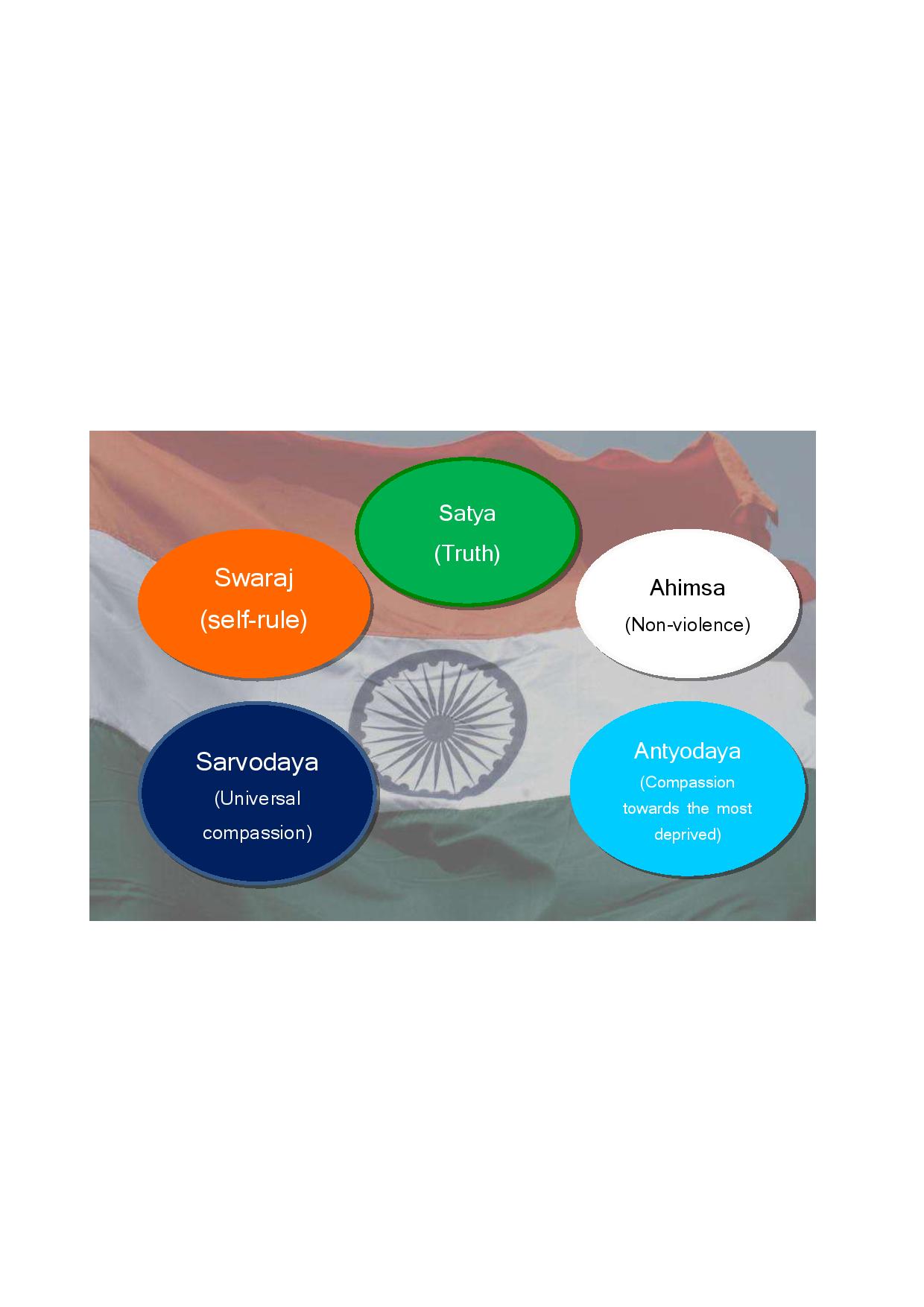
As I warmed up to the theme, I had the attention of the classroom. They did not need too much of prompting, before discovering Professor Gopal’s five core beliefs that inspired the freedom struggle. These were

Satya; truth

Ahimsa; non-violence

Swaraj; self-rule

Sarvodaya; compassion towards everyone

Antyodaya; compassion towards the most deprived.

Why not we re-think one’s village plans, on the basis of these ideals, rather than the availability of money through various schemes?

The transformation was electric.

Over the next few hours, groups of learners huddled together, building their vision of what they wanted for their village. When they returned to present their results to each other, their plans were breathtakingly different.


Maybe, we need a second freedom struggle to demand that the way we look at governance ought to be overturned; that it has to start with the our immediate surroundings and then proceed upward.


They spoke about their Panchayats being corruption free. That’s our commitment to Satya, they said. We will ensure that there are no instances of domestic violence in our village; in our quest for Ahimsa and Sarvodaya. We will plant trees and conserve soil – that would fit under Sarvodaya too.  One friend said it was also Ahimsa; non-violence was not only to be practiced with respect to people and animals, but land as well.  We will ensure that poverty is eliminated, that destitute people would be supported – we will achieve Antyodaya.

Nobody spoke of government programmes and schemes any longer. They only saw these as support systems with which they could achieve a larger ideal; that of a just, harmonious, all inclusive and happy existence.

And that’s how we discovered that Swaraj can be ours, if only we discover that the power to claim it is within us.

Can you imagine what kind of revolution of development would happen, if each Panchayat and Municipality – and within it each ward and mohalla – discovers the Swaraj that lies within them and work for Satya, Ahimsa, Sarvodaya and Antyodaya?

For too long, we have waited for the government to deliver conveniences to us. We are prisoners of plans and budgets designed at the top. True, the Centre and the State governments are ours as well. We have the freedom to elect them, but thereafter, there is precious little freedom for us to question them on a day to day basis. We need to reclaim our spaces from these levels; not in ways that undermine them – that would be a contradiction of the freedom that we cherish – but in ways that decentralizes governance closer to us.

Panchayats and Municipalities are the level of government that is closest to us; its representatives are more likely to have eye contact with us on a daily basis. Let the centre and the State do what they are supposed to do and not interfere in the business of our local governments. Swaraj is not achieved if foreign rulers leave, it has to be practiced on a daily basis, at the local level.

Maybe, we need a second freedom struggle to demand that the way we look at governance ought to be overturned; that it has to start with the our immediate surroundings and then proceed upward.

We are the first mile and the Government of India the last, not the other way around.

My days as a garbage collector

Eight blogs back, I tossed a coin to decide whether I should write a layperson’s introduction to the power sector or the garbage problem. A coin’s toss favoured the power sector. I hoped that the problem of garbage in my city, Bangalore, would go away, but it has gotten worse. So here goes; let me tell you my garbage story too.

In 1997, while I was enjoying myself grappling with the policy challenges of the power sector, I was abruptly told that I must hand over my charge to an appointed successor – I was the Additional Secretary in the Energy Department, Karnataka – and take command of a tottering public sector undertaking, the Karnataka Agro Industries Corporation, as its Chairperson and Managing Director. I was aghast; but there was no going against the appointment. The Karnataka Agro Industries Corporation, a once proud institution that owed its prominence to the fact that it was a near monopoly provider of fertilizer retailing in the days of regulation, had not made the transition to a liberalized era smoothly. It was on its last legs, a leviathan that could not keep pace with its nimble private sector competitors. My brief was an unpleasant one; I was to close the company down as painlessly as possible. That was not a pleasant task; there were nearly a thousand employees in the company, most of them as middle aged as I am now, but who were unwilling to recognize that their glory days were over. They expected me to wrest back monopolistic contracts from the government, but the best that I could do was to offer them what I thought was a good golden handshake deal. To say that that was not appreciated, is a masterly understatement.

But in the rather somber environs of a decaying institution, there was still some sunshine on offer. The Agro Industries Corporation was the majority shareholder in a tripartite joint venture company named the Karnataka Compost Development Corporation (the KCDC), the other shareholders being the Karnataka Cooperative Marketing Federation and the Bangalore City Corporation. The job of the KCDC was to turn Bangalore city’s garbage into compost, which it sold to farmers and it did a pretty good job at it. The KCDC composting plant was not as smelly or dirty as one would imagine; it was a haven for me; an escape from the travails of dealing with its dying parent.


Production was similar to an assembly line and small earth movers constantly shuffled in and out of the day-wise piles, turning them, and ensuring that composting was even.


I was fascinated by garbage and its rotting. I devoured anything that had to do with an understanding of rubbish, learning the microbial processes that went on in composting and the techniques of how to accelerate it. Then I chanced upon the larger picture; the garbage collection mafia, how some garbage is really valuable, the corruption that permeates the entire garbage collection and disposal business and the quacks who sell magic remedies to solve the city’s garbage problem.

The first thing I realized is that the city’s garbage comprises of a significant quantity, in terms of weight, of mud, dust and construction waste. A lot of it is inert material and was perfectly useless for my business of composting; in fact, it was a distinct disadvantage for my company to accept that kind of rubbish.

What I needed was un-adulterated organic rubbish; green waste unsullied by paper, plastic, soil and metal. And that kind of garbage was scarce. In fact, I found that we were being cheated out of such garbage by other privateers, who were in the composting business as well. The best garbage was generated mostly from the city’s wholesale vegetable and fruit markets, and my drivers – we had a few trucks of our own as well – were bribing city road cleaning staff to lay their hands on that good stuff. Food waste was also highly coveted, particularly if it did not have any mixing of animal and meat waste. However, I was unable to get my hands on that; most of the food waste was collected from the large scale generators of waste – the hotels – by piggeries, which sent out their nimble autorickshaws on their collection rounds at night.

Once we got our daily dose of good vegetable and fruit waste, we laid them down on concrete platforms that were as large as football fields, where they rotted into brown, odourless compost, in about two months’ time. This was not as simple a task as it sounds. Production was similar to an assembly line and small earth movers constantly shuffled in and out of the day-wise piles, turning them, and ensuring that composting was even. When it rained, our teams of dedicated workers ran around covering the open air platform with plastic sheet, to prevent these piles from getting sodden, which would slow down the composting process.

What happens when a giant pile of green organic waste is left to compost? The first thing is that it begins to heat up, as rotting sets in. This first phase, when the compost undergoes rapid, anaerobic decomposition, is similar to fermentation. Increased microbial activity can increase the temperature to as high as 70 degrees. Sometimes this is high enough to ignite inflammable material that might be trapped inside the pile. The high temperature cauterizes the pile and also drives out moisture. Then, when the temperature subsides, the pile of garbage shrinks. This is the time to turn it around and allow for aeration of the compost. Finally, in two months, when the pile is composted, it is sieved to remove metal, plastic and other inert material, before being packed into sacks and sold.

We had a long waiting list for our compost. And one of our biggest buyers was a vineyard, who swore by the efficacy of our plum cake like product.

Yet, we were not making a great deal of money. There hangs a tale, which I will relate in my next post.