Patralekha Chatterjee investigates how the Modi Government has performed on health in the first 100 days of its second term.


Patralekha Chatterjee investigates how the Modi Government has performed on health in the first 100 days of its second term.
Through an extensive review of Union budgets and planning documents, and 20 state budgets and finance accounts, this paper seeks to present a descriptive account of emerging trends and the unfolding dynamics of central-state relations in the context of social policy investments in India. This paper was originally published in Seminar magazine.
This paper examines the relationship between fiscal federalism and social policy in India through an analysis of the effects of a recent effort to increase fiscal decentralization to state governments on the nature of social policy investment at the sub-national level. View Details.
There is limited empirical evidence about the efficacy of fiscal transfers for a specific purpose, including for health which represents an important source of funds for the delivery of public services especially in large populous countries such as India. The objective of this paper is to examine two distinct methodologies for allocating specific‐purpose centre‐to‐state transfers, one using an input‐based formula focused on equity and the other using an outcome‐based formula focused on performance.
Trends over the last 25 years suggest that nearly 80% of the social sector spending has come from state budgets. Taken together with other economic happenings in the country, the centre’s role in financing social welfare, including elementary education, is likely to decline further.
Elementary education administrators at the block level primarily perceive themselves, or report themselves to be, disempowered cogs in a hierarchical administrative culture that renders them powerless. They refer to their own roles and offices as “post offices,” used simply for doing the bidding of higher authorities and ferrying messages between the top and bottom of the education chain.
Using the case of education delivery, this paper attempts to probe an administrator’s perspective in resolving the implementation problem at the last mile and is based on detailed primary fieldwork in Bihar and Andhra Pradesh along with some quantitative surveys conducted in Rajasthan, Maharashtra and Himachal Pradesh. It endeavours to trace the “cognitive maps” of administrators by capturing how last mile public servants see themselves and their jobs, and how notions of job performance are internalised and interpreted within the administrative context of elementary education in India.
Despite widespread and substantial private expenditure on private tutoring outside the formal school system in many developing countries, not much is known about their effects on learning outcomes. The main challenge in estimating such an effect is that the decision to send the child for private tutoring is correlated with unobserved variables which are also correlated with learning outcomes. This paper utilizes a large household survey conducted in rural India, and employs Fixed Effect (FE) estimation to control for the effect of unobserved variables. We find positive and significant effect of private tutoring on learning outcomes for students at elementary level (Grades 1-8). This effect is equivalent to an additional year of schooling or being in a private school instead of a government school.
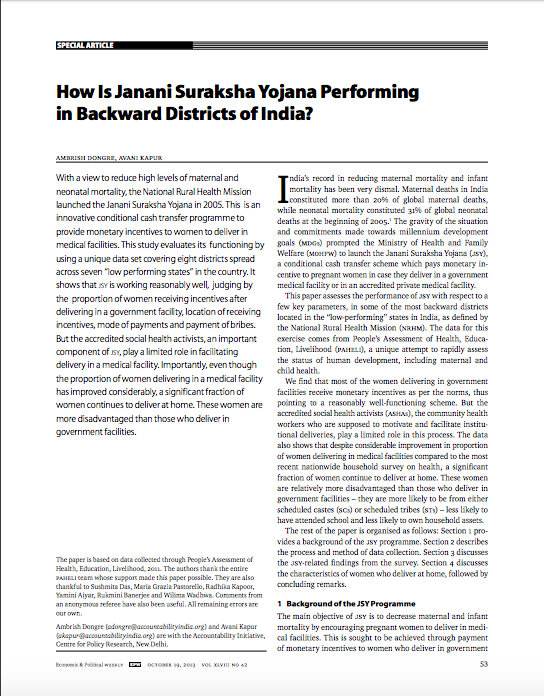
With a view to reduce high levels of maternal and neonatal mortality, the National Rural Health Mission launched the Janani Suraksha Yojana in 2005. This is an innovative conditional cash transfer programme to provide monetary incentives to women to deliver in medical facilities.
This study evaluates its functioning by using a unique data set covering eight districts spread across seven “low performing states” in the country. It shows that JSY is working reasonably well, judging by the proportion of women receiving incentives after delivering in a government facility, location of receiving incentives, mode of payments and payment of bribes. But the accredited social health activists, an important component of JSY, play a limited role in facilitating delivery in a medical facility. Importantly, even though the proportion of women delivering in a medical facility has improved considerably, a significant fraction of women continues to deliver at home. These women are more disadvantaged than those who deliver in government facilities.
India is currently witness to two trends that have the potential to significantly improve the health of its people. The first is the growing recognition that the system of public delivery of health services is in crisis. And the second is India’s bold efforts to strengthen the voice of the rural poor through decentralization to local governments.This paper argues that these two ostensibly separate trends can converge to generate real reform in the health sector in India through the potential for increased accountability that local governments can provide. The argument is that decentralization brings governments closer to people thereby allowing them to respond more effectively to local needs and preferences. Thus efforts at rural decentralization (post the 73rd amendment) have been undertaken within the context of strengthening accountability in governance structures. Moreover, proximity encourages better monitoring and enforcement.
In the specific context of the health sector, a decentralized institutional structure that emphasizes a bottom up, participatory approach can indeed help to redress some of the key failings in the sector such as absenteeism and corruption by strengthening accountability. As Dr. Jaiprakash Narayan, member of the National Advisory Council has put it: “The struggle for better health, the fight for accountable democracy, the quest for peoples sovereignty and the urge for best value for public money spent are all inseparable.” Given GoIs renewed emphasis on decentralization, this paper aims to analyze the specific role that decentralization can play in strengthening accountability in the public delivery of health care and offers some suggestions at how best this may be achieved.
Bottoms Up: To the role of Panchayati Raj Institutions in Health and Health services
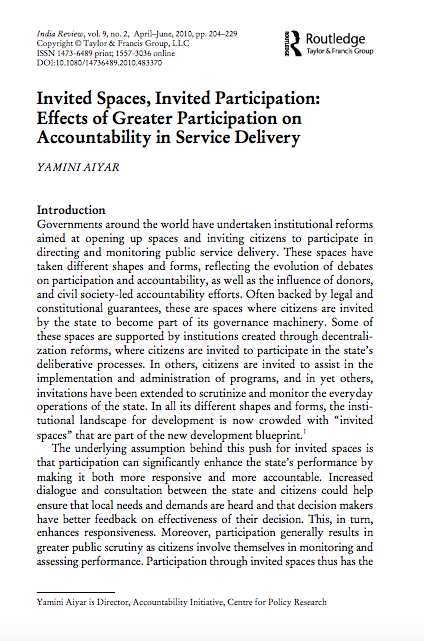
Governments around the world have undertaken institutional reforms aimed at opening up spaces and inviting citizens to participate in directing and monitoring public service delivery. These spaces have taken different shapes and forms, reflecting the evolution of debates on participation and accountability, as well as the influence of donors, and civil society-led accountability efforts. Often backed by legal and constitutional guarantees, these are spaces where citizens are invited by the state to become part of its governance machinery.
Some of these spaces are supported by institutions created through decentralization reforms, where citizens are invited to participate in the state’s deliberative processes. In others, citizens are invited to assist in the implementation and administration of programs, and in yet others, invitations have been extended to scrutinise and monitor the everyday operations of the state. In all its different shapes and forms, the institutional landscape for development is now crowded with “invited spaces” that are part of the new development blueprint.