
This report presents the findings of a small sample study of 30 Gram Panchayats across eight states namely, Assam, Bihar, Himachal Pradesh, Karnataka, Madhya Pradesh, Maharashtra, Odisha, and Rajasthan. In this second report, we present the findings regarding the second part of the money trail from the Union through the States to RLBs, focussing on the questions of whether money reached Panchayats, what were the implications of these grants on their finances, and how they were spent.
Publication Type: Reports
Devolution of Union Finance Commission to Panchayats
The research focusses on answering the following questions:
a) What were the conditions imposed by the Centre in the release and utilisation of the 14th FC grants?
b) To what extent have these conditions been adhered to and to ascertain whether fund flows are in compliance with the state objectives on timely release and untied nature of the grants.
c) Are there state wise variations in the manner of release of funds to GPs and if so, what are these?
PAISA for Municipalities
This study aims to understand the nature and compute the size of the local public sector in the Smart City of Tumakuru, in Karnataka State. It makes use of our flagship methodology Planning, Allocations and Expenditures, Institutions Studies in Accountability (PAISA). It aims to understand:
- An analysis of functions devolved to the Municipal
Corporation. - Study of Tumakuru Corporation revenues and
expenditures in financial years (FY) 2014-15 and FY
2015-16. - Provide methodologies to attribute expenditure to
specific wards, and; - Analyse ward-wise expenditure trends in FY 2014-
15 and FY 2015-16 across all 35 wards of Tumakuru Corporation.
The data sheets are available here.
Don’t have time to go through the report? Listen to this podcast.
State Education Finances: A Deep-Dive into School Education Finances in Eight States
This study is an attempt to provide an in-depth understanding of school education financing in India through an analysis of expenditures incurred across eight states from FY 2014-15 to FY 2017-18.
Report on Time Allocation and Work Perceptions of Teachers
200 teachers from 39 government and municipal schools in Delhi, were surveyed between December 2017 and April 2018 to unpack their work and role related perceptions and to map the time spent by them on various school activities. Teachers were found to be juggling multiple activities in settings with low capacity and resources. The situation is exacerbated due to planning and management issues. This in turn is affecting the quality and time spent on academic tasks, as well as teacher morale.
State of Social Sector Expenditure in 2015-16

The 14th Finance Commission’s (FFC) recommendations, accepted by the Union Government in February 2015, set the stage for a radical overhaul of India’s fiscal architecture. The recommendations were designed to enhance fiscal autonomy of states by increasing the vertical tax devolution of the divisible pool of taxes from 32 per cent to 42 per cent. Consequently, the Ministry of Finance (MoF) allocated Rs. 5.24 lakh crore as tax devolution. This was significantly higher than the 2014-15 allocation of Rs.3.38 lakh crore (RE). This increase in devolution was accompanied by several changes in the mode of state transfers, including cuts in centrally sponsored schemes (CSS), the Union Government’s primary vehicle for financing social sector investments in the country.
What are the implications of these changes? Did increased tax devolution result in enhancing the fiscal space available to states? Or was this offset by cuts in CSS and other grants? How have states responded to these changes? Have we seen any changes in the investment patterns of the states? Crucially, has the changed fiscal structure resulted in any visible shifts in social sector investments at the state level?
Based on an analysis of 19 state budgets, this brief presents a preliminary evaluation of the impact of the FFC recommendations on state finances and social sector expenditure.
India: Using Open School Data to Improve Transparency and Accountability
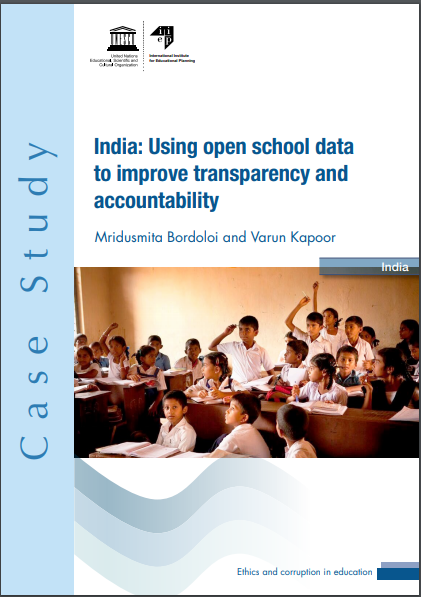
The main assumptions underlying the research are as follows: First, open data initiatives are powerful tools to improve transparency, hold schools accountable, and reduce corruption risks in education. Second, government-led initiatives are less likely than citizen-led initiatives to respond to users’ needs, engage them, and generate real impact, since they are often more supply- than demand-driven. And third, all users do not benefit equally from open data initiatives.
Unpacking the Processes of Open Defecation Free Status in Udaipur
This report is the culmination of a study conducted by the Accountability Initiative (AI) on Swachh Bharat Mission-Gramin in 2017 on the request of the Udaipur district administration. The study understands the outcomes, and the processes, which led to Open Defecation Free status in selected Gram Panchayats.
Putting Research Into Practice: Empowering Stakeholders and Finding Solutions
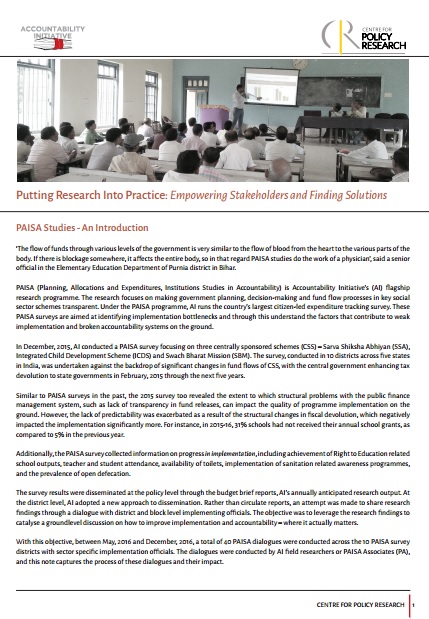
PAISA (Planning, Allocations and Expenditures, Institutions Studies in Accountability) is Accountability Initiative’s (AI) flagship research programme. The research focuses on making government process: planning, decision-making and fund flows in key social sector schemes transparent.
Under the PAISA programme, AI runs the country’s largest citizen-led expenditure tracking survey. In December, 2015, AI conducted a PAISA survey focusing on three centrally sponsored schemes (CSS) – Sarva Shiksha Abhiyan (SSA), Integrated Child Development Scheme (ICDS) and Swach Bharat Mission (SBM).
Between May, 2016 and December, 2016, the results of this survey were taken to frontline sector specific implementation officials. A total of 40 PAISA dialogues were conducted across the 10 PAISA survey districts with them. This note captures the process of these dialogues and their impact.
State of the Nation: RTE Section 12(1)(C)
This report describes the status of implementation of the constitutional mandate under the Right of Children to Free and Compulsory Education Act (Section 12(1)(c)) for private unaided schools (non-minority) and special category schools to keep aside at least 25 per cent of their seats for children from economically weaker and disadvantaged sections of society at no fee to the children. The report focuses on its application for the private unaided non-minority schools.