
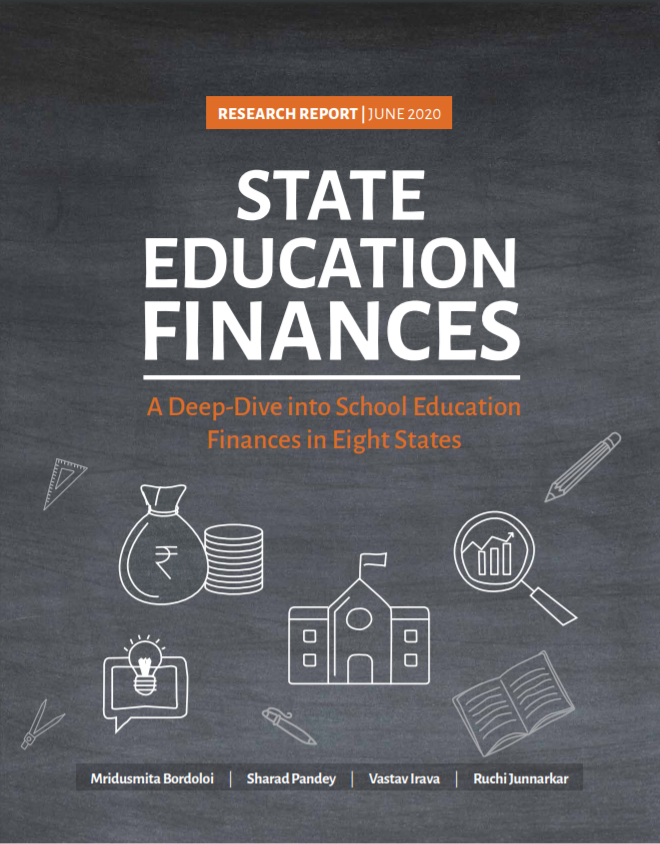
This study is an attempt to provide an in-depth understanding of school education financing in India through an analysis of expenditures incurred across eight states from FY 2014-15 to FY 2017-18.
Sector Scheme Level: State
School Consolidation in Rajasthan: Implementation and Short Term Effects
This paper attempts to add to the given literature by undertaking a detailed analysis of school consolidation process in Rajasthan. It seeks to answer the following questions:-
First, what are the specific criteria and conditions for closure of schools and their consolidation with other schools and whether they were adhered to by the state administration?
Second, whether school consolidation led to improvements in enrolment, availability of teachers, and essential school infrastructure facilities as mandated by the Right of Children to Free and Compulsory Education (RTE) Act, 2010.
Study on Teacher Time Allocation and Work Perceptions
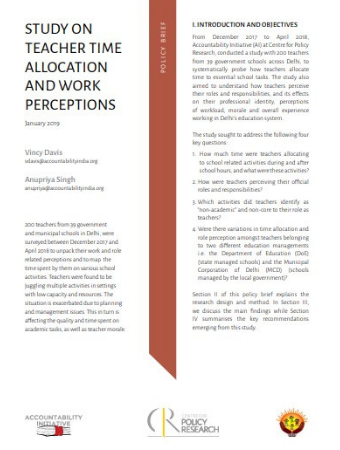
200 teachers from 39 government and municipal schools in Delhi, were surveyed between December 2017 and April 2018 to unpack their work and role related perceptions and to map the time spent by them on various school activities. Teachers were found to be juggling multiple activities in settings with low capacity and resources. The situation is exacerbated due to planning and management issues. This in turn is affecting the quality and time spent on academic tasks, as well as teacher morale.
Report on Time Allocation and Work Perceptions of Teachers
200 teachers from 39 government and municipal schools in Delhi, were surveyed between December 2017 and April 2018 to unpack their work and role related perceptions and to map the time spent by them on various school activities. Teachers were found to be juggling multiple activities in settings with low capacity and resources. The situation is exacerbated due to planning and management issues. This in turn is affecting the quality and time spent on academic tasks, as well as teacher morale.
Mapping work flows of frontline education administrators: Cluster Resource Centre Coordinators in Bihar
How effectively are Cluster Resource Centre Coordinator (CRCCs) able to fulfil their job responsibilities? This report presents a summary of the findings from an intensive time-use study conducted between November 2014-15 and April 2015-16 of select CRCCs from East Champaran and Bhojpur in Bihar and CRCCs from three other states to understand the daily functioning of the education bureaucracy at the frontline.
Education Reforms and the Puzzles of Implementation
Education reforms, bureaucracy and the puzzles of implementation: A case study from Bihar
It is a widely accepted truth that the Indian state suffers from a serious crisis of implementation capability. Despite widespread recognition of this crisis, there is remarkably little analytical work on how the Indian state works, particularly at the level of implementation. We know very little about the everyday practices of local bureaucrats, the decision-making systems within which they function and the organizational culture and norms that this fosters. Such an understanding is critical both to unpacking the roots of this implementation failure as well as to understanding how reform efforts are institutionalized, interpreted and implemented on the ground. Crucially, it can offer insights into understanding why the implementation crisis persists and under what conditions this can be reversed.
Our research is an attempt to fill this gap in the literature by analyzing an attempt by the Government of Bihar (GoB) to adopt an alternative pedagogy tool in government schools to improve the quality of learning as part of a larger reform effort called the ‘Mission Gunvatta,’ initiated in the 2013-14 academic year. The pedagogical strategy was based on homegrown experiments that challenged mainstream assumptions about classroom organization and teaching based on set curricula. Critically, it was designed to strengthen local administrative capacity to support schools from the bottom up.
Through detailed qualitative interviews and time-use studies of Bihar’s education administrators, this study points to the critical role played by organizational culture and resultant perceptions and practices of frontline administrators in interpreting, articulating and implementing reform choices on the ground. In our analysis, the successes and failures of service delivery reforms are as much about appropriate policy design choices, fostering innovation and leadership as it is about the interplay between reform objectives and the every-day practices of those tasked with implementing reforms. This, we argue, is the key missing link in contemporary understanding of public institutions and service delivery reforms in particular.
Impact of Private Tutoring on Learning Levels
Despite widespread and substantial private expenditure on private tutoring outside the formal school system in many developing countries, not much is known about their effects on learning outcomes. The main challenge in estimating such an effect is that the decision to send the child for private tutoring is correlated with unobserved variables which are also correlated with learning outcomes. This paper utilizes a large household survey conducted in rural India, and employs Fixed Effect (FE) estimation to control for the effect of unobserved variables. We find positive and significant effect of private tutoring on learning outcomes for students at elementary level (Grades 1-8). This effect is equivalent to an additional year of schooling or being in a private school instead of a government school.