
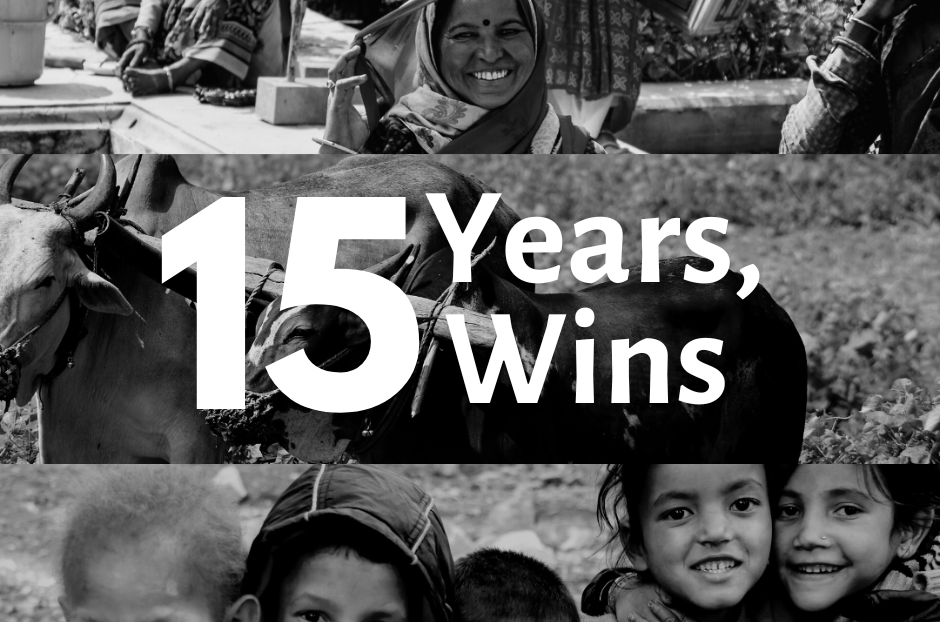
15 years of Accountability Initiative, 15 wins

The Accountability Initiative was founded in 2008 as a research group which would unpack tough questions on the welfare system in India by way of rigorous evidence-building. Over the years, we have established ourselves through not only publishing credible research, but also how this research can be purposefully used by practitioners.

We are a product of our times. The mid-2000s were a period of greater citizen participation in governance. Demands for governmental transparency and accountability were amplified through movements such as the Right to Information (RTI). The RTI movement ultimately led to a law being passed, which was a substantial win for citizens. As our understanding of governance and decision-making grew, we realised that for government systems to be able to respond to citizen needs, working with governments and citizens alike to develop a deeper understanding of process related bottlenecks in service delivery and building capacity to find solutions was critical.

We thus widened our vision to building Responsive Governance or a government system that is agile and has the capacity to respond to citizen needs. To be comprehensive, our work grew from research to also include practice, beyond how traditional think tanks have operated, and building a linkage that is now bearing fruits.

As we celebrate 15 years of our existence, here is a lookback on what we are proud of having achieved in this time.

1. Budget Briefs are an established feature now, informing 800+ Members of Parliament, decision-takers within the government annually on how the government utilised its money to deliver welfare programmes. The briefs look at allocations, releases, expenditures, outputs and outcomes of key welfare schemes on health, nutrition, education, child protection, rural development, livelihood, water, sanitation and housing. The briefs have also provided a window into changing government priorities and provide a good look back at how welfare delivery has evolved in India.

2. Our Planning, Allocations and Expenditures, Institutions Studies in Accountability (PAISA) has emerged as the largest citizen-led process tracking methodology in the country. PAISA surveys have unpacked the little understood aspect of governance by tracking processes such as planning, budgeting and decision-making structures of the government to identify how welfare programmes are delivered on the ground. Using PAISA, we have studied the flow of money from the Union level down to the firstmile be it in households, schools, Anganwadi centres, Rural Local Bodies or districts in Bihar, Chhattisgarh, Madhya Pradesh, Maharashtra, Himachal Pradesh and Rajasthan. By extensively analysing the district as a unit of administration since our inception we have in due time created a repository of knowledge on the administrative structure of a district office, its linkages and convergence with other departments and fund flows thus bolstering India’s aspiration of developing model districts. 

These studies have informed various state governments on persistent challenges and bottlenecks. 

3. We have prided ourselves in an ‘ears to the ground’ approach. Our on-ground knowledge was utilised in 2016 wherein the School Management Committee (SMC) Manual created in Rajasthan featured inputs by our staff and a module on public finance which explained in simple-to-understand language, the grants given to schools. SMC members are essential to citizen monitoring of government school education. This manual was used to train SMC members throughout the state.

In 2018, the NCERT adopted our suggestions on communicating the National Achievement Survey (NAS) results at the state and district levels. The NAS is critical to understanding the status and learning outcomes of school children. NAS findings are communicated to all levels of the government, and are important in planning, monitoring, and course correction.  

4. PAISA Dialogues: Engaging with district and state level officials by sharing insights and knowledge from our PAISA tracking studies to support their decision-making and policy implementation. For instance, in Rajasthan, our field staff presented findings from a study on the Integrated Child Development Services (ICDS) scheme to the state Director of ICDS, the Deputy Director and the Financial Advisor. They shared information on blockages of fund flows in different districts, which led to the Director and Finance Advisor ordering a deeper investigation into the matter, and finding ways to ensure effective transfers. Through the PAISA Dialogues we shared insights and knowledge from our flagship PAISA process tracking survey with district and state level officials to support their decision-making and policy implementation. 

5. Policy research forms our core. What is the reality of fund flows to Panchayats in India? Examining the true status of decentralisation in the country and the estimated costs required for panchayats to effectively undertake their activities, we supported the 14th Finance Commission by studying the structure of devolution of powers, responsibilities and required versus actual finances available to rural local bodies (RLBs). The study covered all decentralisation models, namely, the panchayat system, the extension of the panchayat system to the 5th Scheduled Areas, Autonomous District Councils under the Sixth Schedule and other state specific arrangements. The report contributed to the Finance Commission making recommendations on increasing the amounts allocated to local governments from the divisible pool of taxes available with the Government of India.  

6. Transparency and the availability of reliable, regular data for both government and citizens has been critical to our mission. Over the years e-governance has received a major policy push. In order to increase transparency and the quality of government data, we have actively worked with various departments and ministries to better their Management Information Systems (MIS) used to track the progress made in welfare programmes. They include the Central Plan Scheme Monitoring System (CPSMS) now known as the Public Finance Management System (PFMS), Swachh Bharat Mission MIS of the Ministry of Drinking Water and Sanitation, Sarva Shiksha Abhiyan MIS under the Ministry of HRD, the Public Portal of the MGNREGS, National Data and Analytics Platform (NDAP), and also provided inputs on the Jan Soochna Portal in Rajasthan.

7. We have trained public officials at various levels and lawmakers (Members of Legislative Assemblies) on the intricacies of public finance, governance structures and processes, including women Panchayati Raj Institution members and bureaucrats in government departments. The public officials have included those from the National Audit and Accounts Academy, Comptroller and Auditor General, Indian Economic Services, and early-career IAS officers training at LBSNAA.

8. Engaging champions of change has been core to what we do. We’ve occupied a space few research groups have by launching curated learning programmes drawn from our research. For instance, our Understanding State Capabilities course is informing the next generation of public policy practitioners and leaders. Through an experiential learning curriculum, the USC aims to build a strong foundation in public administration, public finance and social accountability theory linked to realities on the ground. Our participants have included students of policy schools such as ISDM and FLAME University as well as staff of NGOs. We got into institutional partnerships with premier social impact organisations such as Mantra4Change, Pratham and UChicago. 

The Understanding State Capabilities course has played a critical role in helping early career public policy professionals to build an understanding on state capability challenges. One of our students has shared the following thought  about the course:

The course has been designed in such a way that someone who does not even have a background in political science can also pursue it without any difficulty. The course has helped me in understanding federalism, public finances, bureaucracy and social accountability in a better manner. During my time as a LAMP Fellow, the learnings helped me in the better drafting of policy and planning related suggestions.”- Monu Kumar, LAMP Fellow 2021-22

9. Our second course, Hum Aur Hamaari Sarkaar demystifies complex governance structures for grassroots leaders in India’s states.This financial year we conducted the Hum Aur Hamaari Sarkaar open courses in Bhopal, Patna, Jaipur and Udaipur. Through the course, we have been equipping changemakers with the knowledge and skills to navigate governance ecosystems effectively. For instance, in the COVID-19 pandemic, a course participant identified that their Panchayat had received money to spray disinfectants, but it had not done anything. The participant used what he had learnt about the public administrative structure at the local level, identified the right official to complain to, and approached the District Magistrate while also making use of a helpline number. This pressurised the Panchayat to spend the money as directed.  

Devansh Pandey was part of the Hum Aur Hamaari Sarkaar cohort in Udaipur. He has this to say about the course:

“During the workshop I learnt a lot about decentralisation, public finance and e-governance. As a social worker, these topics are very important for me to learn. I am confident that I can use some of these concepts in the field in future”. 

In all, we have trained more than 1,500 professionals over half a decade across all our learning programmes.  

10. In the space of one-and-half decades we have had the opportunity to also work with various state governments on multiple projects. These include the governments of Chhattisgarh, Uttar Pradesh, Meghalaya, Andhra Pradesh, Karnataka and Rajasthan. The trust they have placed in us as a research group has led to the identification of bottlenecks within the government systems, whether they be linked to fund flows, processes, or people. 

11. Working closely with the Technical Support Unit (TSU) set up under the National Health Mission (NHM) in Uttar Pradesh, we aimed to understand the reasons for low utilisation of health expenditure and diagnose bottlenecks in the implementation of government health interventions. The recommendations led to fine tuning of systems and processes and the analysis became an important tool for preparation of next year’s Project Implementation Plan (PIP).

12. Between 2021-2022, we prepared the first ever excel based dashboard on budget and expenditure for the State of Meghalaya to enable it to undertake real time tracking of receipts and expenditures and prepare projections for the following budget cycle.

13. In 2022, we assisted the Government of Meghalaya in the production of the state’s first Gender and Youth Budget. Our role was to study the landscape, bottlenecks to achieving gender parity, and ensure greater gender and youth equity in government spending in the state. Our team played a key role in preparing and disseminating these important policy documents/budget statements in their 2022 Budget.   

14. In 2018, we launched a first-of-its-kind website for development practitioners with resources on governance  in Hindi. The Hum Aur Humaari Sarkaar website has emerged as a popular source for them to learn about each other’s field experiences, trends from Accountability Initiative’s research, and the learnings of government functionaries and officials in the states. 

15. We anchor a one-of-its-kind community of practice called  the PULSE (Platform to Understand, Learn, Share and Exchange) for Development for the cross-pollination of knowledge and insights of development practitioners within India. Launched in 2020, PULSE for Development counts more than 98 development organisations as members, and over 170 individual members, who also include IAS officers. The platform is set to grow in 2023, and retrain focus from the COVID-19 pandemic to longstanding development challenges and India’s achievement of the Sustainable Development Goals. 
 

Policy Buzz

Keep up-to-date with all that is happening in welfare policy with this curated selection of news – Policy Buzz – published every fortnight.

Policy News

  • All projects under Slum Rehabilitation Authority are eligible for Maharashtra’s slum protection policy, which aims to provide 300 square foot rehab homes to qualified recipients for Rs 2.5 lakh, says the Chief Secretary of Housing.
  • A “Green Hydrogen” policy will be formulated by Himachal Pradesh to encourage the use of green hydrogen and position the state as a major hub for its production.

Health and Nutrition

  • Maharashtra received a large allocation under the National Health Mission for the current fiscal year. The ministry of health and family welfare granted the state Rs 652.13 crore for 2022-23 and Rs 1,618.54 for 2023-24. Funding totals Rs 2,270 crore. 
  • E-pharmacy regulations are being drafted based on stakeholder discussions. 
  • Telangana increases the remuneration for medical students working in government facilities by 15%.
  • By creating a five-member panel ‘National Rare Diseases Committee’ to efficiently implement the Centre’s rare illnesses policy, the Delhi High Court has taken a proactive move to address the issues faced by patients with rare diseases.
  • The Union Ministry of Minority Affairs has allocated45.34 crore to bolster the research and development of Unani medicine, a traditional healing system.

Education

Also Read: At A Glance: Himachal Pradesh Budget 2023-24

Ayushman Bharat Digital Mission: Boon or Bane?

This is the second of a two-part blog series on the promises and challenges of the Ayushman Bharat Digital Mission. 

The Ayushman Bharat Digital Mission (ABDM) is India’s attempt to digitise healthcare systems and to transform the medical sector, similar to what UPI has done for fintech. ABDM has great scope to make the lives and job roles of many people easier: patients, doctors, healthcare providers, administrators, and even regulators. This was discussed in detail in the first blog in this series. 

However, a mammoth task like digitising the healthcare system of the most populated country in the world is likely to endure growing pains. There are many concerns that require careful thought. 


Roadblocks on the highway to scaling up 


The primary challenge is that Ayushman Bharat Digital Mission is a national endeavour, whereas health is a state subject in India. There are state schemes and initiatives that have the same vision and mission as ABDM. For instance, the eHealth initiative by Kerala. This implies one of two outcomes. First, it is possible state schemes will run parallel to ABDM, which requires successful integration of data across platforms. 

Even if this is achieved, there is more than enough evidence from the developed world that such integration or interoperability is a challenge that is not easy to side step. The NHS in the UK is still wrestling with interoperability, and the US is yet to see complete interoperability despite “information blocking” by states having been legally prohibited. In India, even at the Union government level, integration has proven to be a challenge. The Union Health Secretary has called for harmony among datasets and might work toward broadening the scope of ABDM when it comes to data collection. 

The second possible outcome is that states don’t adopt ABDM and continue with their own systems. This can  pose problems in uptake and scaling up for ABDM. Therefore, the Union government may have to incentivise state governments to participate. 

Then there is the complication of the cost of digitisation of data. Digitising patient data has a time cost that providers will be reluctant to pay for in a system where the average patient visit is as little as two minutes; the doctor or care provider might not even have time to go through the patients’ history and records, even if available digitally. The subsequent challenge then, is bringing private providers into the system as participants. It is possible that in the absence of enthusiasm, private sector providers and payers will have to be incentivised to participate in digitisation. 


Inequalities can be created, even if the intent is the opposite


When listing the benefits of digital health, the first thought that comes to mind is the ease of access and equity. Questions of inequality in access come to light when interventions are made available through channels which are not equally available to everyone. 

In the context of Ayushman Bharat Digital Mission, when health services are delivered through digital means, it immediately caters to people with access to and are familiar with digital infrastructure like computers, broadband, smartphones, etc. It can put senior citizens, women, rural population and illiterate people at a disadvantage. This makes it difficult for certain sections of the population to adopt these interventions even though they might be more vulnerable. 

This phenomenon is commonly known as “Intervention-Generated Inequality” (IGI). Some initiatives, even well-intended ones, can happen to  work better for those who are already better off. When this happens, something that is said to enhance equity and equality of access actually does the exact opposite. This issue overlaps strongly with existing hierarchical divisions in Indian society like caste, class, gender, and religion, where those at the periphery are deprived of basic provisions required to lead a healthy, dignified life. 


Privacy and trust are the keystone of digitisation 


Wherever data is collected, questions of privacy automatically arise. Enforcing the Right to Privacy in India has been challenging even with Aadhaar, and collecting and storing sensitive medical data safely for a large population requires robust systems. The recent ransomware attack on the All-India Institute of Medical Sciences (AIIMS), Delhi has brought questions of safety, privacy, and dignity to light. 

Another key issue is trust in digital systems. Developing accessible technology is definitely an important need, but transforming health systems is not enough. Facilitating a cultural shift simultaneously is essential to increase uptake. Trust in technology is crucial to encouraging uptake and societal acceptance of digital health services. This will involve every stakeholder across the healthcare landscape, from patient to provider to practitioner, to understand their role in utilising digital health technologies and being able to address relevant challenges and issues. This is where private players can come into play. 

Startups may be able to act as middlemen between ABDM infrastructure and the patients by building a user-friendly interface, helping people book tests and providing 24×7 help. The Rajasthan government uses the e-Mitra platform to support citizens in this way across a range of services, and initiatives like this can be considered. To achieve the goal of making digital services accessible, inclusive, and relevant to our social-economic realities, policymakers need to recognize that IGI exists. Therefore,  portals and digital systems must be designed accordingly. Access for senior citizens, people with disabilities, people of different socio-economic backgrounds, among others should be taken into account and accommodated appropriately. 

Building an efficient, safe, and accessible digital health system has been a global challenge. India is no exception. The hope is that Indian policymakers can learn from other countries’ experiences and build a successful digital health system that can take India closer to achieving Universal Health Coverage.


Madhur Sharma is a Research Associate and Ritwik Shukla is a Senior Research Associate at the Accountability Initiative.


Also Read: Big Questions India Needs to Focus on About Implementing a Right to Health

पॉलिसी बज़्ज़

विभिन्न कल्याणकारी योजनाओं में क्या घटित हो रहा है, यह पॉलिसी बज़्ज़ आपको हर 15 दिन के अंदर ख़ास ख़बरों के साथ अपडेट करता है |

नीतियों से जुडी खबरें

  • ‘वन स्टेशन वन प्रोडक्ट’ (ओएसओपी) योजना रेल मंत्रालय द्वारा पूरे भारतीय रेलवे नेटवर्क में शुरू की गई है।
  • कोयला मंत्रालय ने वित्त वर्ष 2023-24 के लिए 50,119 करोड़ रुपये के परिसंपत्ति मुद्रीकरण लक्ष्य के साथ कार्य योजना प्रस्तुत की।
  • वित्त मंत्रालय ने धन शोधन निवारण अधिनियम (पीएमएलए), 2002 में बदलावों को अधिसूचित किया।
  • गृह मंत्रालय द्वारा मॉडल जेल अधिनियम, 2023 को समापक रूप दिया गया।
  • हरियाणा मंत्रिमंडल ने पिछड़े वर्गों के लिए आरक्षण की मात्रा पर राज्य पिछड़ा वर्ग आयोग की रिपोर्ट को स्वीकार कर लिया।

स्वास्थ्य और पोषण 

  • महिला एवं बाल विकास मंत्रालय ने ‘पोषण भी, पढाई भी’ योजना शुरू की।
  • स्वास्थ्य और परिवार कल्याण मंत्रालय द्वारा सक्षम (सतत स्वास्थ्य प्रबंधन के लिए उन्नत ज्ञान को उत्तेजित करना) नामक लर्निंग मैनेजमेंट इंफॉर्मेशन सिस्टम लॉन्च किया गया।
  • डब्ल्यूएचओ ने कहा, ”कोविड-19 एक स्थापित और जारी स्वास्थ्य समस्या है जो अब सार्वजनिक स्वास्थ्य आपातकाल नहीं है।

स्वच्छता

  • स्वच्छ भारत मिशन ग्रामीण (एसबीएम-जी) के तहत देश के कुल गांवों में से आधे ने ओडीएफ (खुले में शौच से मुक्त) प्लस का दर्जा हासिल कर लिया है।

अन्य खबरें

  • भोपाल सतत विकास लक्ष्योंको पूरा करने की दिशा में प्रगति को ट्रैक करने वाला भारत का पहला शहर बन गया है।
  • उच्चतम न्यायालय ने कार्यस्थल पर महिलाओं के साथ यौन उत्पीड़न (रोकथाम, निषेध और निवारण) अधिनियम, 2013 या पोश अधिनियम का प्रभावी कार्यान्वयन सुनिश्चित करने का निर्देश दिया है।
  • उच्चतम न्यायालय ने कहा है कि हाईकोर्ट के पास अनुसूचित जनजातियों की सूची में बदलाव का निर्देश देने का अधिकार नहीं है।
  • यूनिसेफ ने ‘क्या बाल विवाह का अंत पहुंच के भीतर है? नवीनतम रुझान और भविष्य की संभावनाएं 2023’ अपडेट जारी किया।

यह लेख पॉलिसी बज़्ज़ के अंग्रेजी संस्करण पर आधारित है जो 16 मई 2023 को प्रकाशित हुआ था।

पॉलिसी बझ

हे पॉलिसी बझ तुम्हाला विविध कल्याणकारी योजनांमध्ये काय चालले आहे याविषयी दर 15 दिवसांनी विशेष बातम्या अपडेट करते.

धोरण बातम्या 

  • ‘वन स्टेशन वन प्रॉडक्ट’ (OSOP) योजना रेल्वे मंत्रालयाने संपूर्ण भारतीय रेल्वे नेटवर्कमध्ये सुरू केली आहे.
  • आर्थिक वर्ष 2023-24 साठी कोळसा मंत्रालयाने मालमत्ता मुद्रीकरण लक्ष्यासह ₹50,119 कोटीचा कृती आराखडा सादर केला.
  • अर्थ मंत्रालयाने प्रिव्हेन्शन ऑफ मनी लाँडरिंग कायदा (PMLA), 2002 मध्ये बदल सूचित केले आहेत.
  • आदर्श तुरुंग कायदा, 2023 गृह मंत्रालयाने अंतिम केला आहे.
  • हरियाणा मंत्रिमंडळाने मागासवर्गीयांच्या आरक्षणाच्या प्रमाणात राज्य मागासवर्ग आयोगाचा अहवाल स्वीकारला.

आरोग्य आणि पोषण

  • महिला आणि बाल विकास मंत्रालयाने पोशन भी, पढाई भी योजना सुरू केली.
  • सक्षम (शाश्वत आरोग्य व्यवस्थापनासाठी प्रगत ज्ञान उत्तेजक), एक लर्निंग मॅनेजमेंट इन्फॉर्मेशन सिस्टम (LMIS) आरोग्य आणि कुटुंब कल्याण मंत्रालयाने सुरू केली आहे.
  • कोविड-19 ही आता एक प्रस्थापित आणि चालू असलेली आरोग्य समस्या आहे जी यापुढे आंतरराष्ट्रीय चिंतेची सार्वजनिक आरोग्य आणीबाणी बनत नाही असे WHO ने म्हटले आहे.

स्वच्छता

  • देशातील एकूण गावांपैकी निम्म्या गावांनी स्वच्छ भारत मिशन ग्रामीण (SBM-G) अंतर्गत उघड्यावर शौचास मुक्त (ODF) प्लस दर्जा प्राप्त केला आहे.

इतर बातम्या

  • शाश्वत विकास उद्दिष्टे (SDGs) पूर्ण करण्याच्या दिशेने प्रगतीचा मागोवा घेणारे भोपाळ हे भारतातील पहिले शहर ठरले आहे. 
  • कामाच्या ठिकाणी महिलांचा लैंगिक छळ (प्रतिबंध, प्रतिबंध आणि निवारण) कायदा, 2013 किंवा PoSH कायद्याची प्रभावी अंमलबजावणी सुनिश्चित करण्यासाठी सर्वोच्च न्यायालयाने निर्देश दिले आहेत.
  • सर्वोच्च न्यायालयाने म्हटले आहे की, अनुसूचित जमातींच्या यादीत बदल करण्याचे निर्देश देण्याचा अधिकार उच्च न्यायालयांना नाही.
  • ‘बालविवाह बंद करणे आवाक्यात आहे का? नवीनतम ट्रेंड आणि भविष्यातील संभाव्यतेचे 2023 अपडेट युनिसेफने जारी केले.

हा लेख पॉलिसी बझच्या इंग्रजी आवृत्तीवर आधारित आहे जो 16 मे 2023 रोजी प्रकाशित झाला.

Policy Buzz

Keep up-to-date with all that is happening in welfare policy with this curated selection of news – Policy Buzz – published every fortnight.

Policy News

Health and Nutrition

  • Poshan Bhi, Padhai Bhi scheme launched by the Ministry of Women and Child Development. 
  • SAKSHAM (Stimulating Advanced Knowledge for Sustainable Health Management), a Learning Management Information System (LMIS) launched by the Ministry of Health and Family Welfare.
  • COVID-19 is now an established and ongoing health issue which no longer constitutes a public health emergency of international concern stated WHO.

WASH

Other News

  • Bhopal became the first city in India to track progress towards meeting Sustainable Development Goals (SDGs).
  • The Supreme Court issued directions to ensure effective implementation of Sexual Harassment of Women at Workplace (Prevention, Prohibition and Redressal) Act, 2013, or the PoSH Act.
  • The Supreme Court stated that High Courts do not have power to direct changes in Scheduled Tribes list.
  • Is an End to Child Marriage within Reach? Latest trends and future prospects’ 2023 update released by UNICEF.

Also Read: At A Glance: Himachal Pradesh Budget 2023-24

पॉलिसी बज़्ज़

विभिन्न कल्याणकारी योजनाओं में क्या घटित हो रहा है, यह पॉलिसी बज़्ज़ आपको हर 15 दिन के अंदर ख़ास ख़बरों के साथ अपडेट करता है |

नीतियों से जुडी खबरें

  • केंद्र ने स्मार्ट सिटी मिशन के लिए समय सीमा  जून 2024 तक एक वर्ष के लिए बढ़ा दी है |
  • जनजातीय मामलों के मंत्रालय द्वारा पूर्वोत्तर क्षेत्र में जनजातीय उत्पादों को बढ़ावा देने के लिए विपणन और रसद विकास (पीटीपी-एनईआर) के लिए केंद्रीय क्षेत्र योजना शुरू की गई।
  • दीनदयाल अंत्योदय योजना-राष्ट्रीय ग्रामीण आजीविका मिशन के तहत ग्रामीण विकास मंत्रालय द्वारा समृद्धि अभियान शुरू किया गया।
  • भूमि पंजीकरण के लिए 28 राज्यों और केंद्र शासित प्रदेशों द्वारा राष्ट्रीय जेनेरिक दस्तावेज पंजीकरण प्रणाली (एनगीडीआरएस) को अपनाया।
  • कृषि और किसान कल्याण मंत्रालय ने साथी (बीज ट्रेसेबिलिटी, प्रमाणीकरण और समग्र सूची) पोर्टल और मोबाइल ऐप लॉन्च किया।

स्वास्थ्य और पोषण 

  • स्वास्थ्य और परिवार कल्याण मंत्रालय द्वारा राष्ट्रीय स्वास्थ्य लेखा अनुमान (2019-20) जारी किए गए।
  • केंद्र ने राष्ट्रीय चिकित्सा उपकरण नीति, 2023 को मंजूरी दी।
  • शिक्षा मंत्रालय ने राज्य सरकारों से पीएम पोषण के लिए भारतीय राष्ट्रीय कृषि सहकारी विपणन संघ (नेफेड) से दालों की खरीद करने का आग्रह किया।
  • नीति आयोग द्वारा ‘आहार में बाजरा का संवर्धन: भारत के राज्यों/केंद्र शासित प्रदेशों में सर्वोत्तम प्रथाएं’ रिपोर्ट जारी की गयी।

स्वच्छता


अन्य खबरें

  • सुप्रीम कोर्ट ने कहा कि राज्यों के राज्यपालों को या तो सहमति देनी चाहिए या जल्द से जल्द बिलों को वापस करना चाहिए।
  • संयुक्त राष्ट्र जनसंख्या कोष द्वारा विश्व जनसंख्या की स्थिति 2023 रिपोर्ट जारी की गयी।
  • द स्टेट ऑफ द वर्ल्ड्स चिल्ड्रन (एसओडब्ल्यूसी) 2023: हर बच्चे के लिए टीकाकरण रिपोर्ट यूनिसेफ द्वारा जारी की गयी।
  • विश्व मौसम विज्ञान संगठन द्वारा वैश्विक जलवायु 2022 की स्थिति रिपोर्ट जारी की गयी।
  • विश्व विकास रिपोर्ट 2023: विश्व बैंक द्वारा प्रवासी, शरणार्थी और समाज जारी की गयी।
  • वर्ल्ड इकोनॉमिक फोरम द्वारा फ्यूचर ऑफ जॉब्स रिपोर्ट 2023 जारी की गयी।

यह लेख पॉलिसी बज़्ज़ के अंग्रेजी संस्करण पर आधारित है जो 2 मई 2023 को प्रकाशित हुआ था।

पॉलिसी बझ

हे पॉलिसी बझ तुम्हाला विविध कल्याणकारी योजनांमध्ये काय चालले आहे याविषयी दर 15 दिवसांनी विशेष बातम्या अपडेट करते.

धोरण बातम्या 

  • स्मार्ट सिटी मिशनची अंतिम मुदत केंद्राने जून 2023 ते जून 2024 पर्यंत एक वर्षाने वाढवली आहे.
  • ‘ईशान्य प्रदेशातील आदिवासी उत्पादनांच्या प्रचारासाठी विपणन आणि रसद विकास’ (PTP-NER) ही केंद्रीय क्षेत्र योजना, केंद्रीय आदिवासी व्यवहार मंत्रालयाने सुरू केली.
  • संघटन से समृद्धी अभियान ग्रामीण विकास मंत्रालयाने दीनदयाल अंत्योदय योजना-राष्ट्रीय ग्रामीण आजीविका अभियान अंतर्गत सुरू केले.
  • नॅशनल जेनेरिक दस्तऐवज नोंदणी प्रणाली (NGDRS) 28 राज्ये आणि केंद्रशासित प्रदेशांनी जमिनीच्या नोंदीसाठी स्वीकारली आहे.
  • कृषी आणि शेतकरी कल्याण मंत्रालयाने SATHI (सीड ट्रेसेबिलिटी, ऑथेंटिकेशन आणि होलिस्टिक इन्व्हेंटरी) पोर्टल आणि मोबाइल अॅप लाँच केले.

आरोग्य आणि पोषण

  • राष्ट्रीय आरोग्य लेखा अंदाज (2019-20) आरोग्य आणि कुटुंब कल्याण मंत्रालयाने जारी केले.
  • राष्ट्रीय वैद्यकीय उपकरण धोरण, 2023 ला केंद्राने मान्यता दिली.
  • केंद्रीय शिक्षण मंत्रालयाने राज्य सरकारांना नॅशनल अॅग्रिकल्चरल कोऑपरेटिव्ह मार्केटिंग फेडरेशन ऑफ इंडिया (NAFED) कडून PM POSHAN साठी डाळ खरेदी करण्याचे आवाहन केले.
  • निति आयोगाने प्रसिद्ध केलेला अहवाल ‘आहारात बाजरींचा प्रचार: भारतातील राज्ये/केंद्रशासित प्रदेशातील सर्वोत्तम पद्धती.

स्वच्छता

  • जलशक्ती मंत्रालयाने भारतातील पहिला जलसाठा जनगणना अहवाल प्रसिद्ध केला.

इतर बातम्या

  • राज्यांच्या राज्यपालांनी एकतर संमती द्यावी किंवा लवकरात लवकर बिले परत करावीत, असे निरीक्षण सर्वोच्च न्यायालयाने नोंदवले आहे.
  • स्टेट ऑफ वर्ल्ड पॉप्युलेशन (SOWP) 2023 युनायटेड नेशन्स पॉप्युलेशन फंड द्वारे जारी.
  • द स्टेट ऑफ द वर्ल्ड्स चिल्ड्रन (SOWC) 2023: प्रत्येक मुलासाठी, युनिसेफने जारी केलेला लसीकरण अहवाल.
  • जागतिक हवामान संघटनेने जाहीर केलेला स्टेट ऑफ द ग्लोबल क्लायमेट 2022 अहवाल.
  • जागतिक विकास अहवाल 2023: स्थलांतरित, निर्वासित आणि समाज जागतिक बँकेने जारी केले.
  • फ्युचर ऑफ जॉब्स रिपोर्ट 2023 वर्ल्ड इकॉनॉमिक फोरमने जारी केला आहे.

हा लेख पॉलिसी बझच्या इंग्रजी आवृत्तीवर आधारित आहे जो 2 मे 2023 रोजी प्रकाशित झाला.

Policy Buzz

Keep up-to-date with all that is happening in welfare policy with this curated selection of news – Policy Buzz – published every fortnight.

Policy News

  • The deadline for Smart Cities Mission has been extended by one year, from June 2023 to June 2024, by the Centre.
  • ‘Marketing and Logistics Development for Promotion of Tribal Products from North Eastern Region’ (PTP-NER), a Central Sector Scheme, was launched by the Union Ministry of Tribal Affairs.
  • Sangathan se Samriddhi campaign was launched by the Ministry of Rural Development under the Deendayal Antyodaya Yojana-National Rural Livelihoods Mission.
  • The National Generic Document Registration System (NGDRS) has been adopted by 28 states and Union Territories for land records.
  • The SATHI (Seed Traceability, Authentication and Holistic Inventory) portal and mobile app was launched by the Ministry of Agriculture and Farmers Welfare.

Health and Nutrition

WASH

Other News


Also Read: At A Glance: Maharashtra Budget 2023-24

पॉलिसी बझ

हे पॉलिसी बझ तुम्हाला विविध कल्याणकारी योजनांमध्ये काय चालले आहे याविषयी दर 15 दिवसांनी विशेष बातम्या अपडेट करते.

धोरण बातम्या 

  • नॅशनल कमिशन फॉर प्रोटेक्शन ऑफ चाइल्ड राइट्स (NCPCR) द्वारे जारी केलेल्या जघन्य गुन्ह्यांमधील बाल संशयितांच्या मूल्यांकनासाठी मार्गदर्शक तत्त्वे.
  • शालेय विद्यार्थ्यांमध्ये कृषी क्षेत्रातील नाविन्यपूर्णतेला चालना देण्यासाठी, अटल इनोव्हेशन मिशन (AIM), NITI आयोग आणि कृषी आणि शेतकरी कल्याण मंत्रालय (MoA&FW) यांनी एकत्रित प्रयत्न केले आहेत.
  • युवा धोरण आणि युवा पोर्टल मध्य प्रदेश सरकारने सुरू केलेआहे. मुख्यमंत्र्यांनी मुख्य मंत्री युवा कौशल कमाई योजना (सी.एम – कौशल्य कमाई योजना) या नवीन योजनेचीही घोषणा केली.
  • राज्यपालांना विधेयके मंजूर करण्यासाठी कालमर्यादा निश्चित करण्यासाठी केंद्र आणि राष्ट्रपतींना विनंती करण्याचा ठराव तामिळनाडू विधानसभेने मंजूर केला.

आरोग्य आणि पोषण

  • सर्वोच्च न्यायालयाने शाळेत जाणाऱ्या मुलींसाठी मासिक पाळीच्या स्वच्छतेचे व्यवस्थापन करण्यासाठी राष्ट्रीय मॉडेल तयार करण्याचे निर्देश केंद्राला दिले होते.
  • केंद्र सरकारच्या आरोग्य योजना (CGHS) पॅकेजचे दर केंद्रीय आरोग्य मंत्रालयाने सुधारित केले आहेत.
  • केंद्राद्वारे अ‍ॅनिमल पॅन्डेमिक प्रिपेडनेस इनिशिएटिव्ह (एपीपीआय) आणि वन हेल्थसाठी पशु आरोग्य प्रणाली सपोर्ट सुरू करण्यात आला आहे. 
  • NITI आयोगाच्या शिफारशींनुसार औषध नियमनाची भारतीय मानके जागतिक मानकांच्या बरोबरीने तसेच इंटरनॅशनल कौन्सिल फॉर हार्मोनायझेशन मार्गदर्शक तत्त्वांनुसार असावीत.
  • WHO द्वारे जारी करण्यात आलेले ‘प्रौढ आणि किशोरवयीन मुलांसाठी नवीन टीबी लसींच्या देश परिचयाची तयारी करण्यासाठी जागतिक फ्रेमवर्क’.

शिक्षण

  • नॅशनल क्रेडिट फ्रेमवर्क (NCRF) विद्यापीठ अनुदान आयोगाने (UGC) जारी केले.
  • UGC च्या अखत्यारीतील सर्व उच्च शिक्षण संस्थांना विद्यार्थी तक्रार निवारण पोर्टल स्थापन करण्याचे निर्देश दिले आहेत.
  • UGC द्वारे जारी केलेल्या उच्च शिक्षणामध्ये भारतीय ज्ञान प्रणाली (IKS) च्या समावेशासाठी मसुदा मार्गदर्शक तत्त्वे.
  • बोर्डांनी राज्य शैक्षणिक प्राधिकरण आणि एनसीईआरटीचे पालन न करणारा स्वतःचा अभ्यासक्रम सुरू करण्याचा प्रयत्न करणे कायद्याचे उल्लंघन आहे, असे राष्ट्रीय बाल हक्क संरक्षण आयोगाने (NCPCR) म्हटले आहे.
  • सुधारित UGC निकषांनुसार, स्वायत्त महाविद्यालयांना यापुढे कंत्राटी प्राध्यापकांची संख्या एकूण मंजूर प्राध्यापक पदांच्या 10 टक्क्यांपेक्षा जास्त नाही याची खात्री करणे आवश्यक नाही.

स्वच्छता

  • नमामी गंगे कार्यक्रमाने सर्वसाधारणपणे जलसंवर्धन आणि नदी पुनरुज्जीवन याविषयी तरुणांमध्ये जागरूकता वाढवण्यासाठी ४९ विद्यापीठांसोबत सामंजस्य करार केला.
  • युनिसेफने जारी केलेला ट्रिपल थ्रेट अहवाल, रोग, हवामानातील जोखीम आणि असुरक्षित पाणी, स्वच्छता आणि स्वच्छतेमुळे मुलांना भेडसावणाऱ्या जोखमींशी संबंधित आहे.

इतर बातम्या

  • युनायटेड नेशन्सच्या फूड अँड अॅग्रिकल्चर ऑर्गनायझेशनने जारी केलेला कृषी फूड सिस्टम्समधील महिलांची स्थिती अहवाल.

हा लेख पॉलिसी बझच्या इंग्रजी आवृत्तीवर आधारित आहे जो 17 एप्रिल 2023 रोजी प्रकाशित झाला.